The three basic pillars that make the "great ship" of Espanyol women's football work
The blue and white director, Dolors Ribalta, highlights the importance of betting on former players at the head of the different areas of the club

-
CAT -
CAST
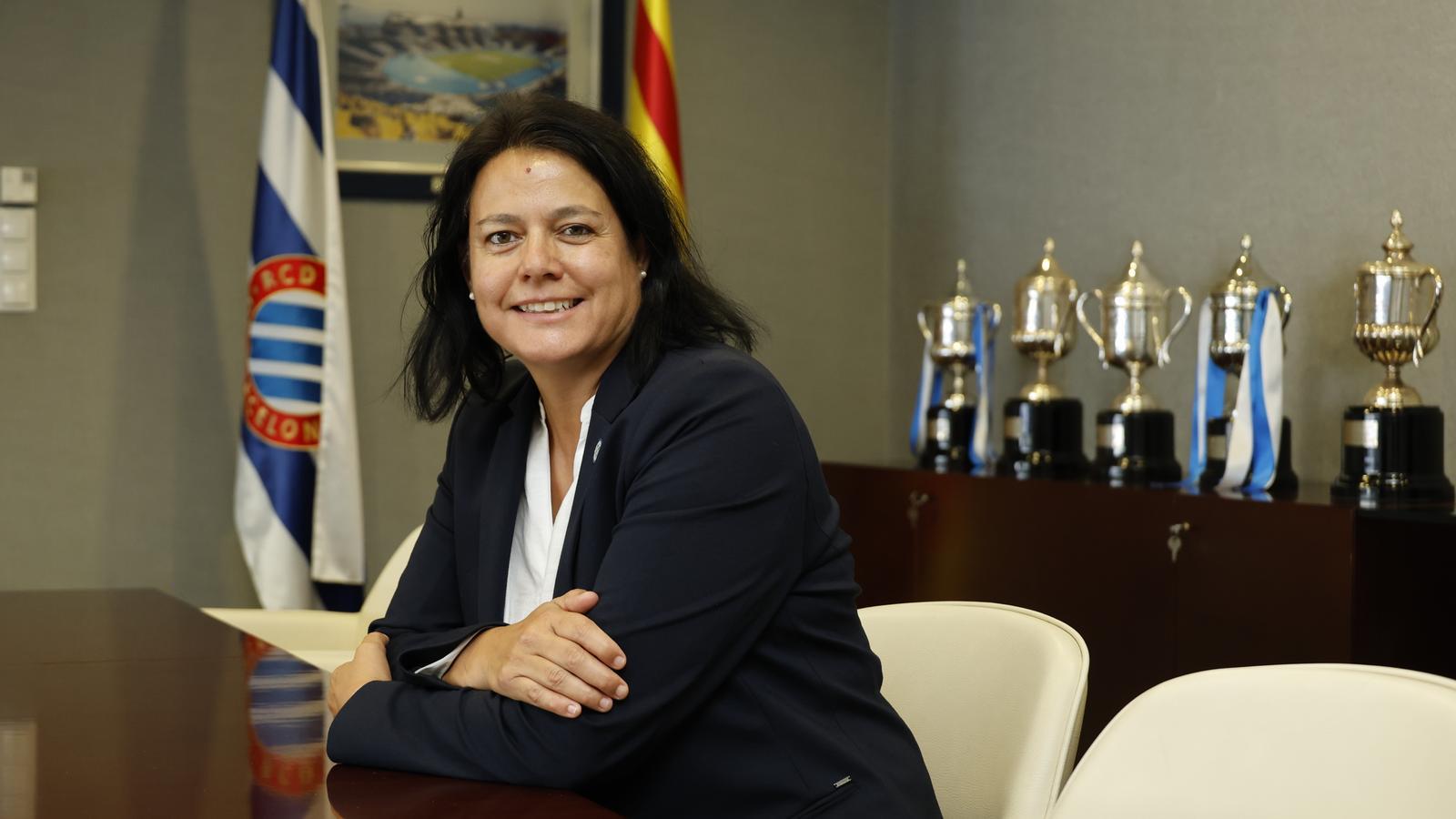
Barcelona“Espanyol is a great ship that must always be brought to a safe harbor. There is a quote by Socrates that says there is no favorable wind for those who have no destination port. We are very clear about where we want to go and our guidelines: providing opportunities for female talent, training players, and the first team, which is the mirror that gives us the most visibility.” Dolors Ribalta (Mafet, Agramunt, 1977) has been the director of women's football at Espanyol for four years.
Led by Sara Monforte and Marta Cubí from the bench of the women's first team, the white-and-blue side is firmly committed to the role of women at the helm of the club's various areas. “The nine teams we have have a female figure, whether it be the physiotherapist, the delegate, the assistant coach, the physical trainer…”, reviews Ribalta. Another key point for the director is the commitment to former players from the club. “Like Sara, Carol Miranda (sporting director) and Lara Rabal (technical secretary) are also former players of the club. Everything that is identity and belonging, we have very clearly defined,” she adds.
A line followed throughout the entire youth academy. “The fact of being a woman and that, when I was little, I couldn't play because at that time it wasn't visible that girls could play football has given me this sensitivity to create a project that bets on female talent,” acknowledges Ribalta, who explains that they are one of the few clubs that have a female under-10 team. “When I see them play, I shed a tear; it is a source of pride that such young girls wear the Espanyol shirt,” she confesses, while assuring that the goal is for home-grown players to reach the first team. “In youth football, we are not so interested in winning leagues. We have many girls' teams competing against boys. We want them to be in demanding leagues so that in the future, as many footballers as possible can reach the first team,” she explains, highlighting the work of the youth football coordinator, Aida Uceda.
Attendance at stadiums, the great challenge
On the other hand, one of the points for improvement at Espanyol and the rest of the clubs in the league is to improve attendance at the stadiums. “We encourage people to come and see us at the Dani Jarque Sports City, but for that the team must also engage. If the fans enjoy it and feel reflected in our style of fighting until the end, of dedication and 'perico' pride, they will accompany us,” she assures.
When this is fulfilled, then the serious option of opening the RCDE Stadium to host a first women's team match will be considered. “It depends on many factors; if the men's team is playing, if there is any marketing element that has it occupied… Every year we talk about it to see what is the best possibility. On the day of the promotion to the First Division we had the option of playing at the stadium, but we preferred to play at Dani Jarque so that it would be a pressure cooker. Playing at the RCDE will be a gift, we all want it and we wish for it, but it must be progressive; first we have to fill the Dani Jarque”.
Audiovisual rights are the other major point for improvement in Spain. “It is in the interest of all the teams in the league that the competition is strong and that, therefore, there are significant amounts of money that make women's football better. That boys and girls can see female role models is a big step. Now they can wear a shirt with the name of Romane Salvador or Lucía Vallejo”, she comments.
Two completely different paths
Women's football has evolved a lot in recent years, but Ribalta wonders what would have happened if she had had the current situation when she retired from the pitch in 2007. “With Mauricio Pochettino, we were assistant coaches to Emilio Montiagut for the first women's team. He continued his career as a coach, while I opted for an academic career. I had completed the two coaching levels and then I had to choose whether to continue with the third or do a degree in Physical Activity and Sports Sciences (CAFE). I was a physical education teacher and had passed some civil service exams, so I decided to do the CAFE degree because I had more possibilities,” she recalls.

In 2022, she took on the role of director of women's football with the goal of returning the team to the Liga F after falling just short of promotion. Espanyol managed to move up in the 2023-24 season and, over the last two years, has maintained its status in the league. "It is one of the most important clubs, with 50 years of history in women's football. Few can say they have such a continuous and long track record as we do. There are many cases of clubs that have been important but have lost prominence, such as Sabadell, Rayo Vallecano, or Levante. Until 2013, we were a benchmark team that won titles; afterwards, we had more complicated moments, but we did not disappear," claims Ribalta.

