The secrets of Joan Garcia's feline reflections
This is how the Barça goalkeeper's training routine is, who is aiming to win the Zamora Trophy for the least conceded goalkeeper in the League
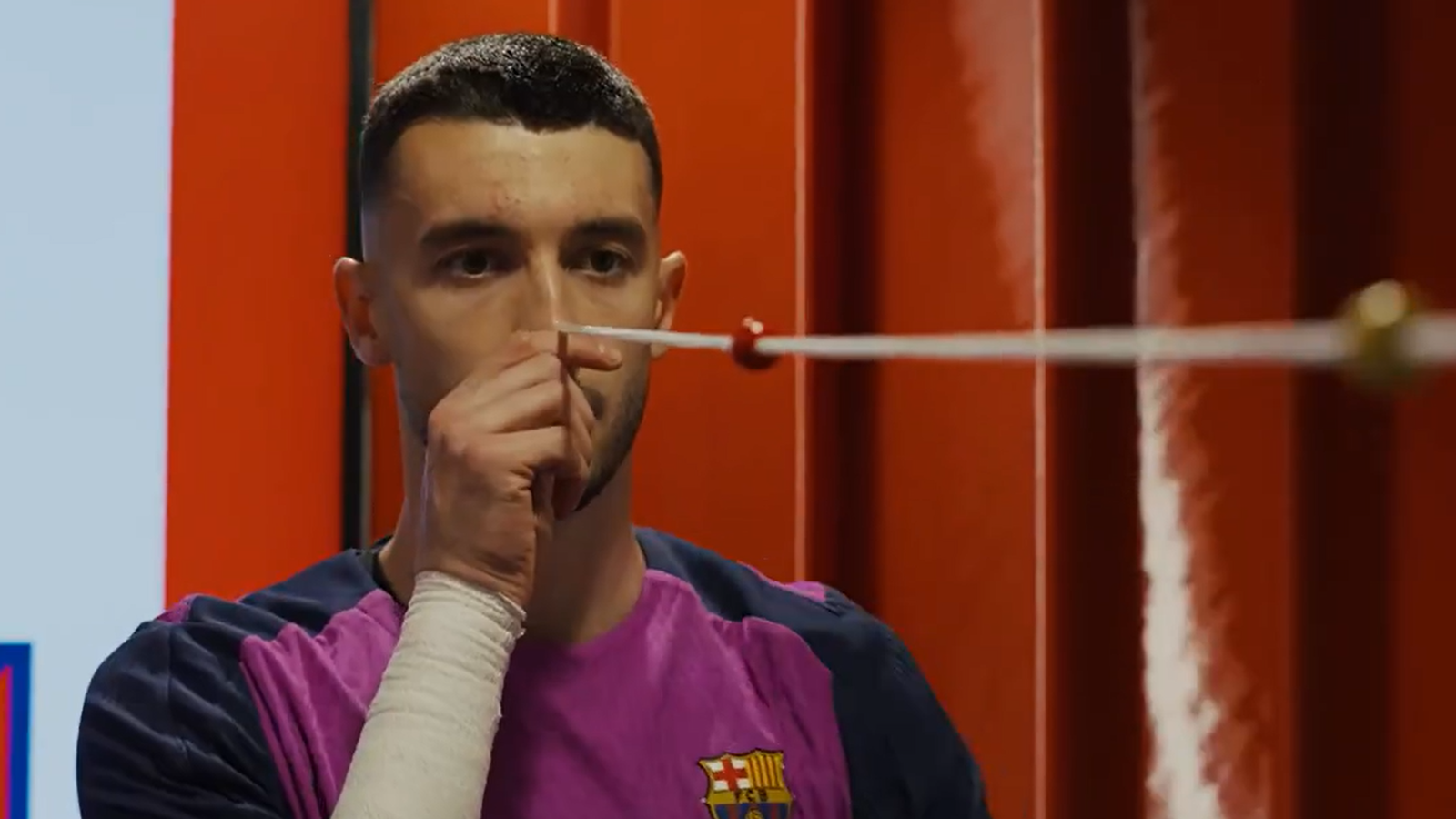
BarcelonaWhat was Joan Garcia doing holding a Brock string with one hand that went from his nose, to the center of his gaze, to one of the members of the Barça technical staff while he threw tennis balls at him? The exercise, recorded on video by the club's media and which went viral in the build-up to the Champions League quarter-final second leg at the Metropolitano, may be surprising to fans, but it is an increasingly common practice in the preparation of high-performance goalkeepers. These types of exercises are part of neurovisual training and have become – at Barça they have been practiced for several seasons now – an essential part of the goalkeepers' routine.
In the blaugrana entity, the preparation of the first team goalkeepers involves, broadly speaking, three key phases. Before each training session, there is preparatory work in the gym and physiotherapy. In this section, individual work is done with Joan Garcia, Wojciech Szczęsny, and Diego Kochen, from the reserve team but a regular in Hansi Flick's squad dynamics. The exercises, for preparation and also for prevention, are designed specifically for each individual, taking into account their medical and physical history. The part based on visual training is worked on, according to sources consulted by ARA, to improve focus and also to enhance peripheral vision, key elements for preparing the nervous system to respond to stimuli, such as, for example, a shot very close to a goalkeeper or a shot that changes trajectory at the last moment because it is deflected by a rebound.
There are various exercises designed to optimize perception, attention, and reaction speed. These include tasks of tracking multiple objects to improve divided attention, situations with unexpected stimuli that force split-second decisions, and refocalization exercises between short and long distances to quickly adapt to game action. Peripheral vision is also worked on to detect lateral movements without losing sight of the ball, as well as eye balance to gain precision in complex interventions. This type of training also helps improve the ability to anticipate by reading opponents' body language. Exercises are also done that involve various colors to accelerate visual processing, and rapid eye movements are practiced to speed up focus changes. Even juggling exercises are performed. The objective: to respond more effectively in high-demand situations and minimize response time in each intervention.
In this part of the training, before going out onto the pitch to do fieldwork, physical and strength prevention work is also done. Muscle strength, as well as agility, also make the difference in saves: it is not the same to brush a ball with your fingers as to reach it with the palm of your hand. A few centimeters are decisive. Once the goalkeepers have done this preparatory work, they continue to exercise their strength and do specific goalkeeping work on the pitch, while the bulk of the outfield players do their part. Also during the sessions there are moments when goalkeepers and outfield players work together, reproducing, for example, match situations or shots on goal, crosses, etc. When the collective training ends, the Barça goalkeepers have a final part of work in which they do structural reinforcement. The preparation of the goalkeepers is in charge of José Ramón de la Fuente and Andrés Martín.
Joan Garcia could bring the Zamora back to Barça
Joan Garcia arrived at Barça from Espanyol –where he also did neurovisual exercises– after being the revelation goalkeeper of last season in La Liga. This year, he has a chance to win the Zamora Trophy, which is awarded to the goalkeeper with the fewest goals conceded in the competition. On Saturday, against Getafe, he added another clean sheet, his second consecutive in the league. The player from Sallent has played 14 matches in La Liga this season without conceding any goals, and has conceded 19 in 27 matches, which represents a coefficient of 0.7 goals conceded per game. If Joan does not yet appear in the standings for the award given by the newspaper Marca it is because, according to its rules, at least 28 matches must have been played and at least 60 minutes must have been played.
If he does not concede a severe thrashing against Osasuna, Joan Garcia –who was injured for six matchdays at the start of the competition– will surpass Thibaut Courtois. The Real Madrid goalkeeper had conceded 24 goals in 28 matches (0.86) before getting injured. If Joan ends up winning the Zamora, he will be the second blaugrana goalkeeper to achieve it in the last decade. Only Marc-André ter Stegen won it in the 2022-23 season, with a spectacular coefficient of 0.49 goals conceded per game.

