The first woman to break a barrier in men's football
How has Marie-Louise Eta reached the Union Berlin bench in the Bundesliga?
-
CAT -
CAST
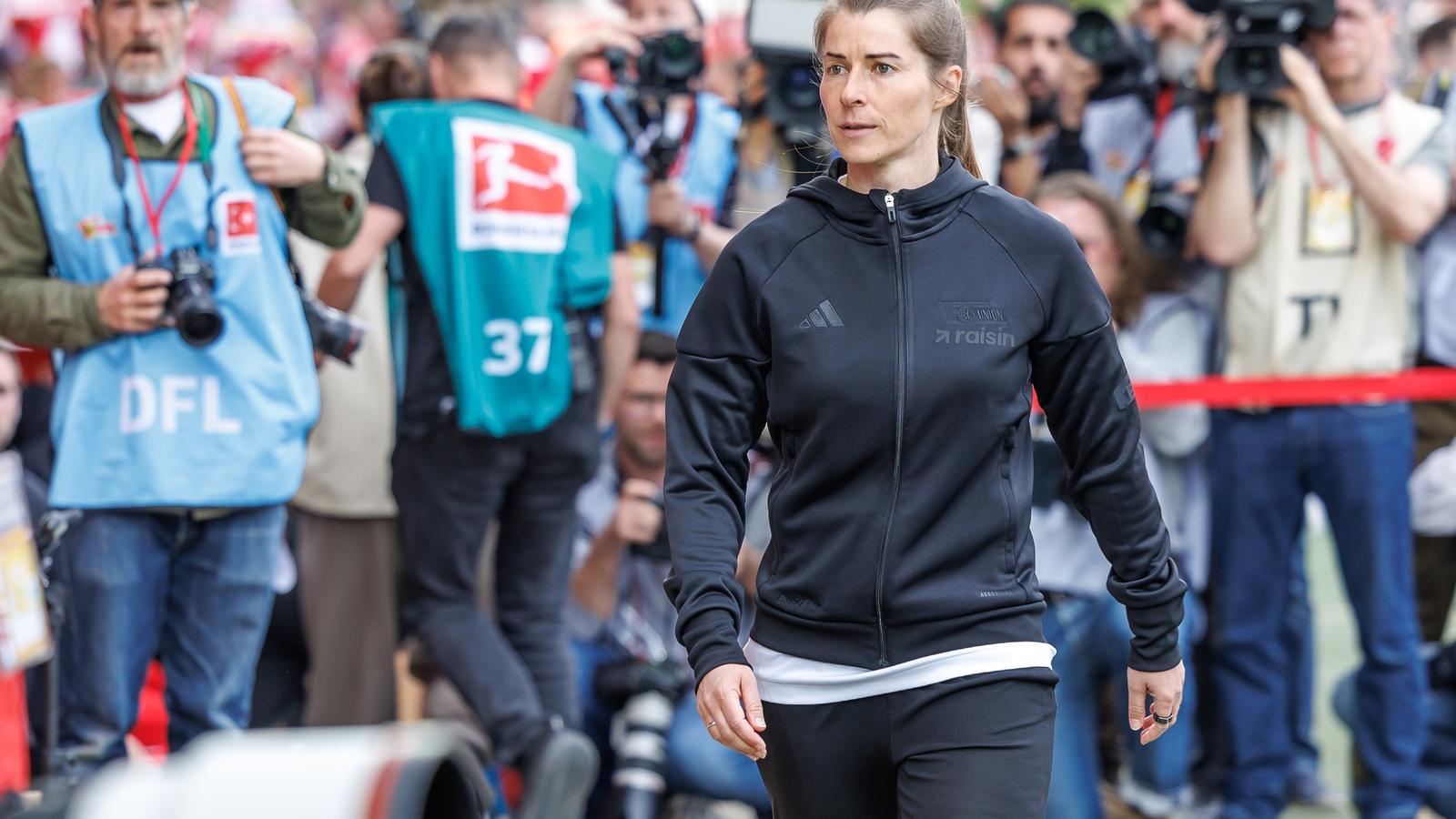
BarcelonaThe name of Marie-Louise Eta (Dresden, 1991) has already been etched in the world of football. She has become the first woman to manage a men's team within the top five leagues (England, Spain, Italy, Germany, and France). She arrives at the Union Berlin bench with the mission to turn around the difficult situation they are going through. The team is not in the relegation zone, but they have been in a very bad dynamic for a few months. They had a good first half of the season and reached Christmas in eighth place, close to European spots. However, since then, results have worsened: out of the last 16 matches, they have only won two.
The turning point was three weekends ago, when Union lost 3-1 against the bottom-placed team, Heidenheim. This defeat confirmed the dismissal of the then-Berlin coach Steffen Baumgart and meant Eta made history. Her debut was last Saturday, when they hosted Wolfsburg, second to last in the league. The match ended with a 1-2 victory for the visitors. "One of our strengths is that we are united. I am convinced that we will get the points we need in these matches," Eta declared at her presentation.
Eta has broken the glass ceiling in football. From a very young age, football ran in her veins; at six years old, she joined the club in her hometown, FV Dresden 06. From there, she moved to Fortuna Dresden-Rähnitz and, later, ended up at FFC Turbine Potsdam, the team that gave her her first professional experience in the 2008-09 season. With them, she won a league and a Champions League, along with the U-20 national team, with whom she won a World Cup. Her next step was in Hamburg, although it only lasted a few months because the club withdrew its women's team from the league. After that came Werder Bremen, where she retired at 26 due to injuries. This was the moment and the team where she decided to switch from the pitch to the dugout.
In November 2019, she was contacted to be an assistant for the U-19 women's national team. A year later, she became the second in command for the U-15s. From here, she began her connection with Union. She joined under coach Marco Grote, serving as an assistant coach in the youth categories. From there, she quickly moved to become the assistant for the first team in 2024, also a historic milestone. Until her appointment, she coached the U-19s, and in June, she signed her move to head coach of the women's first team; however, before that, she will have the mission of saving the men's team.
"From the club, it has been seen as a natural process. I had already had contact with the first-team players a couple of years ago. It has been more of a surprise for outsiders than for the club itself," admitted Alberto Doblaré, head of communication for Union Berlin, in a conversation with ARA. "After a bad run by Steffen Baumgart, a change was sought. When analyzing the options, she was considered the best candidate. The symbolic impact of the appointment was not valued; instead, priority was given to the person who, knowing the players, could best perform the job in these last five matches," he adds. In fact, Union is one of the German league clubs that have adopted the most measures oriented towards equality in recent years. It was the first team in Germany where the men's and women's teams played in the same stadium, the An der Alten Försterei.
Since her appointment, there was a great stir on social media: many comments of support for the coach were shown; unfortunately, many negative and sexist ones also appeared. The club came out in defense of the coach and wanted to report all those people who made these kinds of comments. This wave of hate grew after the recent defeat against Wolfsburg in her debut. Despite this, the support of the fans for Eta has managed to make the negative comments invisible. Despite the defeat, what was experienced on Union's field was a historic event; more than a football match, it was a celebration, with the public's support as the protagonist. "She defends that she is in this position because of her merits and not because of her sex. She understands that there may be repercussions, but she doesn't give them importance. Her goal is to demonstrate her professional capacity," assures Doblaré.
It is not the first case
It is true that it is the first case in the 5 major European leagues, but it has not been in professional football. Before Eta there were already cases where a woman was in charge of a men's team. In 2014, Clermont Foot, then playing in the French Second Division, made official the appointment of Helena Costa as coach of the first team. Her debut never took place, as in preseason the Portuguese technician resigned from her position due to misunderstandings with the sporting director, after starting to plan the season without consulting her. When her resignation became official, Corinne Diacre took over and was at Clermont for three seasons. Furthermore, she was the first woman in France to obtain the UEFA Pro license.
Another case was that of Carolina Morace, the first woman to manage a professional men's team in the world of football. After hanging up her boots, the Italian decided to start in coaching and in 1999 took charge of Viterbese in the Serie C of her country. She only lasted two matches. She resigned after a dispute with the club's owner.
