The night Badalona dreamed of another star
Families, firecrackers and hugs turned the President Tarradellas square into a World Cup grandstand
-
CAT -
CAST
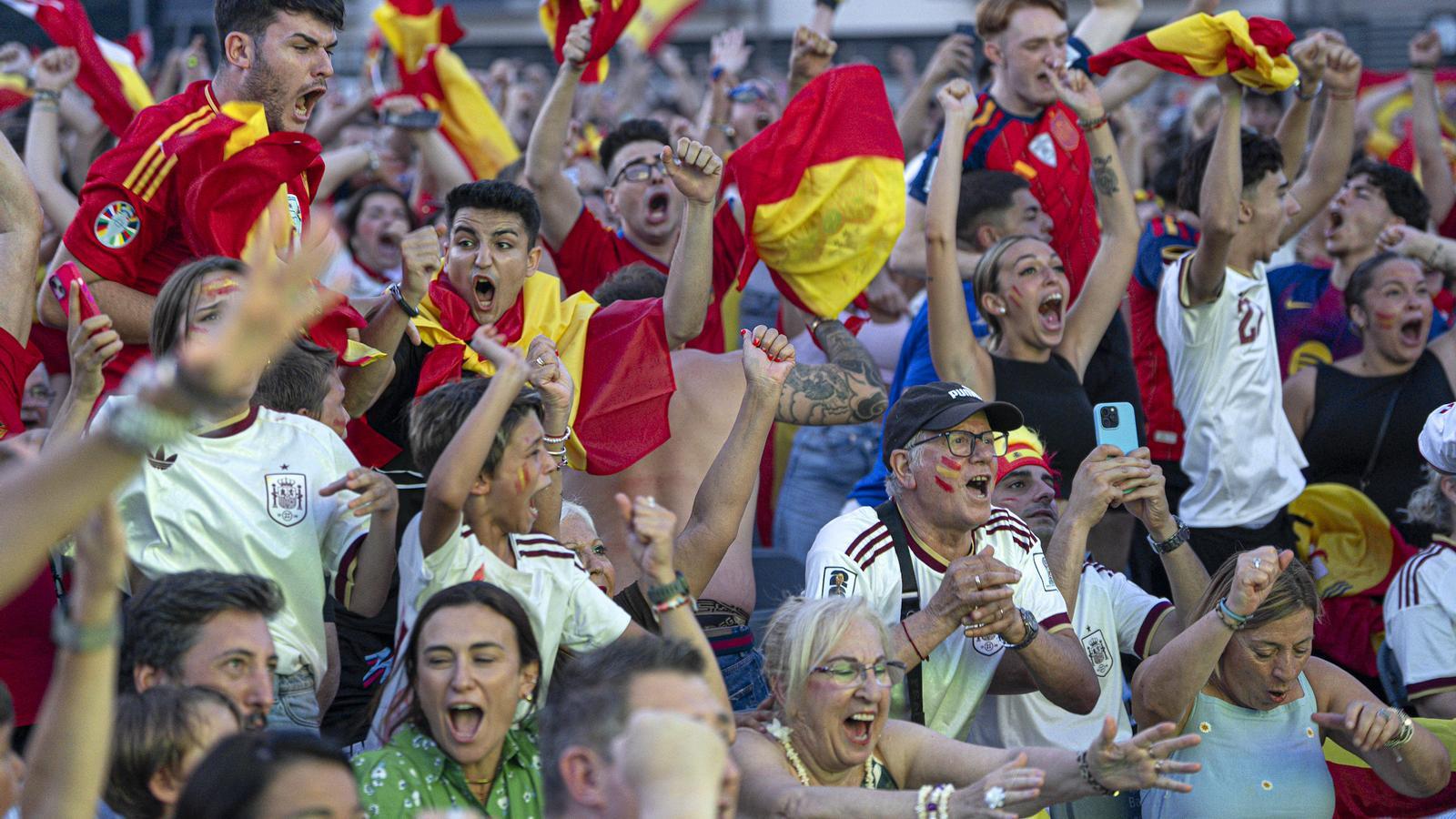
BadalonaIf Barcelona did not install a giant screen, the surrounding municipalities did. Badalona, for example. While the mayor, Xavier García Albiol, followed the World Cup from New York, Plaça President Tarradellas became the meeting point for thousands of fans ready to push the Spanish team towards a new final.
Long before the initial whistle, the match was already being played in the streets. T-shirts from all eras – those from the World Cup in South Africa, from the last European Championships, retro replicas, some fakes, and even one from Barça or Espanyol – paraded towards the surroundings of the Olympic Pavilion. People arrived on foot, by bicycle, by bus, by tram, by motorbike, or by taxi. Everywhere you looked, there was a sea of national team t-shirts.
The improvised stands gradually turned red, speckled with the white of the second kit of la roja. Hundreds of Spanish flags waved above the fans' shoulders, among which a Burgundy cross could also be seen. In contrast, there was no trace of senyeres. The atmosphere was more reminiscent of a Fan Zone for a major international competition than a square in the metropolitan area.
One square, six ways to experience a semi-final
Víctor, a "lifelong" resident of Badalona, had gone with his whole family. About ten people gathered to share what he considered "the first of two finals" for Luis de la Fuente's team. "We trust them one hundred percent," he assured. If he had to choose a goal scorer, he didn't hesitate: "Oyarzabal or Merino. They always show up when they're needed most."
Not everyone, however, was cheering for Spain. Alfredo, an Argentinian, was hoping for a French victory. He thought about a hypothetical final against Argentina, which could be "Messi's last dance." He assured that he hadn't missed any of the World Cup matches and predicted a 2-1 for France or a win on penalties. "Football breaks many friendships," he remarked.
Marina, a young woman from the southwest of France who lives in Barcelona, was also following the match. Wearing a 1998 World Cup jersey, she was confident of a French victory by 3-2. However, she admitted that that had been "the World Cup of suffering."
A few meters away, Iván, from Santa Coloma de Gramenet, predicted a 1-2. His son was even more precise with his prediction: "2-3, with goals from Cucurella, Lamine, and Pedri!". He bitterly recalled Qatar's elimination, which he attributed to "a robbery by Infantino," and dreamed of a final against England. His four sons, all wearing jerseys from different World Cups, had grown up listening to the exploits of 2010. "They know Iniesta's goal by heart," he explained.
After Morocco's elimination, Achraf had also joined the Spanish fans. He hoped that la roja would reach the end, although he admitted that a hypothetical final against England would be "impossible to predict".
The one who suffered the most, however, was Romero. Beer in one hand and his gaze fixed on the screen, he shouted every play as if he were in the stands of a stadium. He was convinced that if Spain overcame France, they would end up playing the final against Argentina. "Lamine and Merino," he replied when asked about the goal scorers.
Twenty minutes of silence and a penalty to go crazy
From the first minute, the crowd experienced the match between nerves and concentration. Bitten nails, heart in one's mouth, and a silence that was only broken every time Mbappé approached the Spanish area. Nothing seemed to alter the mood until the 21st minute, when the referee pointed to a penalty in favor of Spain and the square went wild.
Oyarzabal did not miss from eleven meters. His goal brought the red one closer to a new World Cup final and unleashed euphoria in Badalona. Fireworks, flares, hugs, shouts, and a few tears accompanied a celebration shared by young and old. There was still a lot of the match left, but for a few moments, the final could already be touched with the tips of their fingers.
The goal from the Gipuzkoan player released the tension, but only for a few minutes. Every opportunity from Baena or Fabián Ruiz lifted the fans out of their seats and ended with a sigh of disappointment. The tense calm returned to President Tarradellas square. Spain dominated, but the score remained too tight and, with each passing minute, nerves gained ground.
Porro kicked off a night of maximum celebration
In the second half, the surroundings of the Olympic Pavilion regained a tense calm. Between improvised dinners and beers, the national team's fans awaited the second goal that would definitively bring Spain closer to another final. It arrived in the 58th minute, when Pedro Porro made the square erupt with joy. The beers flew, the fireworks boomed, and shouts accompanied an unbridled celebration by thousands of fans, surrendered to the great start of the second half by Luis de la Fuente's team. The third goal, scored by Lamine Yamal, arrived to make the square go wild, but the joy lasted very little: the offside signaled by the refereeing team postponed a party that seemed a matter of time.
Each substitution of Luis de la Fuente's eleven was met with a round of applause. Also, every ball that ended up in Unai Simón's hands, who put in a solid performance, despite a few isolated errors that made everyone in the square hold their breath.
With the nerves of the final minutes, marked by constant interruptions and the slow passage of the clock, the semifinal was heading towards the expected outcome. The final whistle confirmed Spain's ticket to their second World Cup final. Then, indeed, Plaça President Tarradellas erupted in joy: hugs, fireworks, and chants to celebrate a new chapter in the history of la roja, qualified for the final thanks to the 0-2 against France.
Celebrations in Plaça Catalunya
Although Barcelona had not installed any giant screens to follow the semifinals, a few moments after the match ended, fans of the Spanish national team gathered around the Canaletes fountain – a place for celebrating Barça's titles that is currently under construction – to celebrate the victory of Luis de la Fuente's team. Horns, Spanish flags, and shouts of support for the national team – with some mention of France too – took over the center of the capital of Catalonia.

