Fotyen Tesfay achieves the second fastest women's time of all time in the Barcelona Marathon
Ugandan Abel Chelangat has won the men's category in a race with a record number of participants.
-
CAT -
CAST
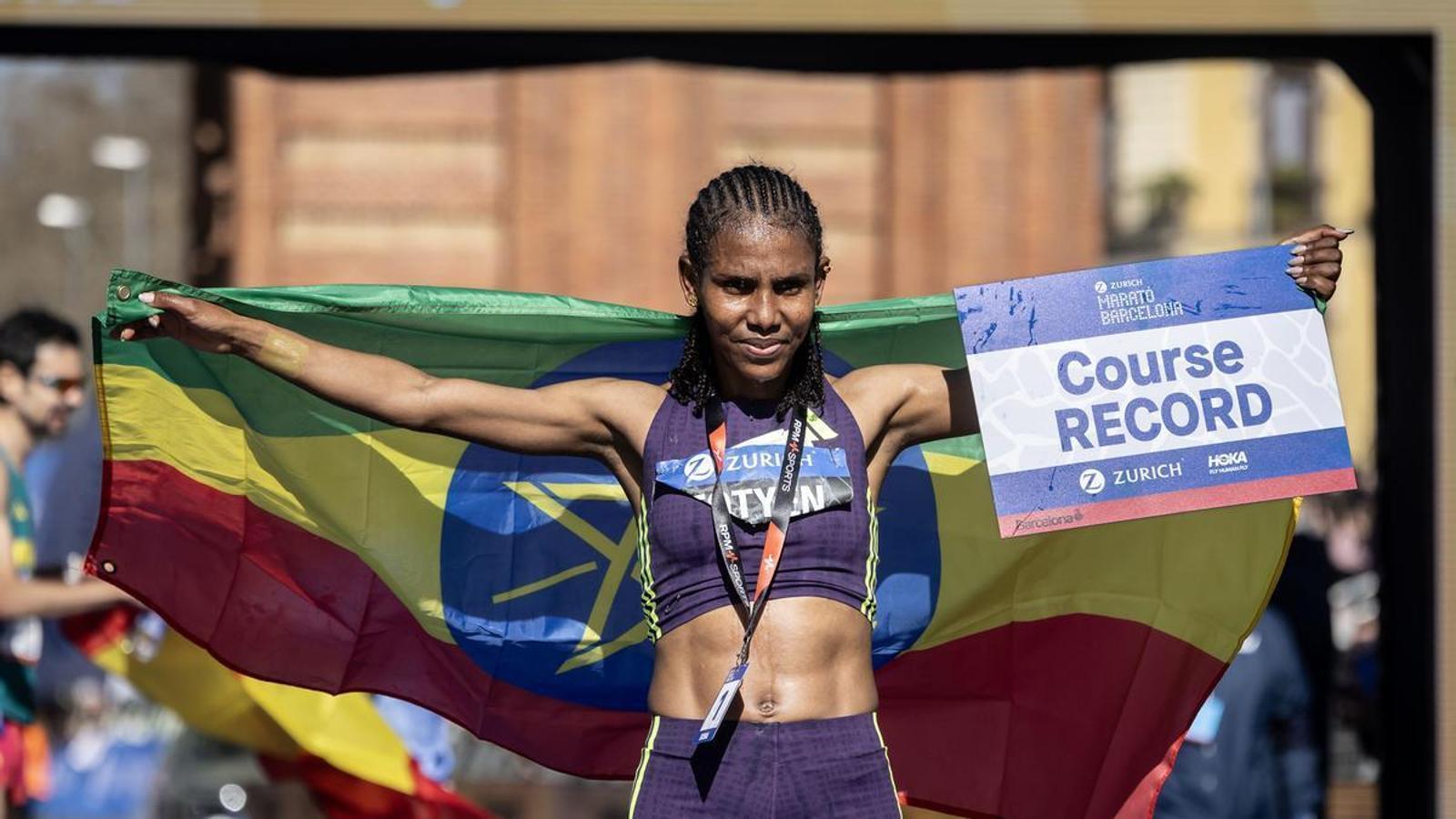
BarcelonaA memorable milestone at the Barcelona Marathon. Ethiopian runner Fotyen Tesfay Haiylu achieved the second-fastest time in history, with a time of 2 hours, 10 minutes, and 53 seconds. The 28-year-old thrilled everyone with an explosive start, seemingly poised to set a new world record. Taking advantage of the new, faster course and the good weather, she maintained a steady pace. However, in the final 10 kilometers, she slowed down, finishing less than a minute shy of the world record of 2:09:56, set by Kenyan Ruth Chepngetich in 2014 in Chicago. Tesfay, competing in her first marathon – having previously run shorter distances – beat Kenyan Jepkosgei Kiplimo (2:18:42) and fellow Ethiopian Zeineba Yimer Worku (2:18:49).
Tesfay Haiylu, 28, flew through the streets of Barcelona with an explosive start. For the first 30 kilometers, she set a pace that made everyone dream of a new world record. And indeed, the winner established a new women's record for the event, shattering the previous best mark set a year ago by Sharon Chelimo (2:19:33). That is, Tesfay Haiylu broke the record by more than 9 minutes. In fact, the first three runners all beat Chelimo's time.
In the men's race, Abel Chelangat triumphed. The 32-year-old made a powerful surge in the final kilometers, winning with a time of 2 hours, 4 minutes, and 59 seconds. Kenya's Kabirech Mosin finished second, and his compatriot, Jonathan Samanayo Korir, finished third. This year's race was heavily influenced by the surprising attack of Vincent Kipkorir, one of the pacemakers for the favorites, who launched a decisive attack that ultimately failed to secure the victory.

The Barcelona Marathon reached its 48th edition this Sunday in excellent form, as demonstrated by the new record number of registered runners who filled the city streets. All 32,000 available bib numbers were snapped up for a race that featured a route with some new elements, among other things, to help runners improve their times. Construction work in Plaça Espanya forced organizers to rethink the route, which, as has become common in recent years, passed close to some of the city's major tourist attractions. This draws many international runners, more than 50% of those registered, to a race that, beyond the times themselves, has become a popular celebration. "Your butt's heavy, Dad," read a humorous banner held by two young Catalans waiting for their father, who has already run more than 30 marathons. A few meters away, Martina waited for her father, who has run 20, with a banner featuring a giant heart. The father, Marc, sacrificed a few seconds to stop, give her a kiss, and walk a few meters with her. The time isn't always what matters.

As is customary, the Marathon also hosted the Spanish Marathon Championships. In the tenth national edition held in the Catalan capital, 310 runners participated, and Ricardo Rosado from Madrid took the victory, crossing the finish line in 2:13:31. Second place went to José Ignacio Giménez (2:14:18) and third to Cristian Martínez Alaez (2:16:19). In the women's category, the victory went to Carolina Robles from Seville, who stopped the clock at 2:24:58, followed by Carolina Torres (2:32:30) and Fabia Lafuente (2:36:43). To help runners improve their times, the organizers have deployed 35 pacers, spread across seven different paces (2:45, 3, 3:15, 3:30, 3:45, 4, and 4:30) to help them manage their goals. This edition has become the most attended in the race's history, and this sustained growth solidifies its position as one of the five most popular marathons in Europe.

