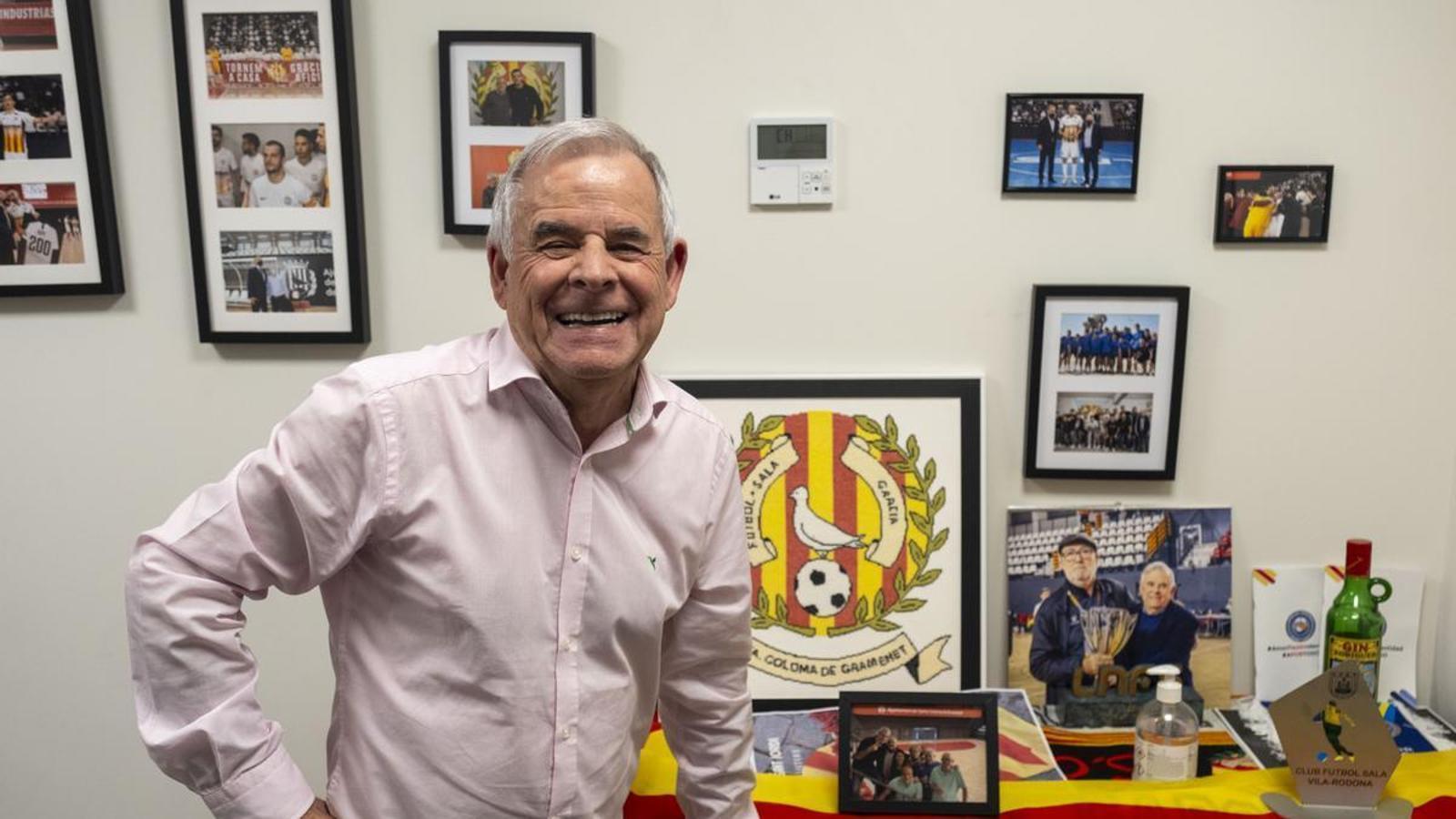
Vicenç Garcia Grau: We were four pot-bellied ones from here Santa Coloma and we became league runners-up
Founder and president of Industries Garcia Santa Coloma futsal

-
CAT -
CAST
Santa Coloma de GramenetIt is hard to find a story like this in Catalan sport. Vicenç Garcia (es Mercadal, Menorca, 1945) arrived in Santa Coloma de Gramenet as a young man when the town still had fields and orchards right where there is now concrete. As a youngster, he was a good footballer and even debuted in friendly matches with Espanyol's first team, despite being a Barcelona supporter. Later, he was a coach in Barça's youth categories and for many teams, while prioritizing looking after the family business, Industrias Garcia Grau. And almost as a game, he discovered futsal and created a team for his workers which, over time, became the second oldest futsal club in the world: Futbol Sala Garcia, known by everyone as Industrias Garcia, one of the best schools for this sport in the country. At 80 years old, Vicenç is finally retiring this summer. He is stepping down as president of the club he founded half a century ago and closing a chapter.
How was it deciding to step down?
— When you are young you have more energy to face problems and management. Now it costs me more. So I had been looking for someone for a few years to hand over the club to, knowing that it would be in good hands.
And he/she has found it.
— It will be the Everest business group, under the presidency of its maximum responsible, Julio Gómez. They already put money in as a sponsor. Now it's up to them to run the club. They have ambition, they know the entity and they can dedicate resources to grow the team. For 50 years, this club has been driven forward by people dedicating hours and hours, leaving their health but happy. Now it's time to let go and rest, as it's time. I have been proclaimed honorary president, so I can continue coming to the matches but without the burden of being the president.
Has set conditions for the new managers?
— Yes. I have asked that we continue to wear the flag on the jersey, as we have worn it since the day of its foundation, that the flag has not been missing any year. And I have asked that the team continue to bear the name of Santa Coloma. Besides, I hope they continue with the same philosophy of the club.
He has seen the transformation of this sport, previously almost amateur, to the present day.
— A lot. I think about it a lot these days. I especially remember the year we were league runners-up in 1999, when we had two fantastic Brazilians, especially Marcelo. In the semi-finals we eliminated Playas de Castellón, which was the best team at the time and had signed Javi Rodríguez just before Reyes. And we beat them 11-4 at home, a day when people couldn't get into the pavilion because of the huge crowd. Even today, I think the big mistake I made was in the final, against Caja Segovia, when they told us we couldn't play at home because the pavilion wasn't in condition, due to a fence that was there... things that could have been fixed. And we played the final at home in the Olímpic de Badalona. I should have stood my ground and played in Santa Coloma no matter what. Now, back then, many teams won the league and disappeared within a few years. Not us. They signed the players, but we stayed very much alive.

He was talking about origins. Let's talk about it. He has a bottle of Gin Xoriguer in his office. How does a Menorcan end up in Santa Coloma?
— The great secret of the Menorcans is Xoriguer, that's why we live so long [smiles]. My father was from Barcelona, from Poblenou. He went to do his military service in Menorca and fell in love with a Menorcan woman. But he wanted to return to Catalonia and so it was. My mother had a very hard time adapting, she missed Menorca. We came to Santa Coloma when there were still fields. I was crazy about football and Espanyol signed me, although I stayed one step away from debuting in the First Division. I played friendlies and that was it. Then I got my coaching badges and I ended up coaching teams at Barça's La Masia. When I started the business in Santa Coloma, they told me there was a futsal league in Meiland. It was run by Marcet's son, that former Espanyol player. And we formed a company team and signed up for it. I had never played futsal, although there are people who say that the first match of this sport in Spain was played here, in Santa Coloma. And now we are the oldest club in Europe and the second oldest in the world, only behind Peñarol from Uruguay, because futsal was born in Uruguay.
What were the beginnings like?
— We, the company's employees, used to play from 10 to 11 PM. There were four of us locals from Santa Coloma creating a club that would eventually become league runner-up. I used to play as goalkeeper and we did quite well. And since I'm competitive, we kept improving, signing players. I remember all those names: Jacinto, Fali, who was our first international player... And so we went up through the divisions.
How is futsal today?
— In recent years there has been a war between the National Futsal League and the Spanish Federation that has not helped. Now it seems there is a little peace. We need it. The futsal league is a giant with feet of clay. We need more sponsors and support. Outside of Catalonia, you often find clubs inflated with public money, it is unfair. And here I remember a year I went to see Josep Maldonado when he was a counselor, and he kept me waiting for hours. In the end, he gave me 25,000 pesetas. Not much. If there has been any improvement, it is that the level has been equalized, since in recent years Barça, Pozo or Interviú were far above the others.
What has Industrias meant for the city of Santa Coloma de Gramenet?
— A lot. It annoyed me that the press only talked about Santa Coloma for bad things. I am a Catalan from Menorca and a Menorcan from Catalonia. Santa Coloma is my home. When they founded the club in 1975, one of the ideas was to work for the city. We wanted Santa Coloma to be talked about for good things. And I am clear that we got it right when I remember the parents who have been grateful to us because they had somewhere to take their children, instead of leaving them on the street. They told us that thanks to Industrias, more than one has not ended up in prison. This city has suffered a lot. And that was a thorn in my side, I always wanted to do something so that Santa Coloma would appear in the press in a positive way. The rest of the league clubs do not have the roots that we have. I have always admired Penya a lot. What Joventut has done in Badalona is admirable. We wanted to do the same with futsal in Santa Coloma.
How has the relationship with Barça been, being a Barcelona supporter but at the same time a rival?
— Some years things have gone wrong, especially when players are taken from you in bad ways. Now they have Jordi Torras, whom I know and he is an excellent person. Now we get along well.
Before the interview, a man was waiting for him at the pavilion door to greet him. Who was he?
— It was very nice, I didn't recognize him when I saw him. He is a former player who played with us in the 80s and moved to Andalusia some time ago. And since he was around, he came for hours and hours to the pavilion door just in case he saw me, as he wanted to thank me for what I did for him. It moved me. I am receiving messages from numbers I don't know from former players who want to wish me luck now that I am retiring.
Remember any player over others?
— I remember Fali a lot, as he was our first international. And then Dani Salgado, whom we saw kicking against a wall in the street and he went on to be one of the best in the world. A very charismatic player.

