"Being blind, I can run through a mountain with more ease than go through the city"
This woman from Maresme lost her sight at 17 in an accident and has found a space where she can overcome herself
-
CAT -
CAST
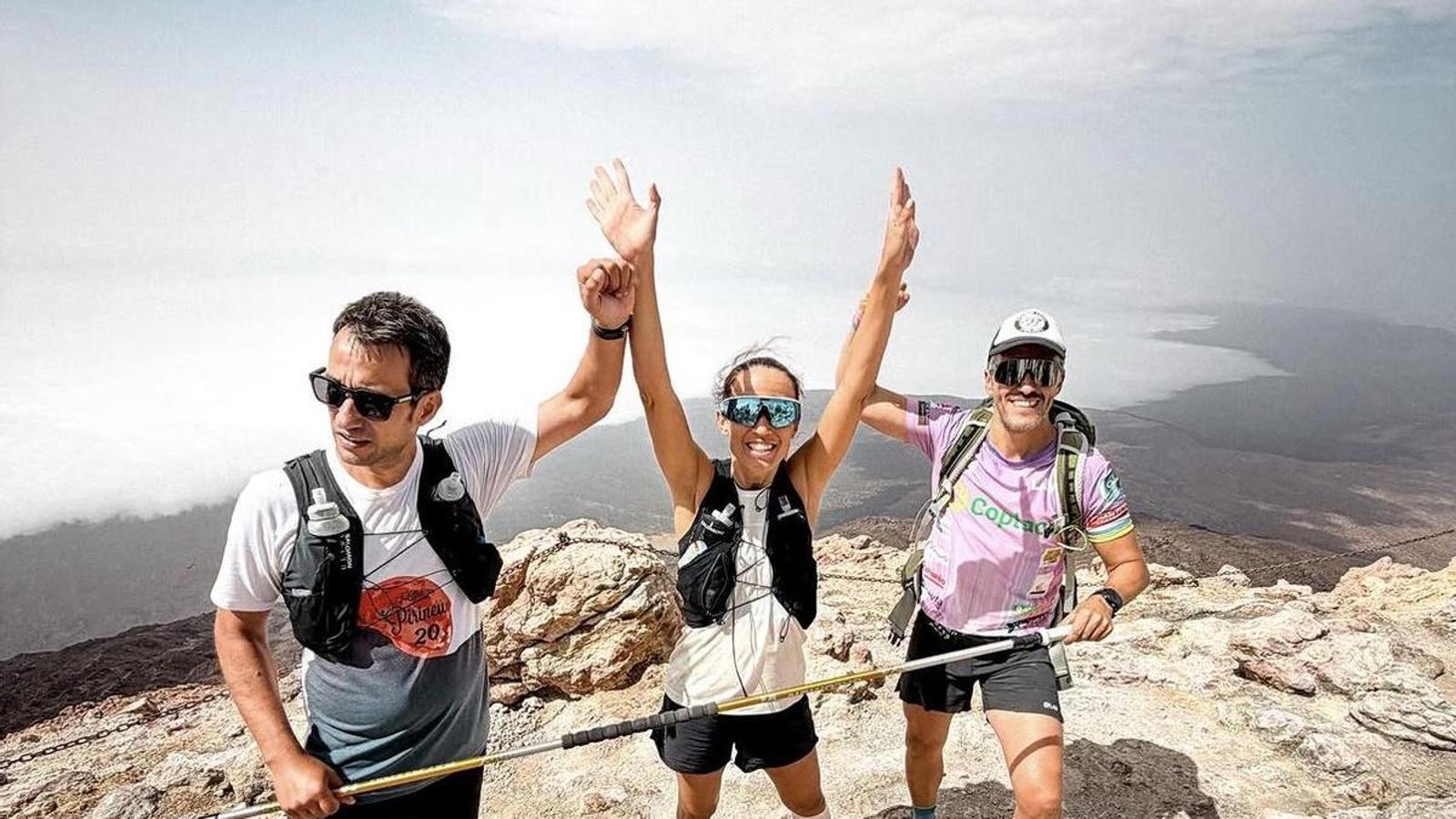
BarcelonaThis week, Maria Petit (Vilassar de Mar, 1992) will return to Chamonix to participate in one of the UTMB races, the prestigious Mont Blanc mountain race. She was there last year and is now returning to compete in the 15 km race with 1,200 m of elevation gain, a category "so tough and technical that it feels like more than 15 km," she explains. "At first glance, it might seem short, but it's a demanding race, especially since two weeks ago I participated in Sierre-Zinal," she tells ARA, referring to an iconic mountain marathon in Switzerland. If undertaking these challenges is already complicated enough for most athletes, it's even more so in her case, as Maria Petit is blind. At 17, she completely lost her sight and sense of smell due to a motorcycle accident. Now, she climbs mountains by running, leaving many athletes participating in the same races astonished and bewildered to see a blind person ascending the mountain.
Accompanied by a guide dog, Maria always maintains a positive attitude when she's in cities or giving interviews. She has always stood out for her initiative, such as the 'Ulleres de sol' (Sunglasses) project to raise awareness for visually impaired people.the 'Ulleres de sol' project for raising awareness among visually impaired people. Now, she has carved out a niche for herself in Catalan mountain sports, achieving milestones such as being the first blind woman to climb Mount Teide from sea level. Before the accident, she already practiced sports, but she didn't know about mountain races. That would come later. "Before the accident, I had done artistic gymnastics, and now I'll be in a bad position: I had also played basketball, but they kicked me out for being too rebellious," she explains with a laugh. And how did she end up running? "In 2011, I couldn't sleep at night. I realized I needed to do something and started exercising. First skiing and athletics. And since athletics was easier, I progressed and reached European championships. I even dreamed of going to the Paralympics, but I burned out before," she recalls. "Back then, I didn't even know you could run in the mountains, and I discovered it at home. In my town, Vilassar de Mar. For years, we've been doing the Burriac Atac, a very technical race. It was wonderful to do it because of the support from the people, who cheered, who helped me... It remains the most special race I've ever done," she explains.
And look how many races she's done. Her schedule leaves her little time to rest. "This year I'm doing the Ultra Pirineu, I'll be in Ibiza and at the Puigcerdà Half Marathon, where I'll be the godmother of the race. The big challenge will be to get a little rest! My day-to-day is always different, between travel, work, and training. Whenever I can, I try to go outside to train, if I find people to help me. And if not, then with the treadmill at home," she says. Because when you are blind and train in the mountains, you need the help of people to guide you. "To participate in races, I use a directional bar. It's a bar that can change its length from two to three meters to adapt to different mountain terrains. Three people hold the bar. I'm in the middle. There's a guide in front and a guide behind. The first one decides the path and the words with which they communicate with me, and the second one acts as a rudder," she explains. "Communication with the guide during the race is minimal, just enough to ensure safety and avoid stressing the person receiving instructions. The guide says things like 'steep descent' or 'technical terrain.' Few words and clear ones," she adds. The key is to maintain a safe and constant pace, accept falls, and have the ability to manage fear, as sometimes, especially on descents, it can be daunting. "A short while ago the bar broke on a descent and I wasn't sure about it," she admits.
Doing sports in the mountains isn't easy, but she admits that "it can be easier to do these races than to go through the city," as streets can be spaces not well thought out for people without vision. Maria doesn't see herself as a role model. "If I felt like a role model every day, I'd have a personality problem, but I do know that people like me can help those who have gone through similar situations to take a step forward and dare to do sports" despite having lost their sight. Thus, she has become the first blind woman to finish races like the Sierre-Zinal in Switzerland or reach the summit of Teide. Integrated into the Salomon mountain racing team, Petit has gone from receiving rejections from organizers of some races, who didn't want her for fear she might have an accident, to making history.

