Not only Barça speaks Catalan in Europe: the last frontier of Andorran football
Inter d'Escaldes seeks to make history and bring the Pyrenean country to a continental league phase for the first time

-
CAT -
CAST
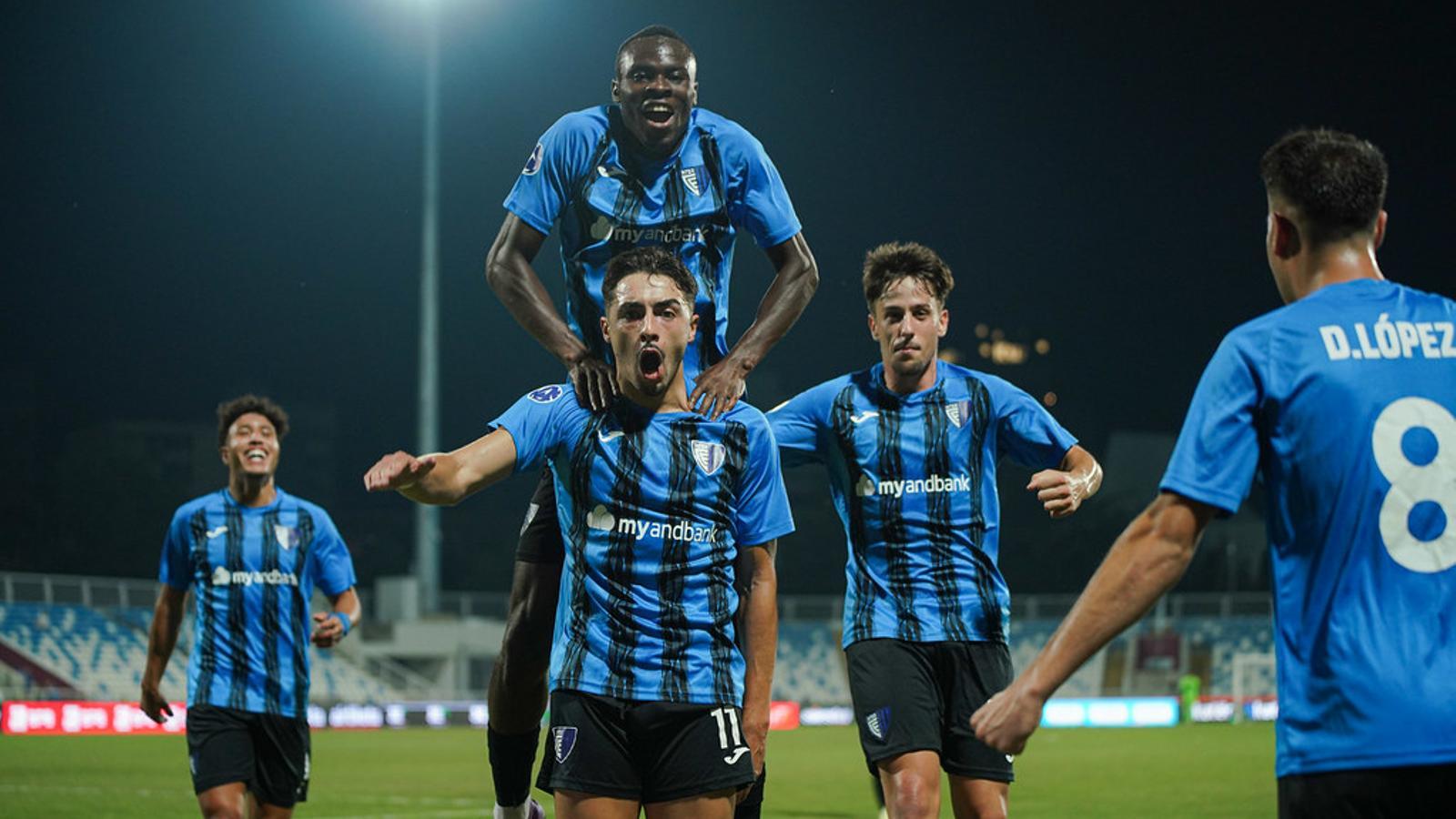
BarcelonaAndorra is a small country with two very different footballing realities. On the one hand, Gerard Piqué's FC Andorra, professionalized and integrated into the Spanish league system. On the other, a much more modest and unknown football that competes under the Principality's flag. With a budget ten times lower than that of the ex-Blaugrana's team, Inter Club d'Escaldes is just 90 minutes away from qualifying for the Conference League. If this Thursday (7:00 PM) they overcome Kosovo's Drita – they drew 2-2 in Pristina – in the second leg of the last qualifying round, they will make history: they will be the first Andorran club to compete in the final stage of a European competition.
“For players who come from Primera and Segunda RFEF, who have fought hard to make a living from football, imagine what it means,” comments Felip Ortiz, Inter's coach, a club founded in 1991 by a group of friends from the same company. “Almost all our rivals have higher budgets than ours – it's 1.2 million euros – and many things have to come together, like getting lucky in the draw. Last year we faced Steaua Bucharest, a European champion, and Olimpija Ljubljana. In fact, all predictions say Drita is the favorite,” adds the former Lleida goalkeeper, who has a past at La Masia. This year, the Escaldes team fell in the first round of the Champions League against Gibraltar's Lincoln and eliminated Flora Tallinn in the penultimate round of the Conference.
“Everyone had another job”
“I had hung up my gloves at Palamós and Toni Lima called me to go to Andorra,” explains Joan Bayona, who in January 2017 signed for Inter, when they were competing in the Second Andorran division. During the week, he lived in Sant Feliu de Guíxols, worked as a salesman for a construction materials company, and was a goalkeeping coach at Palamós and Guíxols. “On weekends, I went up there: on Saturday I trained and on Sunday I played the league match,” recalls Bayona, who at 46 years old still makes appearances for Calonge in the Third Catalan division. “In Andorra, training was in the evening because everyone had another job. And none of the players who came from outside lived in the country,” adds the Girona native, who was promoted to a higher category and even played a Champions League qualifier with the Escaldes team.
“The League is increasingly professionalized and that no longer happens. We train in the mornings. The footballers live in Andorra and their work priority is Inter”, explains Xavi Romero, the entity's sporting director. He was also the architect of UE Santa Coloma, the first club in the country that, two years ago, reached a final preliminary European round, losing against the Icelandic Víkingur.
“It can change the club's life”
In addition to the money raised for passing knockout rounds, reaching the Conference League stage awards clubs over three million euros. “Economically, it can change the entity's life,” says Romero. UEFA prizes and funds received by the federation have boosted football in a country of 468 km² that did not compete internationally until the 90s. “Now we have facilities that were unthinkable ten years ago. Three more fields have been built,” adds the sports director of Inter, the great dominator of Andorran football, with four of the last six league championships. The match against Drita will be played on the newest of all, the one in Encamp, which is natural grass – the League is usually played on artificial turf–.
Despite the evolution of infrastructures, Andorran football still retains some of its most differentiating features today: “Almost all matches were played on the same field and on the same day. At twelve, at two, at four... Nearby there was a bar where we usually met and coincided with the players from the rest of the teams. It was a bit like rugby's third half,” says Bayona, nostalgically. “It's very useful for coaches because you can see all your rivals on the same day,” completes Felip Ortiz. It's one of the good things about competing in such a small country. It also has its bad sides.

Last year the League started a few weeks late due to restrictions on residence permits for foreign footballers. There were up to 88 licenses held up at Immigration. “The Ministry has reached an agreement so that each club has ten places for foreigners. Therefore, we can only sign ten players from abroad,” reveals Romero.
In addition, UEFA regulations reserve eight of the 25 slots on the European list for players trained in the country, so only 17 can be filled by footballers who are not. “In a country like Andorra, it is very difficult for players to have been trained here because when they reach youth level they go abroad to study,” details Ortiz, who recalls that his footballers have not had a vacation: “Five days after the league ended, we started preparing for the playoffs”.
The Andorran dream
Despite the obstacles, football in the Principality has not stopped growing since 1997 when the CE Principat lost 0-8 against Dundee United in the first match of a team from the country in Europe. Now, Andorra is experiencing the best footballing moment in its history and next summer, for the first time, it will have four clubs in the preliminary European rounds, the prize for having settled in the top 50 of the UEFA coefficient ranking. Before that, it will look to achieve another milestone
“Qualifying for the Conference League phase can mean a generational change, a change in mentality. Teams and the national team used to go out not to lose or not to concede many goals... and that is already ending. We can fight for great achievements. Imagine an Ajax or a Getafe coming to Andorra,” dreams Felip Ortiz, just a few hours before the Inter d'Escaldes-Drita match that could change the sporting history of the country. It is the last frontier of Andorran football.
