Resilience, network and legal certainty to combat geopolitical tensions
Experts and institutions analyze the geopolitical moment in energy prices in the fourth edition of the ARA-CEEC Conversations
-
CAT -
CAST
With a global map marked by geopolitical tensions, armed conflicts, and the struggle for hegemony among great powers, the world faces a new stage of uncertainty also in economic terms. “The new signs of the times strengthen nations and countries, by themselves, can do very little,” warned Pol Morillas. According to the president of CIDOB, the global interdependence that for years had contributed to ensuring stability “is now instrumentalized by the great powers” through tariffs or new political pressure formulas, in a context that goes far beyond the conflict in the Strait of Hormuz.
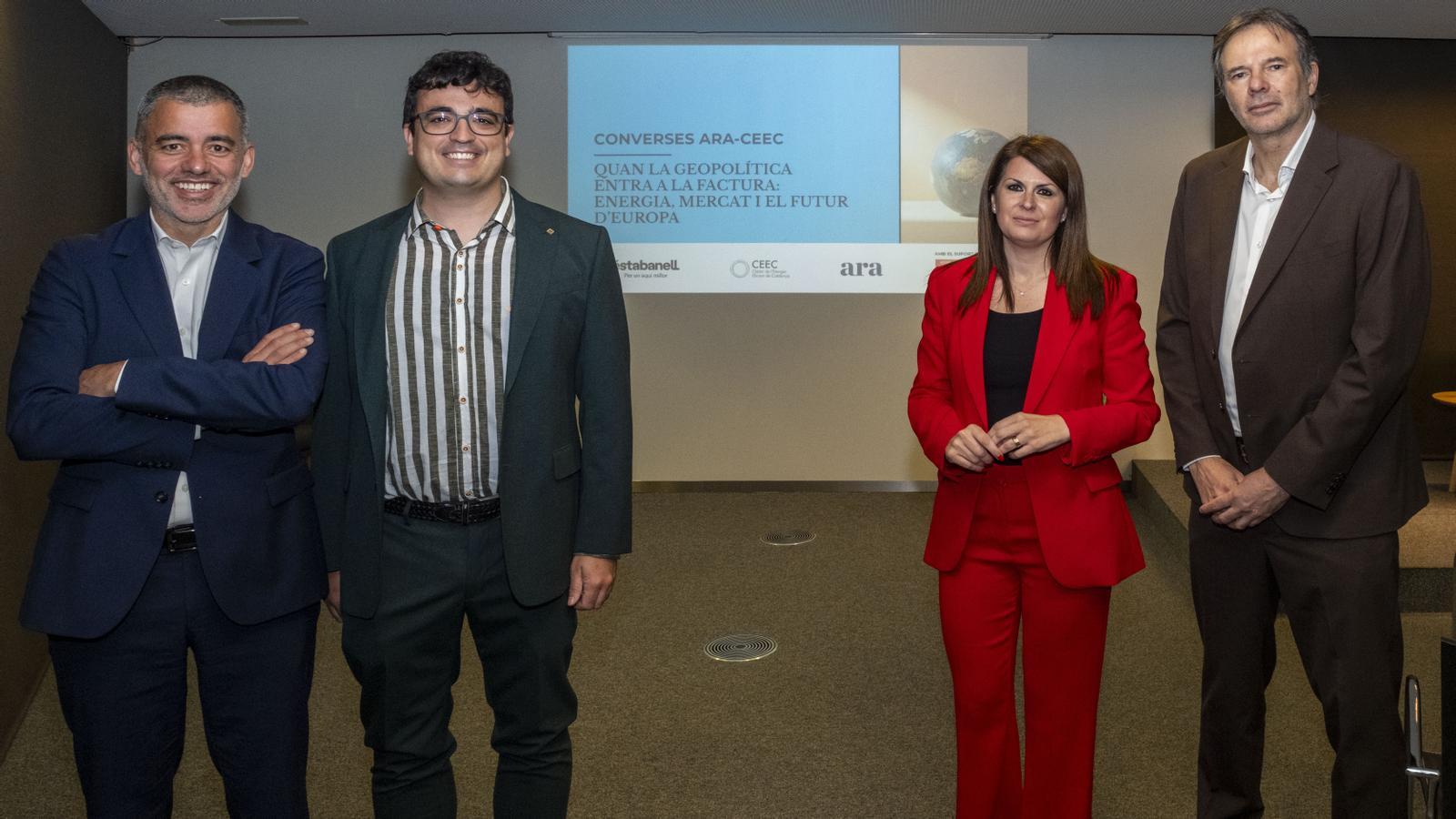
This reflection focused the fourth edition of the Converses ARA-CEEC, an event co-organized by the newspaper ARA and the Cluster of Efficient Energy of Catalonia (CEEC), at the Cercle d'Economia, with the collaboration of Estabanell. Under the title "When Geopolitics Enters the Bill: Energy, Market, and the Future of Europe", the event analyzed the business and economic impact of the new international scenario. The debate, which included a clear radiography from the CIDOB expert, focused on the need to strengthen European strategic autonomy and energy sovereignty in the face of a structural change that forces companies and institutions to act with greater resilience in the face of energy market volatility.
The idea of a bipolar world dominated by the United States and China now seems insufficient in the face of the multipolarity described by Pol Morillas, with actors such as India, Turkey, Japan, South Korea, or Indonesia gaining influence. Although Russia continues to act as a "disruptive" element, new alliances and crossed interests form "part of the uncertainty of where the world is going," as Morillas stated at the beginning of the debate.
Esteve Rodríguez, Director of Markets and Operations at Estabanell; Trinidad Sala, Regional Delegate of Red Eléctrica in Catalonia, and Pere Guerra, Vice President of the Energy Commission of PIMEC and member of the entity's Board of Directors, formed the panel of speakers, moderated by the journalist from the newspaper ARA, Natàlia Vila, and all of them defined a changing scenario full of uncertainties, but also an opportunity to demonstrate capacity for adaptation and resilience in the face of the new energy and geopolitical reality.
In the words of Pol Morillas, “resilience and diversification are the two recipes to follow”, and if we adapt “we can make this a positive challenge to give our economy an opportunity”, remarked Esteve Rodríguez, from Estabanell. Agility and dialogue between all parties must be the basis and, in this sense, Trinidad Sala based her presentation. “We must be agile and we need to row in the same direction, because electrification is an opportunity to reduce costs. We need good dialogue and state pacts”.
From the perspective of small and medium-sized enterprises, Pere Guerra called for more regulatory stability and political consensus on energy matters. “The legal volatility that SMEs have had to endure has been enormous. Without real political consensus, the sector has lived through a real nightmare since 2008”, he lamented. Guerra also recalled the consequences of retroactive cuts to the photovoltaic sector, which have ended up taking Spain to international bodies linked to the Energy Charter Treaty. “Many small solar producers have once again paid the price for lack of foresight. There are people who have gone bankrupt and SMEs that end up paying to produce”, he denounced.
As Esteve Rodríguez recalled, this is a non-negotiable issue and “it is everyone’s obligation to get involved, because the generation of new renewable energies is part of the solution. It will lower prices and is the best tool for us to be sovereign and resilient”.
Electrification is the future
The energy transition is inevitable, but carrying it out with stability and guarantees has become a strategic necessity. In this context, the electrical grid becomes a key infrastructure for ensuring energy supply. Trinidad Sala defined it as “the veins and arteries” of the system: “We can have generation and demand, but we need this connection”.
According to Sala, Red Eléctrica's function is precisely to respond to the territory's needs and facilitate the integration of new renewable generation sources. “We are now focused on enabling these new generations to be incorporated into the system and meet new demands”, she explained.
Sala focused on the role of grids in making the energy transition possible. She highlighted that the system has a “meshed and robust” network, but pointed out that the increase in renewable generation requires adapting operation, regulation, and access mechanisms. “We can generate a lot, but we need grids”, she affirmed, emphasizing the importance of coordination among the different system agents.
Pere Guerra addressed the debate from the perspective of small and medium-sized enterprises, emphasizing the importance of guaranteeing a stable, competitive, and predictable supply. In this context, he advocated for the need to continue strengthening energy infrastructures and maintaining an energy mix capable of responding to the needs of the productive sector. Guerra also warned that “we cannot shut down nuclear power plants” without first guaranteeing sufficient alternatives to ensure supply security.
As Esteve Rodríguez pointed out, “energy has ceased to be a simple bill and has become a strategic element”. Rodríguez emphasized that in energy efficiency, “the most important kilowatt is the one that is not consumed”, and advocated for the need to help companies, SMEs, and consumers move towards a more efficient and digitized model, both in businesses and homes, to take advantage of new technologies and accelerate the energy transition. “We must all contribute and act in a coordinated manner to make this progress towards the future possible”, he concluded.
