"Cities are like monsters that live upon their own excrement"
The Italian biologist Stefano Mancuso closes the Enfoquem with a call to rethink the dogma of infinite economic growth

-
CAT -
CAST
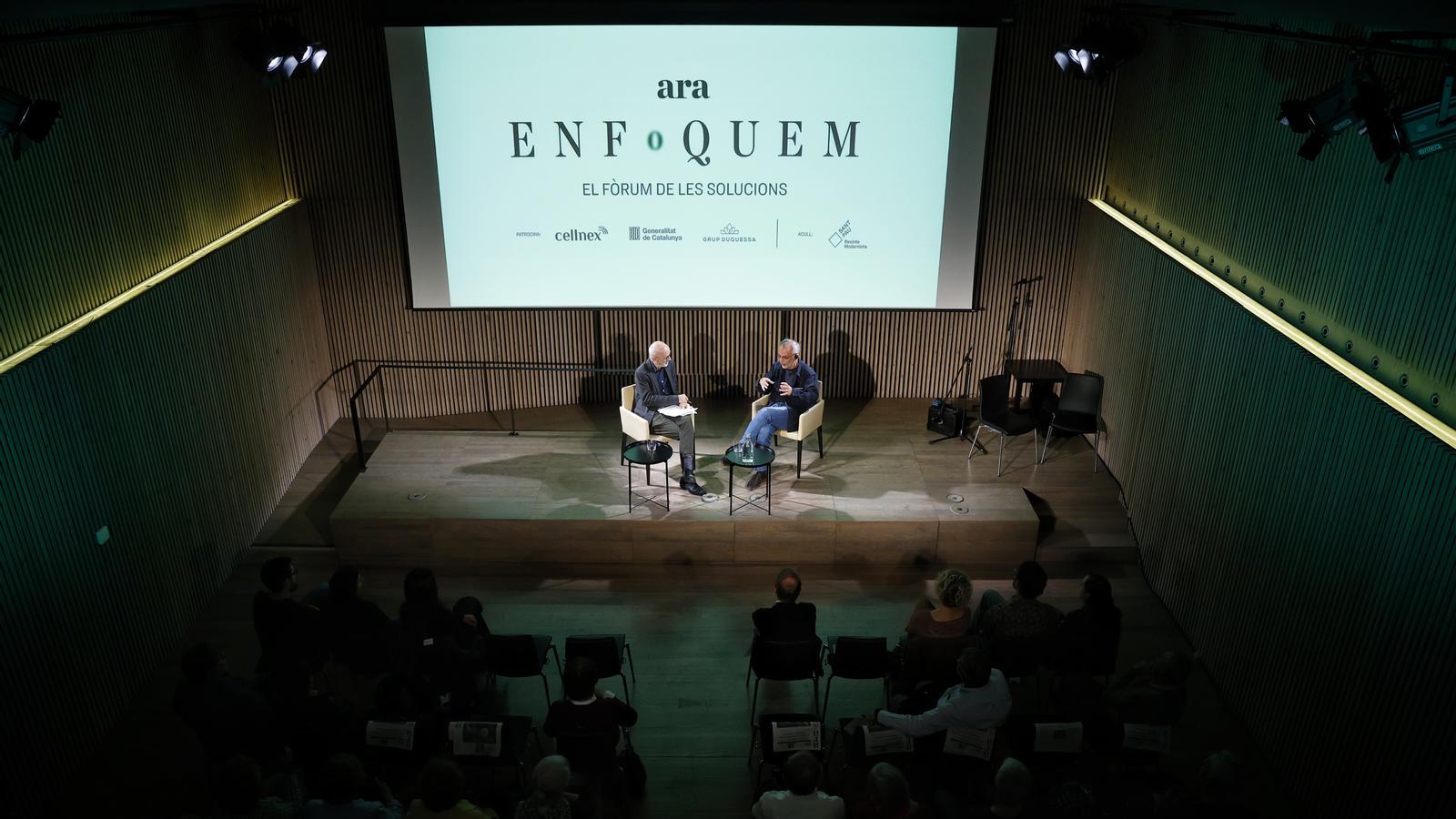
BarcelonaThe human species has stopped having the survival of the species as its fundamental objective. This was how forceful the Italian biologist and science communicator Stefano Mancuso was during his intervention at Enfoquem, the debate forum organized by ARA this Monday and Tuesday at the Sant Pau Modernist Site in Barcelona. In conversation with the deputy director of ARA, Ignasi Aragay, Mancuso admitted to having shifted from optimism to "moderate pessimism" regarding current technological advances, but even so, he defended some "solutions" to current climate and environmental challenges, such as the renaturalization of cities.
"We are the only species that thinks about the future and the only one that subtracts resources from future generations," he remarked, convinced that we have "lost the fundamental engine of the evolution of species," which is that of fighting for the survival of the species, an objective that we have replaced with that of individual well-being. "Any problem, if we want to solve it by improving the individual's quality of life, has one solution, but if we want to solve it by improving the species' capacity for survival, it has the opposite solution," he said.
In his latest essay, The Song of the Earth (Galaxia Gutenberg), the Italian botanist precisely reinterprets from a philosophical-ecological perspective the Canticle of the Creatures written by Saint Francis of Assisi, who already in the 13th century advocated that "when you consume resources of the planet, you are stealing from future generations."
Mancuso states that we have a "crisis of civilization" that adds to the current climate crisis and that stems from an "economic system that is based on the presumption of a dogmatic premise that has no scientific validity, which is that natural resources are infinite." "Anyone with some knowledge of science knows that in a finite system like ours it is impossible to pursue infinite growth, and yet, we pursue this model," he added. As proof of this dogmatism of economic growth, the Italian author recalled that the term most used today to define citizens is that of "consumers," when consuming something means "finishing it."
With a message that combines scientific data with philosophical discourse, Mancuso focused on cities, which today represent less than 2% of the planet's habitable surface but consume 90% of resources and emit 85% of CO₂. "Compared to a living being, the city would be a monster living on a mountain of its own excrement," he said. And this is especially worrying when 70% of the world's population lives in cities, a change that has occurred since 1970 (when it was only 30%) and that for Mancuso is a leap similar to the one humanity made when it moved from hunter-gatherer societies to agricultural ones. Now we are urban beings.
Mancuso is also the author of Phytopolis, where he advocates for the massive "renaturalization" of cities, and of Sensitivity and Intelligence in the Plant World, also translated into Catalan and Spanish by the publisher Galàxia Gutenberg. At Enfoquem, he also defended the urgency of this renaturalization, a concept that, as Aragay recalled, was already defended in the 19th century by the creator of the Eixample, Ildefons Cerdà: "To avoid heat-related deaths, you must cover cities with plants," said Mancuso. But, according to the biologist, today "no city in the world has the number of trees it should have, not even one."
The Italian author recalled that in 2024, the last year for which data is available, there were 68,000 heat-related deaths throughout Europe. "When we have data from the summer we just went through, we will see an enormous number of people who have died from the heat," he added. These are deaths that could be avoided, he insisted, through the renaturalization of cities, since "plants are natural air conditioners."
The problem stems, according to Mancuso, from the fact that "cities are human monocultures," when from agriculture we have learned that monocultures "require pesticides and herbicides because they are very vulnerable." "The ecosystems that are stable are those that are composed of many different species, together with fixed relationships; on the other hand, the metabolism of a city is terrible: it consumes enormous amounts of energy and matter and produces an enormous amount of waste."
Mancuso put an end to two days of debates at the Sant Pau Modernista Precinct, which on the first day were focused on global security and technology challenges, such as hybrid warfare or artificial intelligence. On the second day, the forum organized by ARA discussed the environmental challenges facing the planet and the philosophical and humanistic challenges it generates. The link is clear: "The first problem we have —Mancuso said— is that technological progress advances at a speed far superior to the progress of our consciousness".
Tuesday's event closed with a surprise for the biologist, the performance of the young Catalan singer Belen Bandera, who for her album Bamboo was inspired by Mancuso's essays, who was unaware of this music and discovered it on stage, where two fragments of recorded pieces could be heard and where Bandera performed live, accompanied by guitarist Jaume Llombart, an unreleased song.
"Colonies will not be able to be established on Mars if they are not genetically modified"

It was precisely the question of the ethical limits of science that was the topic focused on in the preliminary conversation between science journalist Cristina Sáez, director of the ARA supplement Va de Ciència, and UB genetics professor and bioethics expert Gemma Marfany. "Editing the genome, intervening in processes that until now were untouchable, and even an artificial intelligence that forces us to rethink what it is to be human," are some of the challenges, Sáez noted, that require deep reflection.
"We scientists must consider the impact that what we do may have on the future of humanity, and philosophy" and other humanistic disciplines can help with this, stated Marfany. In the field of genetics, in which she is a specialist, it is especially urgent. "What I explain in class now, I thought was science fiction ten years ago," said the UB professor, who defended the "crucial" need to apply "bioethics" to all the advances being achieved in the field of biogenetics.
"In the European Union, modifications cannot be made to embryos to make designer changes, but in other countries they consider it normal and it is allowed to be done; is it that we are more right than them?" asked Marfany. In order to make these decisions, she argued, one must be helped by philosophy, ethics, and even literature. And she gave a very clear example: "Colonies will not be able to be established on Mars if they are not genetically modified", she stated, since direct exposure to the sun's radiation in environments without an atmosphere like those has a very great impact on human cells in the form of "neurodegeneration and cancer." "It will be necessary to make genetic improvements, to tune them [the members of these future missions] to make them different. But who decides if this is done or how it is done?" she asked.
The bioethics specialist admitted that there are still more questions than answers, but precisely to find them, science must make use of many other tools, such as ethics, philosophy, or culture, which differs from one place in the world to another.
