Twenty years since the Valencia metro accident: "The PP showed that it is interested in power and not in the victims"
The tragic accident resulted in 43 deaths and 47 injured and the suffering of families due to the slow judicial investigation and the treatment by the Generalitat
-
CAT -
CAST
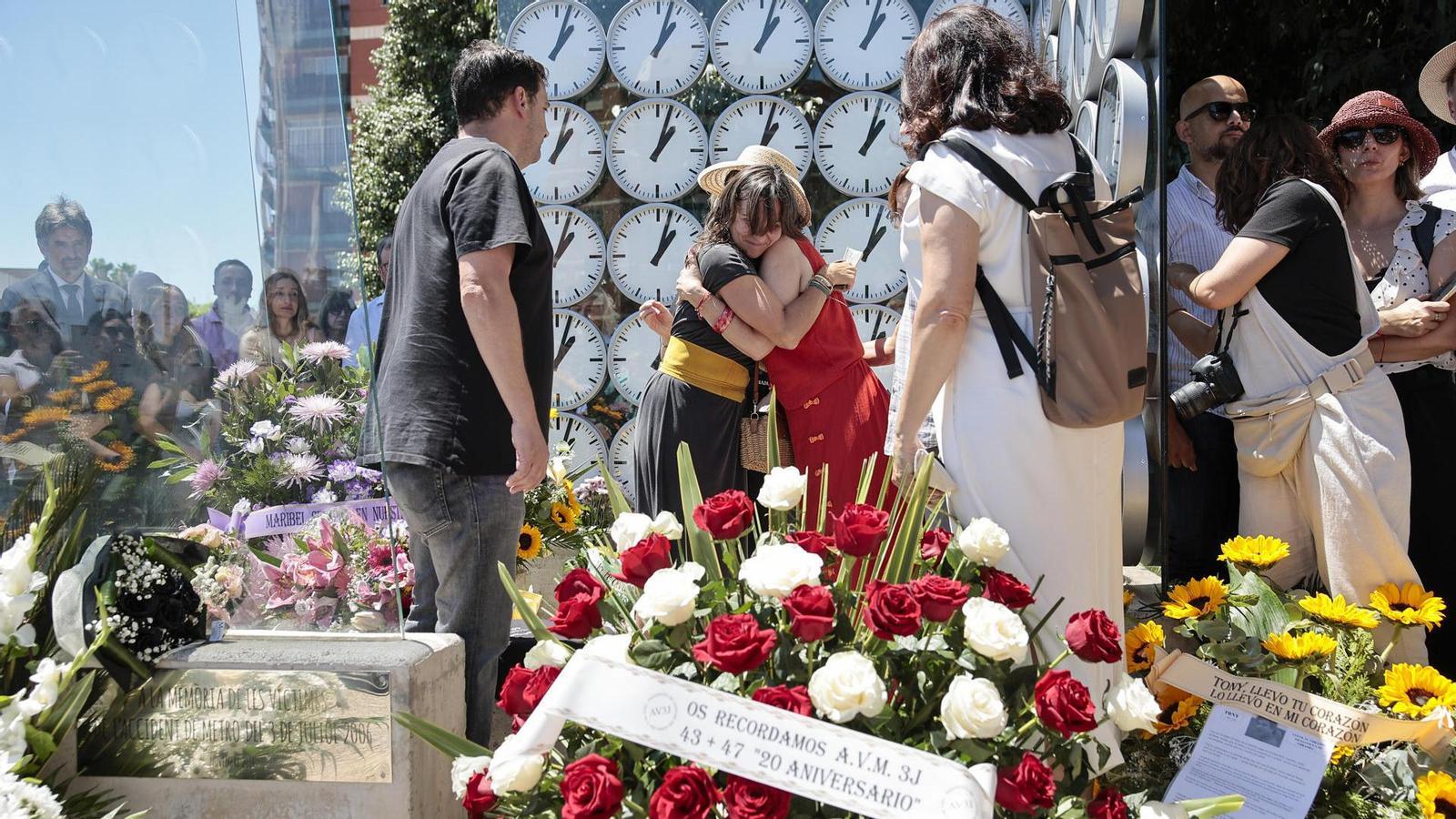
Valencia"The PP proved that it is interested in power and not in the victims", summarizes Enric Chulio. On July 3, 2006, he lost his wife in the tragic Valencia metro accident, the largest in Spain and the second in Europe. 43 people died and another 47 were injured. To the suffering of the absence of loved ones, the relatives had to add the pain of indifferent courts, passive media, and an indifferent citizenry. Also for a Valencian government that belittled them to the point that the then president of the Generalitat, Francisco Camps, refused to receive them. Two decades after the tragedy, the balance is less painful. "After a bitter period of many years, the support of the people and a conviction sentence arrived, which relieved us", summarizes Chulio, who has been one of the three presidents of the association of relatives.
One of the elements that most struck the victims was the investigation by magistrate Nieves Molina, who shelved the case on up to three occasions. Against the judge's will, a plea agreement was reached in 2020. Four former executives were convicted and four others were acquitted. According to the facts declared proven, all four were aware of the "safety deficiencies" of the section. The absence of a beacon that guaranteed speed reduction on particularly dangerous curves stands out. Despite being aware of them, they "omitted" their obligation to implement safety measures and "neutralize" the risks of derailment and overturning of trains.
They were also held responsible for having allowed deficiencies in the "rolling stock", referring to the use of old wheels without the manufacturer's approval and the existence of modified windows with insufficient fastening. In fact, when the train overturned, the windows came loose, throwing passengers onto the tracks moments before the second carriage passed. Finally, they were reprimanded for the insufficient "training and selection" of the drivers, given that the driver had just over two months of experience.

The ruling amended the Generalitat's version, which argued that the accident was "unforeseeable and unavoidable" and that the sole responsible party was the driver – who died in the accident – due to excessive speed. The train was traveling at 80 kilometers per hour, double the speed limit for that section. But it also left many doubts. "It did not clarify the suspicious disappearance of the logbook, the deletion of the metro's black box after its initial reading, and whether the tracks were damaged as some workers reported because they were quickly repaired by the Generalitat without judicial presence," complains Rosa Garrote, also former president of the victims' families association, who lost a sister in the accident.
Imposition of a narrative
One of the responsible for the suffering of the relatives was a Valencian government that for the journalist Vicent Peris "covered up negligent management and mistreated the victims by accusing them of acting out of political and economic interest". The informant is co-author of the web documentary 0 responsible people and of the documentary The strategy of silence which, alongside the program Salvados, provided key data for the reopening of the case. He attributes the lack of social support for the victims to the fact that "they were times of supposed economic splendor and people did not want to empathize with misfortunes". For Rosa Garrote, the key piece was the media. "It was a manipulated society, with a very conservative Canal 9," she highlights.
Twenty years later, with the 'dana' (a severe weather event), the families have seen how another Valencian government has "mistreated the victims". "It is no coincidence that in both cases it is the same party that is in power," points out Chulio. "We thought our struggle would have served a purpose, but we were fooling ourselves, as it doesn't cost them votes...", laments Garrote. What has changed according to Peris is the media coverage. "Mazón has been brought down by the media. Unlike Camps, he has not been able to impose his narrative," he concludes.

