"With Noelia's euthanasia, they have tried to change in the courts what they did not achieve in Congress"
The ultra-Catholic group Lawyers of the Christian Faith has prolonged the standoff until the last moment with a rally at the socio-health center where the young woman received dignified death
-
CAT -
CAST
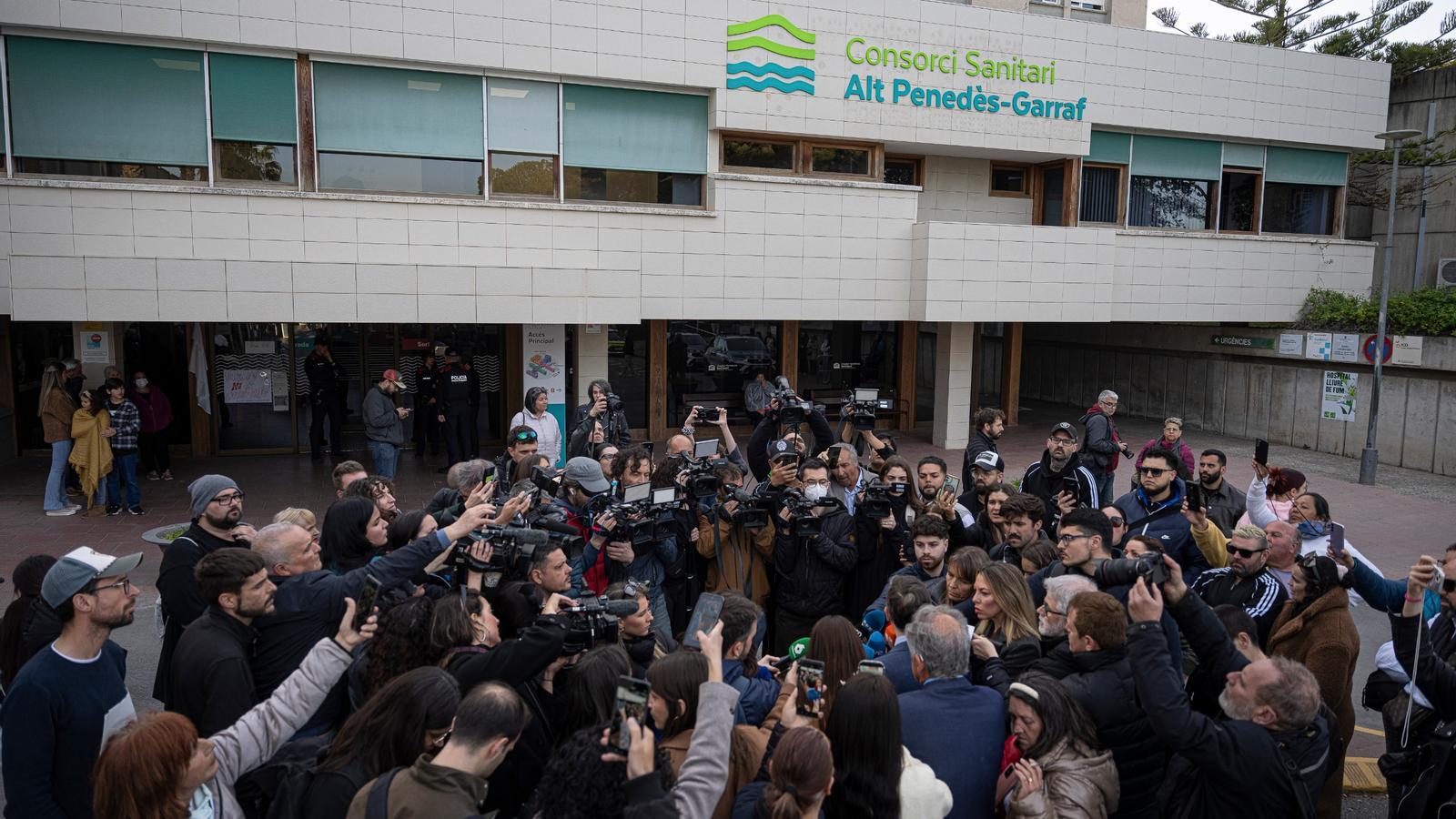
BarcelonaAfter 20 months of waiting, Noelia Castillo received euthanasia this Thursday afternoon. Her father and the ultracatholic group Abogados Cristianos tried to prevent it until the last moment with a lawsuit that brought the ideological battle against the right to a dignified death to the courts. Today, a ruling reiterated to them that justice would not stop the girl's euthanasia. But even when they no longer had any option in the judicial route, their pressure continued with a gathering at the doors of the health center where she was admitted, where about twenty people shouted her name at the same time that the dignified death was scheduled to be administered. The protest forced the deployment of a police operation at the Hospital Residència Sant Camil in Sant Pere de Ribes, a now public center that the religious order of the Camilos inaugurated in 1975 and which today was the scene of this dispute against euthanasia in the name of religion.
Noelia Castillo's case has escalated to the European Court of Human Rights (ECtHR), and all the courts that had to rule during the process –five instances– have confirmed that the girl had full faculties to decide about her life and that she met the requirements to receive euthanasia, which also had the medical approval of the Guarantee and Evaluation Commission, the group of experts responsible for assessing assisted death requests. "It is a very careful process," insists the president of the Associació pel Dret a Morir Dignament de Catalunya (DMD), Cristina Vallès. And she adds: "If Abogados Cristianos had not gotten involved, there would be no case. Noelia would have been able to die in peace and quiet as she wanted two years ago."
The president of DMD criticizes the ideological intentions of the lawsuits filed against Noelia's decision and the expert opinion: "What the PP did not achieve in Congress with the law, they are now trying in the courts through Abogados Cristianos." However, she dismisses that these lawsuits put the right to euthanasia at risk and recalls that the law has the approval of Congress and the endorsement of the Constitutional Court. "All this media circus only benefits Abogados Cristianos and harms Noelia," concludes Vallès.
The jurist specialized in bioethics and member of the Guarantee and Evaluation Commission, Núria Terribas, believes that the possibility of restrictions on access to euthanasia would depend on a change in the Spanish government. "It's difficult for them to scrap the whole law because it has a lot of social consensus and the Constitutional Court's approval, but they might try to restrict, for example, mental health cases," she adds. Regarding Noelia's case, where both her mental health and the spinal cord injury she has as a result of a suicide attempt were taken into account, Terribas argues that it has awakened in citizens "solidarity towards the girl and censure of the father's attitude of harassing her until the last moment".
To prevent any other patient from having to spend so much time awaiting a judicial procedure to receive assisted death, DMD has registered a proposal to modify the law that regulates contentious-administrative procedures to ensure these proceedings last a maximum of 20 days.
A case that will leave "a judicial footprint"
The legal loophole that the ultra-Catholics used to push the procedure was the doubt about who can judicially intercede in someone's euthanasia request. The law already provided that if the Guarantee and Evaluation Commission declined the patient's request, they could appeal. Instead, it was not foreseen that anyone could appeal against a positive response from the Commission, and that is what Noelia's father did, with the help of Christian Lawyers. This has opened the legal debate on whether the relatives of an adult patient with full faculties can intervene judicially to stop an euthanasia procedure that already has medical approval.
For now, the High Court of Justice of Catalonia (TSJC) has ruled on this debate in the case of a 54-year-old man, Francesc, stating that a patient's relatives can be legitimized to take an euthanasia procedure to court even if the applicant already has the approval of the expert commission. "It is the first case and it could leave a judicial mark, but we believe it will not, and the Generalitat's legal services are also trying to prevent it from happening," says Vallès. In fact, the Supreme Court has a pending appeal against this TSJC decision, with a ruling that will set a precedent on this debate and which is expected to be published around June.

So far, all courts superior to the TSJC that have ruled on the case –the Supreme Court, the Constitutional Court and the ECJHR– have not yet taken a position on this fundamental debate. The judiciary's response in Francesc's case, which has also been litigated as a result of an appeal by his father, who unlike Noelia's acts individually and not with the hand of Abogados Cristianos.
The far-right instrumentalizes the case
In parallel to the judicial battle of Abogados Cristianos, the far-right party Vox has also taken Noelia's story as a throwing weapon for its ideological war against Pedro Sánchez's government. In a tweet published this Thursday, Santiago Abascal assured he was "very affected" by the girl's assisted death and gave a voluntarily manipulated summary of the case. "The State takes a daughter from her parents. The unaccompanied foreign minors rape her. And the solution the State gives her is to commit suicide," he wrote, before attacking the state executive: "Sánchez's Spain is a horror movie".
The tweet not only omits the context of the girl's guardianship when she was a minor, but also accuses migrants without evidence of the multiple sexual assaults she suffered in 2022 and holds the State responsible for her death. What Abascal does with this message, therefore, is to take advantage of the case to "shoot at will" against institutions, against vulnerable people, and against the Spanish government, as Miquel Ramos, a journalist and researcher specializing in the far-right, explains to el ARA. "And lies are part of the menu," he adds.
For Ramos, beyond trying to "expose the errors of the public system," both Christian Lawyers and Vox see Noelia's story as an opportunity to advocate for their opposition to euthanasia, one of the most recognizable "banners" of the ultra-Catholic far-right, along with the rejection of abortion. "They champion a supposed defense of life" against the "defense of death" that they attribute to the left and progressive circles, says the expert. Not in vain, the ultra deputy Carlos Flores referred to the case in an intervention in Congress as the "execution of a 25-year-old girl".
This type of discourse, which Ramos interprets as a way to "reinforce the clientele" – the voters – and gain "media attention," is simultaneously reproduced by both ultra entities and those of Abascal. "Perhaps they haven't even spoken, but they all know what they should say and there is a harmony in the message," highlights the journalist. And the main medium for amplifying this message is social media.
From Abascal to Bukele
Abascal's tweet, with nearly 3 million views in a few hours and hundreds of thousands of reposts, mentioned another message from a supposed user named @Capitana_espana, who has 200,000 followers and in her profile proudly states that she lives in Catalonia, does not speak Catalan, and is called a fascist. This is a common type of account in the orbit of the far-right and reproduces the narrative of Vox. But not only that.
The message from this supposed user, who described the outcome of Noelia's case as a "barbarity," has served as a basis for attacks against the young woman's euthanasia by the president of El Salvador, the ultra-rightist Nayib Bukele, and Mateusz Morawiecki, former Polish prime minister and leader of European Conservatives and Reformists. For Ramos, it is proof that there are shared battle topics among the global far-right and that, through the amplification of networks, they articulate a 'joint global strategy'.
