The USTEC specifies its priorities for negotiation: inclusive school, staffing and salaries
The union assures that it will not sign any agreement without first consulting the teaching collective

-
CAT -
CAST
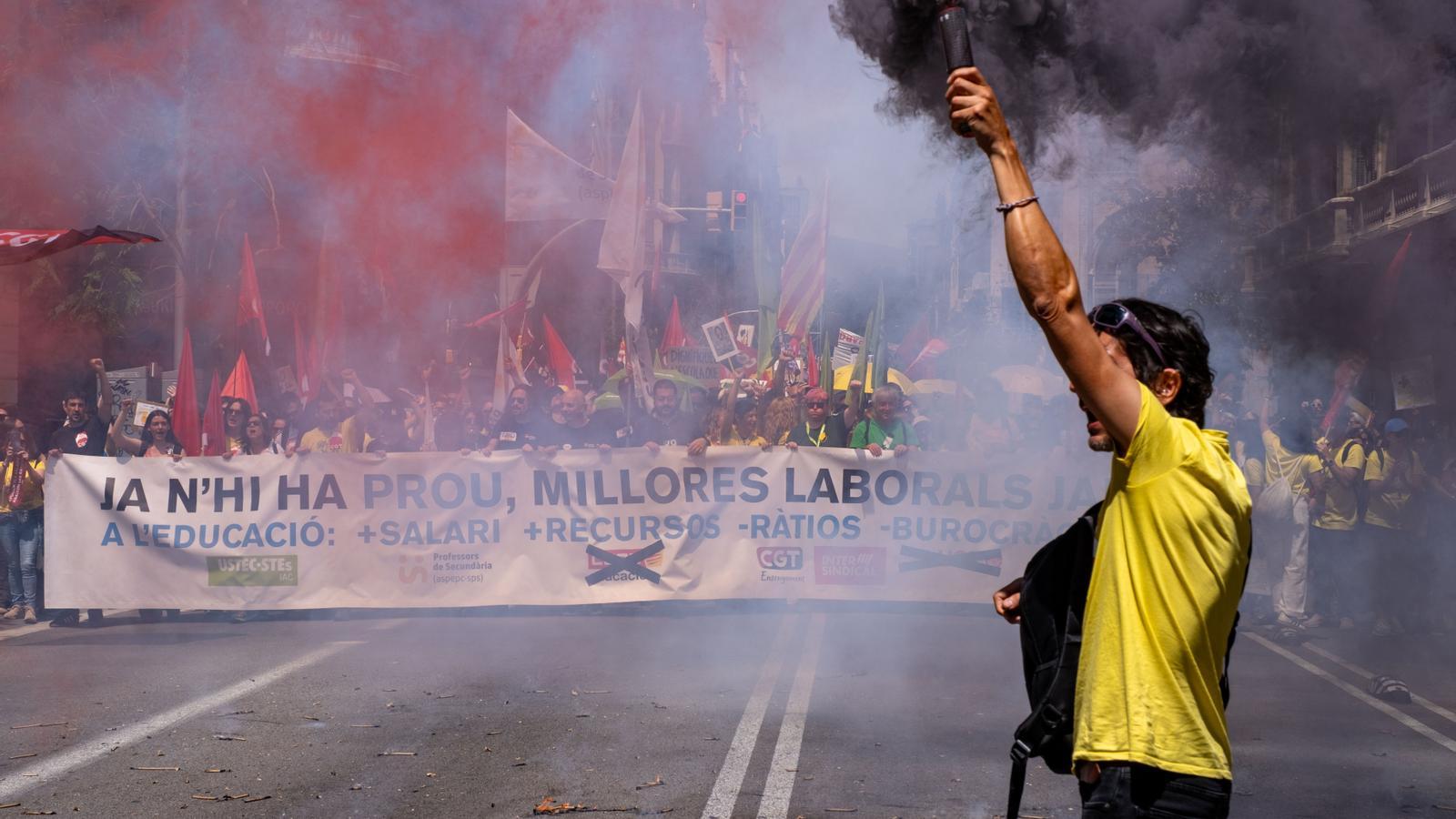
BarcelonaRecover purchasing power and a shock plan to strengthen inclusive education. These are the two "main immediate priorities" of the negotiation framework that USTEC – the majority union in the education sector – has submitted to the Government with the aim of "unblocking the educational conflict". In a statement made public the day before the meeting between the Ministry of Education and the union forces, USTEC proposes a dozen measures focused on inclusive education and recalls that 40% of students have specific educational support needs, mostly for socioeconomic reasons. "Without a shock plan to strengthen staff and inclusive education, there will be no agreement," it assures. It also insists that "any proposal" will have to be ratified by the collective in a consultation and that it will not endorse any agreement "behind the backs of the centers or without the direct validation of the people who have sustained the mobilization".
of the strike that 35% of teachers supported USTEC also asks the Government that, starting next year, there be "half a provision" – the equivalent of a half-time teacher – for an arrival classroom starting with five students who need it. And if more newly arrived students arrive, they ask for this resource to increase "without limits". They also demand that from the 2027-2028 academic year onwards, the maximum ratio of arrival classrooms be ten students per group, and they request that all centers have SIEI teams (professionals supporting inclusive education) with an educational counselor and a speech and language teacher.
On the other hand, the majority union proposes that next year the labor staff and teachers for educational support be increased by 15% – to attend to students with special educational needs –, as well as setting a schedule to increase them by up to 50% in the coming years. Likewise, they also request 25% more staff in the EAP – the psycho-pedagogical counseling and orientation teams that support educational centers – and a schedule so that in the future there will be 50% more professionals. In addition, they urge Education to convert all positions in this sector into structural ones to guarantee their stability. Currently, they operate with programs.
Regarding inclusive education, USTEC requests to reduce the ratios in special education centers and to carry out a "real accounting" of students needing educational support, whether for socioeconomic reasons, educational causes, or health. In fact, the union wants that, regarding ratios, students with special needs count as two and those with socioeconomic problems count as one and a half. Finally, the union requests a plan to reduce two teaching hours for all professionals dedicated to educational support so that they can "coordinate, plan, and carry out real monitoring of student support".
Salary to dignify the profession
Beyond the measures to strengthen inclusive education, the USTEC also assures that salary measures are "a key axis for an agreement". They explain that the negotiation framework they have presented to the Government includes a salary bloc that is essential to dignify the profession. Although no specific figure is included, the union's spokesperson, Iolanda Segura, explained in an interview with ARA that an intermediate point between the Government's proposal and the union's could be around 400 euros per month.
According to the USTEC's statement this Wednesday, the salary bloc does include "a real salary increase that reverses the loss of purchasing power", a schedule for the repayment of outstanding debt, and a salary guarantee clause linked to inflation, among other things. The union insists that "any proposal must be clear, budgeted, and verifiable both on the payslip and in the centers".
Finally, the union also explains that in the medium term they plan to establish a schedule for educational investment with the aim of reaching 6% of GDP as mandated by the education law and to implement a plan to achieve ratios of fifteen students in primary school and twenty in secondary school. "We don't want more propaganda. We want resources in the centers, improvements in the payslip, and guarantees in writing," they conclude in the statement.
