The Spanish government sends the statute of healthcare professionals to Congress under the threat of a doctors' strike
The council of ministers gives the green light to the text without counting on the support in Congress
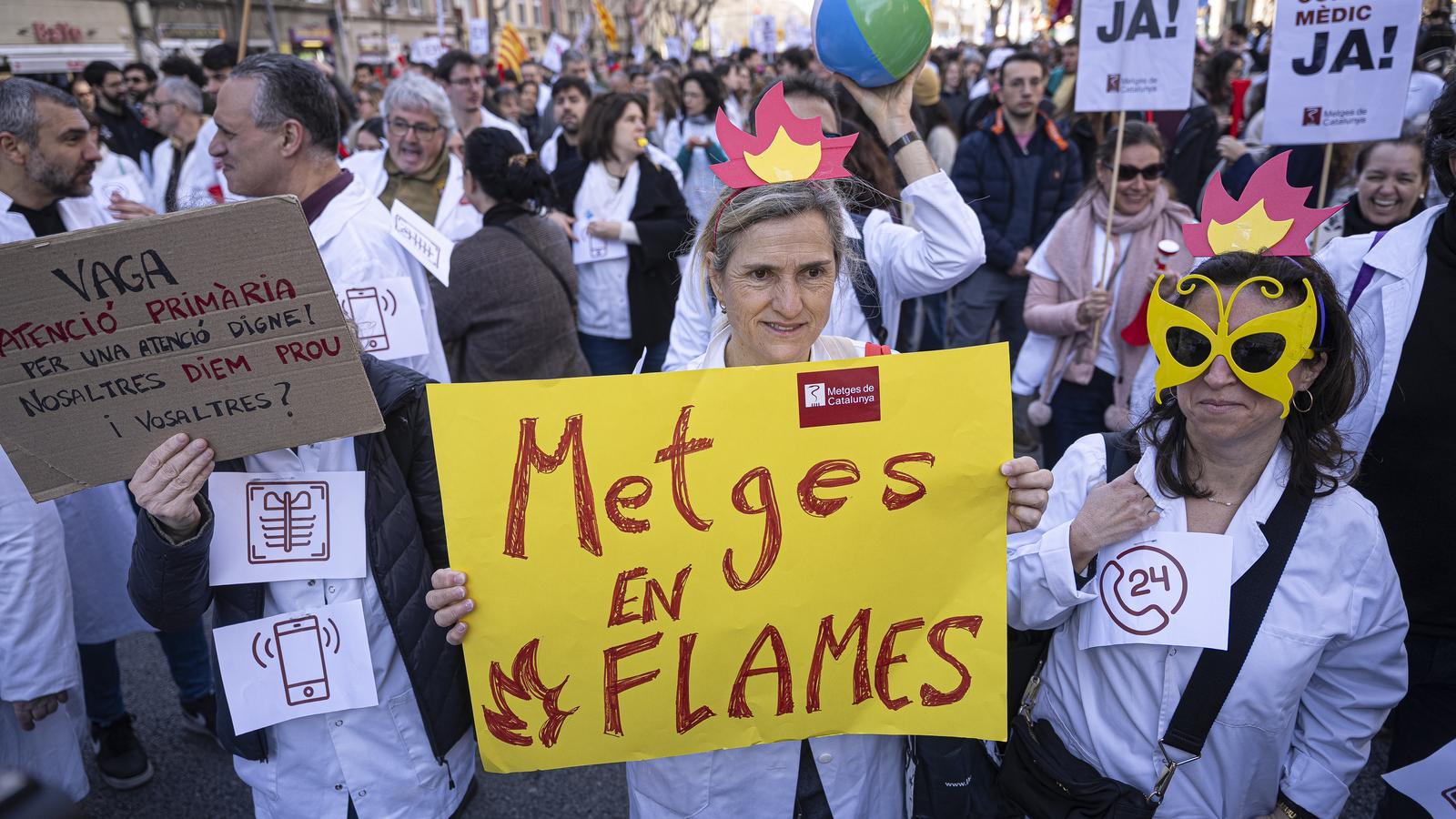
BarcelonaWith thethreat of an indefinite strike, the Council of Ministers approved this Tuesday the bill for the framework statute of health personnel, which will now have to begin its parliamentary journey despite the frontal rejection of doctors, who demand their own and exclusive negotiation space and labor and professional improvements.
The future statute governs the minimum labor conditions of the National Health System personnel and introduces certain improvements compared to the one in force since 2003: it regulates the working hours and rest periods of health professionals and homogenizes the professional category, adapting it to the European framework. But among the medical professionals, the text is insufficient to meet their demands and they demand their own statute. In fact, they have shown their rejection with various rounds of mobilizations and service stoppages that have had discrete follow-ups, according to data from the Department of Health.
Despite the professionals' demands, the Minister of Health, Mónica García, refused to create a specific statute for doctors and, in fact, managed to sign an agreement with five majority unions in the sector —SATSE-FSES, CCOO, UGT, CSIF and CIG-Saúde—, which did not stop the protests of strictly medical unions, such as Metges de Catalunya.
17-hour on-call shifts
Among other measures, the reform puts an end to 24-hour medical on-call duties, reducing them to a maximum of 17, prevents ordinary shifts from being worked immediately after an on-call duty, and sets a limit of 45 working hours per week compared to the European ceiling of 48. Doctors, however, are increasing their demands for shifts not exceeding 35 hours per week and are calling for the creation of a professional category (A1+).
From now on, the preliminary draft begins its parliamentary process. The minister does not, for the time being, have the guaranteed majority to move forward with one of her major legislative goals, as the text has provoked the outright rejection of the PP and Vox, in line with the autonomous communities where they govern, while among the investiture partners (ERC, Junts, PNB, and EH Bildu) the final decision will largely depend on whether their amendments are incorporated.
In parallel, the medical unions that continue to fight are threatening to call an indefinite strike across the State. In a survey conducted by Metges de Catalunya – the majority professional union – among its members, 60% of professionals have shown themselves in favor of a total stoppage until sectoral demands are met. The Association for a Medical and Faculty Statute (APEMYF) had already announced that if there were no progress during the summer, they would opt to return to striking.
Meanwhile, other professional groups affected by the framework statute are urging the approval of this reform, such as nursing, as it would mean their professional category would be recognized as a university degree, in accordance with their current training and competencies, and not as a diploma as it is now.
