The Spanish government and Ceuta agree on new spaces for immigrants after the outbreak of violence
The State extends to 44.51 million euros the budget allocated to humanitarian aid and requests the support of Frontex
-
CAT -
CAST
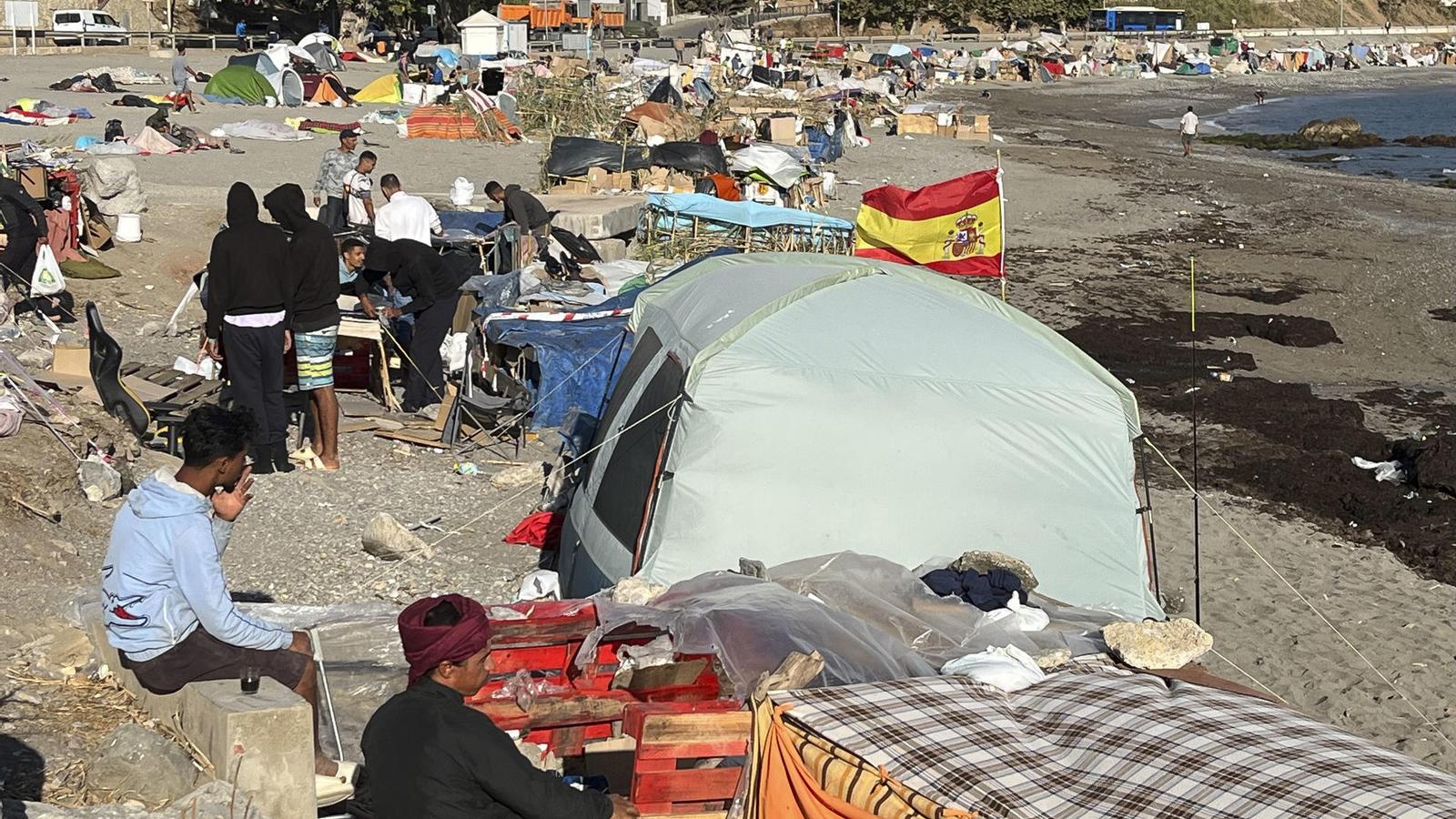
BarcelonaThe day after the altercations and of the outbreak of violence against a migrant settlement, the committee in charge of coordinating the response to the Ceuta crisis has agreed "unanimously" on a new list of spaces to relocate immigrants who do not have accommodation in the autonomous city, according to Spanish government sources. The location of the spaces will not be made public until the list has been formally approved at the next council of ministers.
The decision was announced after days of clashes between the executive led by Pedro Sánchez and the Ceuta authorities. The lack of suitable spaces to accommodate thousands of immigrants – either because they could not access the scarce available resources or because they refuse to go there out of fear – has fueled the conflict between the administrations. The Spanish executive announced four temporary sites, although only two are operational – with fewer than 2,000 places – and requested the collaboration of the Ceuta government to find more.
Meanwhile, this Friday, almost a month after the crisis began in the city, hundreds of people have once again taken to the streets to protest the lack of solutions. The demonstrators, shouting "Invaders, expulsion" and carrying Spanish flags, have marched through the city's neighborhoods so that all residents would join them, one day after a group of people assaulted and set fire to the immigrants' settlement on the beach. This time there were no incidents – some threw carnations at the doors of the Spanish government delegation – but a call was made to "despair" the immigrant population and force them to leave, according to Efe.
More equipment
Regarding the reception, one of the options on the table is the cession of Ceuta's sports centers as temporary spaces, but the rejection of residents and the city council ended up thwarting this possibility. The Ceuta president, Juan Jesús Vivas, opposed the inclusion of the sports centers in the catalog, and the Spanish government agreed to discard them. Therefore, new spaces had to be sought, both of regional and state ownership.
The Minister of Territorial Policy and Democratic Memory, Ángel Víctor Torres, who has taken sole command of the crisis, has insisted that temporary reception spaces are "necessary" precisely to speed up returns: "The sooner we have people in the spaces, the sooner they can be returned." Although the Ceuta president offered alternative spaces, Torres dismissed them because they "would take months to be habitable," as they would require significant works and would not allow for dignified reception.
The State has also requested the support of the EU border management agency (Frontex) and Europol from the European Commission for the triage tasks of the immigrants remaining in Ceuta. This was done by letter by the Minister of the Interior, Fernando Grande-Marlaska. Specifically, the incorporation of ten additional Frontex agents has been requested for triage to speed up the collection of information from immigrants who have not yet undergone this procedure. They have also requested to extend the duration of Operation Minerva, which affects the ports of Algeciras, Tarifa, and Ceuta during the Strait Crossing operation, scheduled until September 2nd, for as long as possible.
Funding and more reception places
On the other hand, the Minister of Inclusion, Social Security and Migration, Elma Saiz, has announced that the Spanish government has increased the budget for humanitarian aid in Ceuta to 44.51 million euros with funding from the European Union. She also explained that they have doubled the capacity of the temporary immigrant reception center (CETI), from 512 places to 1,105 (116% more), by setting up differentiated spaces for women with children and a specific area for families because the "priority" is the "protection of vulnerable people".
It has been almost a month since the massive arrival of thousands of people in an irregular situation. The State estimates that around 72,000 people entered, of whom about 140 died in the attempt, making it the deadliest tragedy on the southern border. Thus, Saiz has advocated for the distribution of food and water to meet the most basic needs of immigrants, such as the 93,650 kits of food delivered to El Trampolín beach and other locations in the autonomous city up to August 27, and the 1,396 kits of feminine hygiene and 2,150 of masculine hygiene. She also highlighted the assistance of the Red Cross, with 6,687 attentions and 256 transfers to hospitals and health centers.
Condemnation of the "violent drift"
This Friday an extraordinary meeting of the special committee for Ceuta was held, chaired by the president, Pedro Sánchez, which coincides with the worsening of the tension in the city. All members of this body have agreed on the need to condemn the violence observed in recent hours to guarantee coexistence in the city, and have stressed the importance of ensuring the distribution of food to all vulnerable people. On Thursday, hundreds of people blocked the access of a Red Cross truck to El Trampolín beach for more than two hours.
The Coordinator of Organizations for Development and Amnesty International have also expressed their "deep concern" about the "violent drift" and the growing climate of tension in the streets of Ceuta and have called on the authorities for a coordinated response to protect immigrants and refugees, ensure the safety of humanitarian personnel and avoid the "political instrumentalization" of the crisis.
The tension and unease are affecting more and more sectors of the city. For example, five days before returning to work, teachers in Ceuta remain restless and are awaiting the security measures announced by the Ministry of Education. They are also asking for certainty and generalized psychological help, according to union sources told Efe. Faced with this situation, María Trinidad Megías, from the UGT, has issued a warning if their requests are not met and the safety of teachers, children and their families is not guaranteed. "What we have demanded is that the course begin not in any way. If we start and the teachers are not in ideal circumstances, we will not stand idly by," she warned.
