Goodbye to basic skills tests: this is how Catalan students will be assessed from now on
Catalan end-of-stage assessments will be combined with state diagnostic tests

-
CAT -
CAST
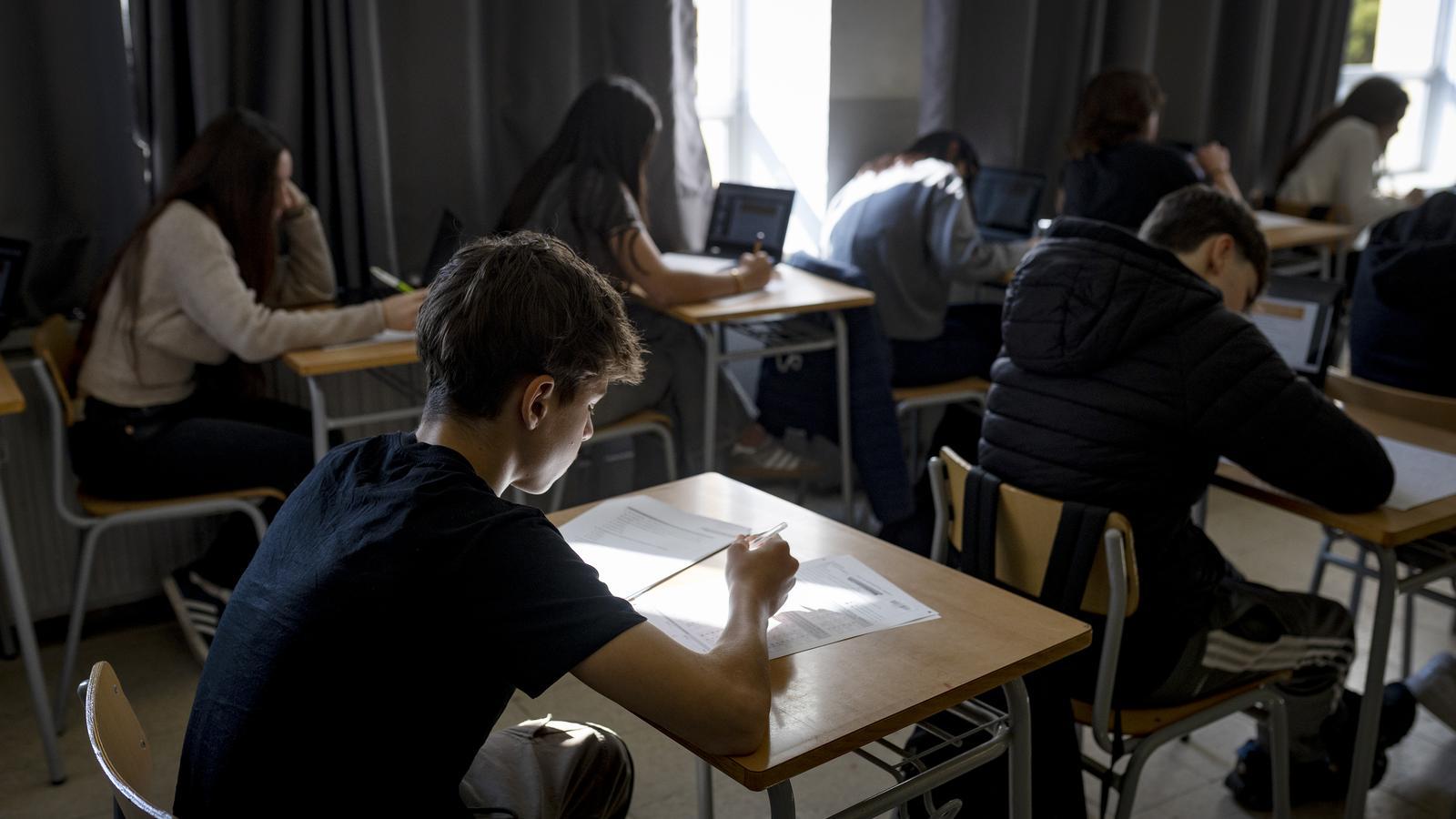
"These are competency-based tests, but it's very important to clarify that they are not tests of basic skills." This was the emphatic statement made this Monday by Núria Planas, director of the Agency for Evaluation and Foresight of Education – formerly the Higher Council for Evaluation – when speaking about the end-of-stage exams that some 4th-year ESO (Compulsory Secondary Education) students began taking this Monday. "These are not the tests from five or six years ago; these are end-of-stage tests that measure three levels of achievement," the mathematician insisted. Planas made these remarks from one of the 69 Catalan secondary schools – whose names will not be disclosed to protect anonymity – that are administering what were traditionally called basic skills tests this week. These tests will not only analyze students' basic knowledge, nor will they be administered in a standardized way. The exams will be taken by 5,700 students and will cover five subjects: Catalan, Spanish, English, mathematics, and science, technology, and engineering. "These are not tests that assess recalling facts or repeating routines or memorization techniques. They are tests that assess the ability to connect and extrapolate content to new and diverse situations," Planas explained. The tests, which premiered this Monday, include questions of basic, medium, and high difficulty levels. In fact, the Agency's director highlighted that "a considerable percentage, close to 20%, of the questions are cognitively demanding and designed to measure excellence." In this regard, Planas asserted that the basic competency tests did not include "items to assess the achievement of excellence." Results in the fall
Once the tests are completed, the evaluation agency will have six months to analyze the results. "We will conduct a mixed data analysis: quantitative and qualitative," Planas specified. In this regard, they have committed to having the results in the fall, not in the summer as was the case until now. "We will move very quickly because six months is a very short time. Keep in mind that PISA takes approximately a year, and the general system evaluation—a new national test—takes about 15 months," Planas explained. Regarding the reason why this year 6th-grade students are not taking the end-of-stage assessment, the Department of Education already explained that students finishing primary school will undergo the general system evaluations; these are new exams defined by the Spanish government that 6th-grade students in all regions must take, and which will also be sample-based (meaning not all schools will take them). In fact, from now on, since the state exams will be held every three years in the 6th grade of primary school and the 4th year of secondary school (ESO), the Catalan end-of-stage assessment will be combined with the state one. Specifically, there will be two years in which students finishing primary or secondary school will take the Catalan exams and one more year in which they will take the state exam. Both the Catalan and state exams will be administered using a sample test, meaning that not all schools and institutes will participate as before. Therefore, the test results will no longer be able to serve as a barometer for schools and families to gauge a student's performance. Planas justified this change by insisting that this information can be obtained from the diagnostic tests (the exams that all 4th grade primary and 2nd year ESO students will take) and assured that "the objective" of the end-of-stage assessment "is to capture a snapshot of the system, not of the school or the student." In this regard, he insisted that the quantity of data should not be confused with scientific evidence, and that with the new system there will be less data, but it will be comparable and can be transformed into scientific evidence. "It's not a matter of quantity but of quality," he concluded.
