The first days of regularization: "Volunteers pay for photocopies and bring the scanner from home"
Social entities and city councils report that they are overwhelmed when processing the vulnerability report
-
CAT -
CAST
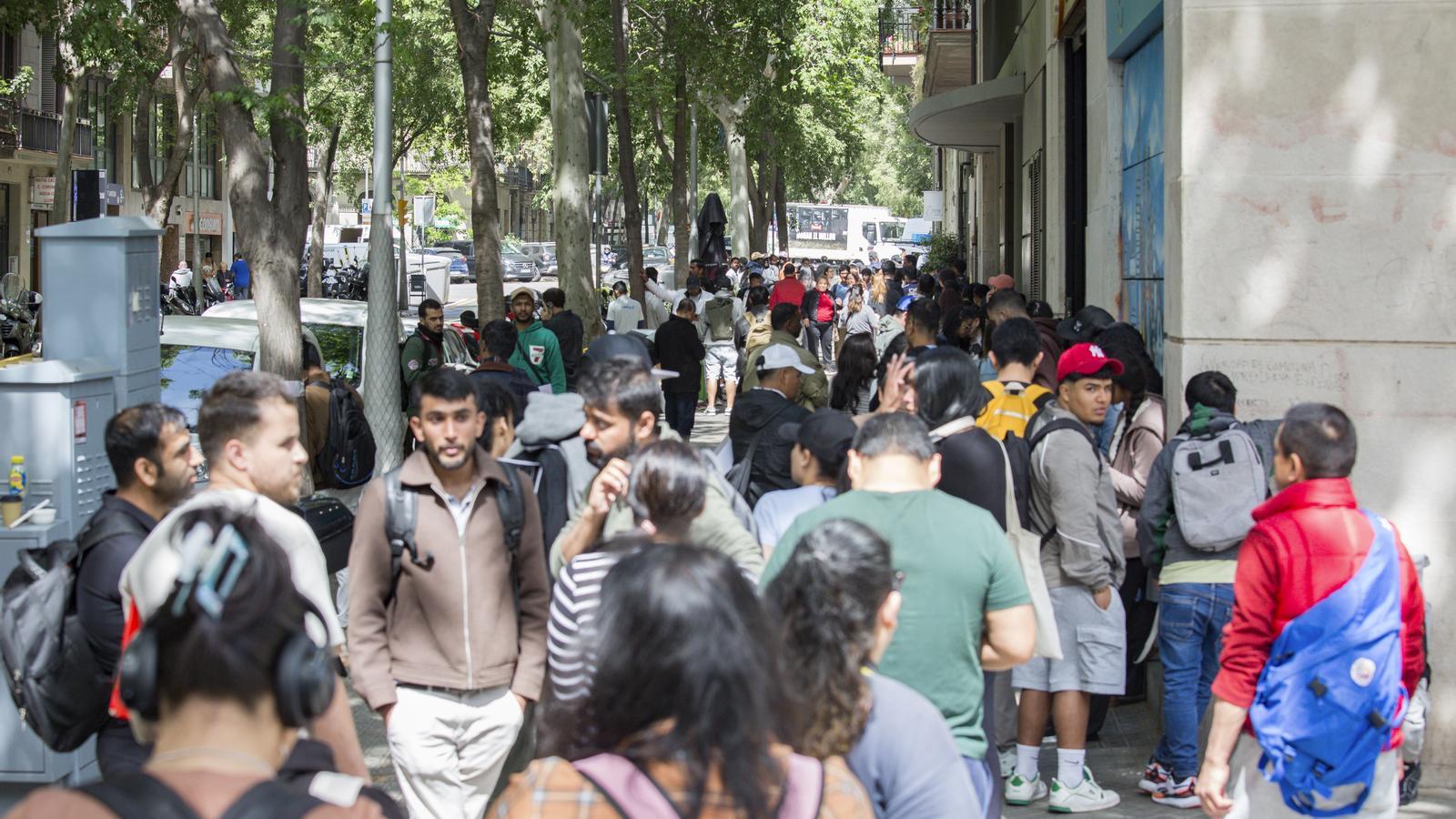
BarcelonaThe balance of the first week of the regularization of the 150,000 migrants living and in many cases working in Catalonia is summarized by 12-hour queues at the doors of town halls and social entities to obtain the vulnerability report and by the consequences of having had to improvise at the last minute to adapt to the definitive wording of the approved instruction. "They say we don't need the vulnerability report or the census, but I know people who then don't have their application accepted," says Elida Rojas, a Bolivian with two children to support.
Rojas waits for her turn in a long line that stretches for almost half a block in the Eixample. "We don't want to miss the opportunity," she says by way of excuse. At the Monumental Citizen Attention Office or the one in Plaça Sant Miquel at Barcelona City Hall, the situation is similar, as is the case with SAIER, the municipal service for migrants and refugees.
In the Florida neighborhood of L'Hospitalet de Llobregat, the two entities collaborating with this extraordinary process are also overwhelmed by the number of people, who, in principle, did not expect this. Mariló Fernández, from the La Fundició foundation, complains that both this entity and the neighborhood association responded to the Spanish government's call for social fabric to get involved to "help with the procedures for the neighborhood's residents who needed it," but that on the eve of the process starting, the government included the vulnerability report requirement.
"We didn't want to do reports and now we've done 2,000 for people arriving at the center desperate for a solution from Igualada, Sant Vicenç dels Horts, Manresa... We can't take it anymore," complains the activist, who criticizes "the little support" that social entities receive from the town halls and the Generalitat.
In La Florida, Fernández assures that the premises have become too small and that ordinary activity has been affected, so they have reserved a space to try to maintain programs for resident families. Volunteers take turns, pay "800 euros for photocopies" out of their own pocket, or have brought a scanner or copier from home.
Shortened hours
In Àmbit Prevenció, an NGO from the La Bordeta neighborhood of Barcelona, they have had to slow down because the first week they didn't stop and "friends, volunteers, and neighbors" could no longer take it, recounts the entity's president, Mercè Meroño. They also assist many people they didn't have on their radar and who are concentrating at the doors in long queues, even at night. The entity has limited its hours to prepare vulnerability reports on Tuesday to Thursday mornings – without an appointment – to continue assisting regular users. For Meroño, the queues are a sign of the "degrading and inhumane treatment" towards migrants by institutions.
At this point, Victoria Columba, spokesperson for Regularización Ya,, the movement that initiated the ILP with the collection of signatures to make this process possible, is very critical. She denounces that, at this stage, people have to queue at night to wait for their turn and that the Barcelona City Council and the Generalitat are not acting as they did with the arrival of 250,000 Ukrainians fleeing the war to obtain a special and express residence permit. "That process was done in an orderly manner, you didn't see Ukrainians crying in queues and everyone was quickly attended to in designated centers, like the one at Fira", she recalls. In contrast, those who now want to regularize their situation are finding nothing but contempt for their situation which – she assures – serves to fuel xenophobic discourse and the far-right. "The administrations have not been up to the task", she concludes.
Although there have been criticisms for the lack of specificity in the Spanish government's instruction, for Columba "everything is clear" and that social services demand "the registry or the vulnerability report" are The requirement of the town councils to issue reports only to their residents makes the process difficult for those who cannot prove residency because they rent, the owner refuses to register them, or they live on the street. Furthermore, some town councils do not register individuals without a fixed address. In the social services of the Tordera City Council, they have chosen not to ask for the registry, following the letter of the instruction to favor the right to regularization for the maximum number of people. Carlos Hidalgo is the head of the service and regarding the improvisation of the first days, he states that the General Directorate of Migration of the Generalitat itself had problems resolving doubts about who signs the official documentation in the training courses given to municipal officials.
Hidalgo's complaint focuses largely on the fact that the Spanish government has not taken into account the experience and criteria of the College of Social Work of Catalonia, the professionals who are "on the front lines". A colleague of his from another town council criticizes that the teams have not been reinforced, already very strained by the management of other procedures.
The participation of entities in the process is non-profit, with the desire to lend a hand to the people they already assist. The Ministry of Inclusion has authorized dozens of associations to process all the required documentation through the Mercurio platform. The problem lies, on the one hand, in how the urgency has made them concentrate efforts on vulnerability reports and, on the other, in the inexperience of a large part of the associations, which have signed up with all good intentions and have had to organize themselves as best they can, agree the consulted professionals.
In day-to-day operations, the entities have encountered the fact that to use Mercurio, one had to have the digital certificate, but not that of the entity, but the personal one. "The volunteers have had to download the certificate to our computers to be able to carry out the procedures," states Meroño.
