Nights on the street and kilometer-long queues in Barcelona: reproaches to Collboni for the management of the regularization
Bars and neighbours complain about the intensive use of the street around the municipal office where procedures are carried out
-
CAT -
CAST
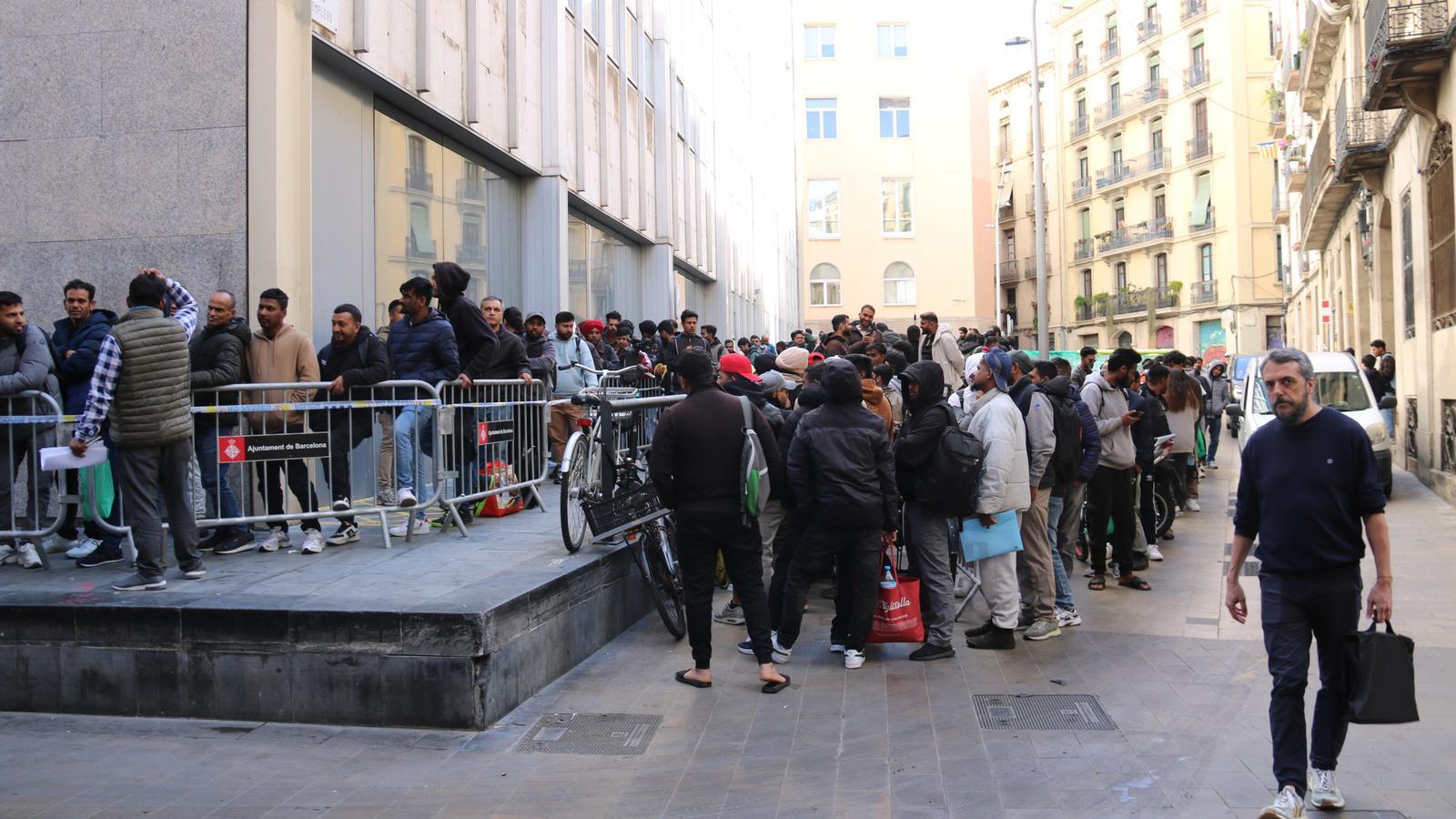
BarcelonaThe queues to carry out the procedures for the extraordinary regularization of migrants are not subsiding. Around the Citizen Attention Office (OAC) in Plaça de Sant Miquel in Barcelona, next to the City Hall, dozens of people are waiting this Friday with their sleeping bags after spending the night on the street to get the necessary documentation as soon as possible to complete the process of obtaining residence and a work permit in order. The line, up to a kilometer long, passes behind the consistory and winds through Carrer dels Templers and Plaça de Sant Jaume. Most people are carrying folders with documentation, as well as bags with food and water, prepared to spend hours there until their turn comes.
All this is happening so close to Barcelona City Hall that it was almost inevitable that the long lines would interrupt the start of the municipal plenary session. Several groups have criticized this Friday the management that Jaume Collboni's government is doing of the extraordinary regularization process for migrants and, in this regard, the president of Junts, Jordi Martí, has asked for the floor to express "concern" about the queues, which have also caused complaints from residents, drivers, and shopkeepers, especially regarding the intensive use of the bars' restrooms in the area.

In fact, the images of long waits have coincided with the fact that the OAC in Plaça Sant Miquel has allowed the vulnerability report to be requested without an appointment since this Friday, according to ACN. Thus, images similar to those already seen at the Service for Attention to Immigrants, Emigrants and Refugees (SAIER) have been repeated, the first municipal space that was enabled this Wednesday to attend without an appointment those citizens who need the registration certificates or the vulnerability report for regularization procedures.
Martí has described the situation as "indignifying," both for the people queuing and for the professionals and officials. The councilors explain that they had already requested some time ago to create a coordination table to monitor services and advice and procedures, but this table has not been convened until May 7, and the process began on April 16. "They couldn't have done worse," said councilor Joan Rodríguez.
Facility at the old Miquel Bleach School
The municipal government has accepted a request registered by Comuns for the municipal government to "urgently establish an attention and support service" while the process lasts. The group requested a facility with high capacity and easy access, with in-person attention by appointment and walk-in. It also demanded that all necessary municipal resources be allocated to it, including attention to people without an open file, to avoid "collapses and delays." Finally, the council will open the old Miquel Bleach School "specifically to provide this service."
On the other hand, the PP has a proposal in which it asks to urge the Spanish government to withdraw the regularization royal decree "due to a lack of necessary control mechanisms." The proposal, however, only had the support of the Popular Party and Vox and, therefore, was not approved. The far-right group Vox plans to ask what estimate the municipal government makes of the total number of people who could be regularized in Barcelona, although they have asked for toilets to be provided so that those queuing have somewhere to go.
The majority of the groups have agreed to request more resources and foresight to prevent images like the one seen this Friday morning just outside the council from being repeated. In response to the complaints, Mayor Collboni defended that he finds it "understandable" that there are more people queuing to carry out procedures in the first few days, and he called for putting oneself "in the place of these people who have been in very complicated personal and family circumstances for a long time and who, due to this anguish, are in a hurry." Nevertheless, he also insisted on asking for "calm," as the procedure can be done until June 30, and indicated that in the coming days the City Council will evaluate whether it is necessary to reinforce services, so that "no one is left unattended."
The deputy mayor for Social Rights, Raquel Gil, defended that the municipal government has made "provisions" and indicated that at the beginning of this week more than 80,000 certificates and residency proofs had already been issued in Barcelona. She also recalled that documentation can be obtained through 010 and the municipal website, and pointed out that the council works with various itineraries depending on whether people are already users of public services or not.
