The August eclipse will be "the perfect storm" to collapse Catalan roads
The usual full summer tourism plus occasional visitors due to the meteorological phenomenon threaten to saturate the south of the country

-
CAT -
CAST
TarragonaThe solar eclipse on August 12, which will last one minute, will be a spectacle of nature but will also bring great risks in terms of crowds of curious onlookers. Both the public administration, which has already got down to work, and citizens will have to organize themselves in advance to prevent the day from turning into a chaotic one. “It will be the perfect storm,” warned Josep Maria Arauzo this morning, a professor of economics at the Universitat Rovira i Virgili (URV) and a specialist in economic structure in Camp de Tarragona, who cited the possibility of mobile phone service failing as an example. The regions of Lleida and Tarragona, especially in Terres de l'Ebre, will be a privileged place from which to enjoy the spectacle, but the avalanche of visitors requires extreme safety measures.
Large crowds are expected on the AP7, which could easily become congested that day, but what is more concerning are the secondary roads, less known to drivers and more difficult for emergency services to manage. The Government has already announced up to 20 observation points (such as El Vendrell, Lleida, Tarragona, or Amposta) that will be prepared for viewing the eclipse. These are municipalities where a considerable number of people can gather and where it will be easier to manage the massive arrival of tourists. Parking will be provided in these areas, approved glasses will be given to attendees, and emergency services can be deployed. However, many people who want to enjoy the eclipse will go to their chosen locations on their own, which complicates safety. It is estimated that this August, in the areas of Spain from which the eclipse will be visible, there will be a total of ten million more tourists than there would be in a normal summer, and it is very likely that a large part of this crowd will focus on Tarragona, where the sky is usually clearer than in Galicia, which is another of the locations from which the phenomenon can be seen. “There is a risk of illegal camping and there will be bottlenecks, all with the usual summer fire risk,” explained Arauzo, who predicted that “difficult and unpopular decisions will have to be made”, such as closing access to roads or small towns. “It will be a very important task for the administration to determine where people can go and where they cannot,” he said.
Faced with this situation, experts are asking to limit mobility as much as possible and recommend that if the astronomical phenomenon can be seen from home, it is better to stay there. Those who are not so lucky can go to the municipalities chosen by the Generalitat, and those who want to go on their own should consider that they may find blocked roads —the closed accesses will be made public later— or that the chosen place may not be good enough because the eclipse will be around 8:30 p.m., shortly before sunset, and it is possible that a mountain will block it. On May 1st, the sun will be in the same position as on August 12th, so it is a good day to check if the chosen place is suitable or not. The days following May 1st will also be valid for testing.

Losing vision
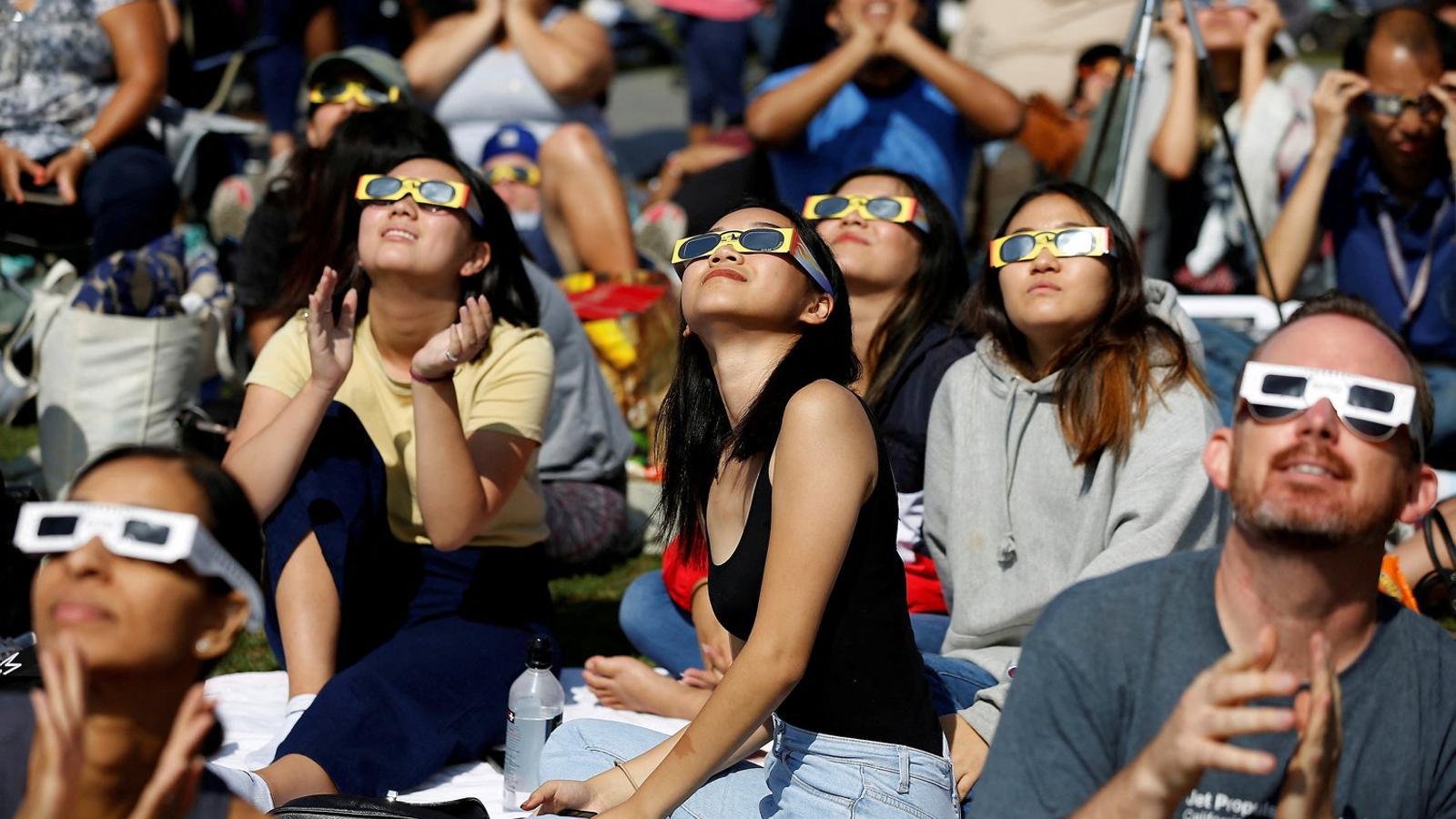
Another risk that the eclipse will entail is losing vision. “In all eclipses there are people who lose their vision”, has warned Pere Romero, ophthalmologist and titular professor at the URV. Romero has warned that the only glasses that are not dangerous are the approved ones that comply with the ISO 12312-2 standard. Any alternative will be a bad idea. No type of sunglasses works, and the strategy of looking at intervals is counterproductive and can be even worse for your health. The risk of burning the central part of the retina is really high. Romero has explained that “loss of vision occurs two hours after” looking at the Sun and can cause vision problems in both eyes for six months. In some cases, vision can be lost directly, but it mostly returns, albeit after half a year. Romero has warned that young people are the ones at most risk and has asked the public administration to strengthen the ophthalmological emergency service in the days following the eclipse.
