The value of knowledge sticks to the 'chill' Spanish exam of the PAU
The teachers' strike, which coincides with the Pope's visit, has had a 10% follow-through

-
CAT -
CAST
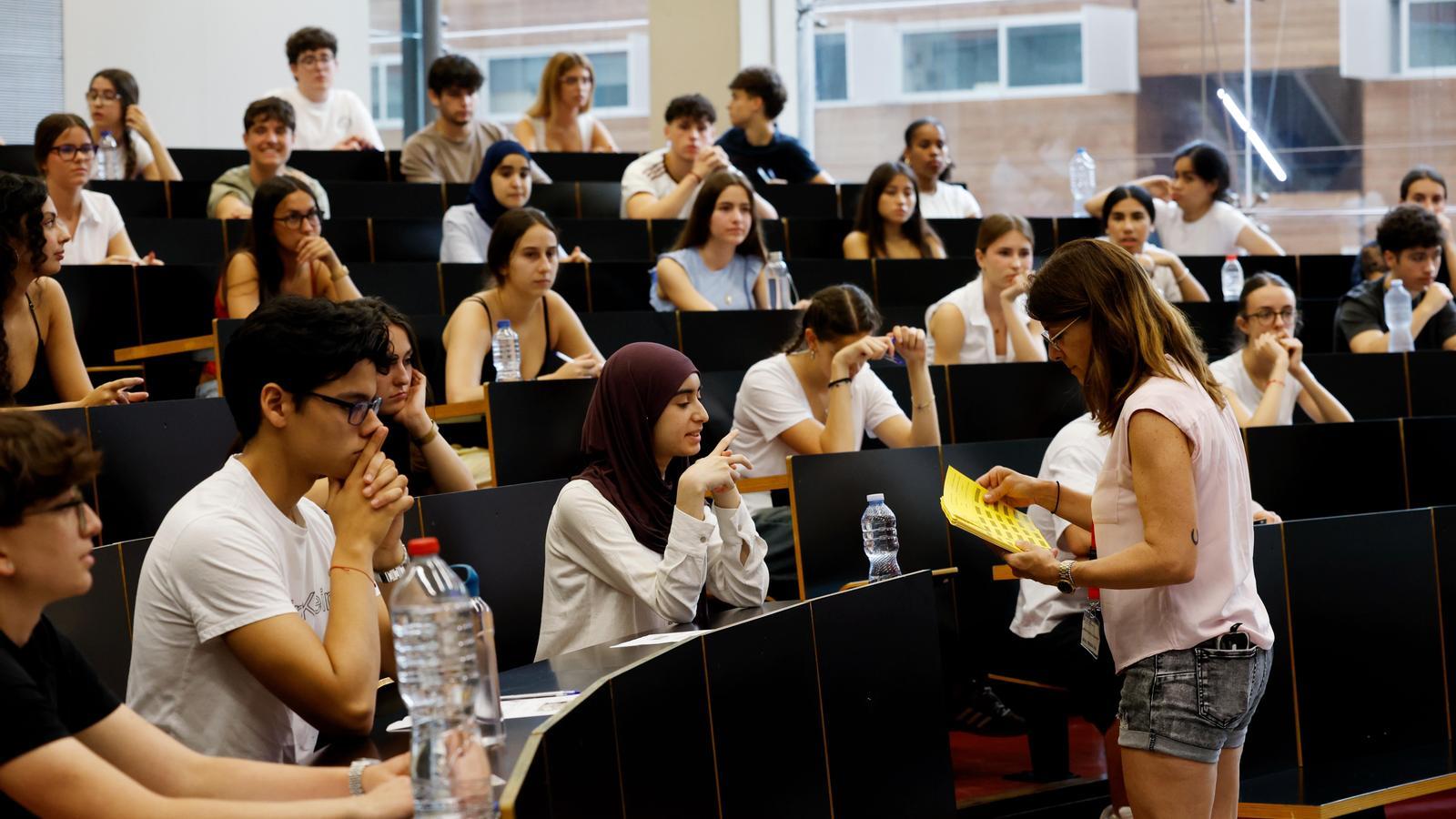
BarcelonaJoy and some relief at the end of the first PAU exam of this 2026. After the pressure of whether reaching the tests would be complicated due to mobility restrictions for the Pope's visit and the teachers' strike, most students have come out satisfied from the Spanish language and literature exam. "It was very chill —easy to pass—", one of the students taking the selectivity at UPF replied to her teacher. An exam in which reading comprehension was based on the adaptation of the text The Utility of the Useless. Manifesto, in which the Italian philosopher Nuccio Ordine reflects on how in recent decades humanities have been considered "useless", even in state budgets.
Also noteworthy was one of the exercises in which adolescents had to relate statements with types of linguistic prejudices. In this section there were phrases such as "If only a few tens of thousands of people speak that language, it must be for a reason" or "What they speak in my grandmother's village is not a language, it's a poorly spoken dialect".
On the other hand, in the written expression section, students were asked to reflect in a maximum of 150 words on the value that current society places on culture and knowledge. Students had to talk about its usefulness in relation to the economy or its role in the "formation of people".
Regarding literary knowledge, students had to work with the poem Gloria's Explanatory Letter, in which, faced with any setback, the poet Gloria Fuertes writes: "They pay me and I write, they hit me and I write, they stop looking at me and I write, I see the person I love most with someone else and I write, alone in the room, I've been here for centuries, and I write, I make them laugh and I write", says a fragment of the letter. In addition, students also found the poem "In the Beginning, by Blas de Otero in the exam.
Marta, Paola, and Àxel, from the public institute Thalassa de Montgat, also surprisingly celebrated that the linguistic section questions were multiple-choice. "We didn't expect it and at first I was scared, but then I think it made it easier for us", admitted Paola, and Marta said that the test organizers "behaved very well".
In fact, unlike other editions, this year almost all of the linguistic reflection part consisted of multiple-choice questions or sentences to be completed, with the exception of the last one. In this one, students had to determine which diatopic (dialectal) variety of Spanish a text with sentences like "Vengah, noh vemoh prontico". The answer is that it is the Murcian variety, of Southern Spanish.
Should less homework be assigned? The doubt in English
In the English exam – taken by the majority of students (98.76%) – the trend has been similar, with several students leaving happy and saying it had been easy, despite some doubts with the listening, which was about the music group Gotcha. Regarding the reading, there was a text about umami and the proposition of whether a sixth basic taste should be created. Finally, in the writingThese are the first selectivity tests in which mobile detectors to prevent students from cheatingbitcoins hard work is no longer a guarantee of a good future.
In the afternoon, it was the turn for the elective subjects of choir and vocal technique, physics, artistic foundations, geology and environmental sciences, dramatic literature, and geography. In the latter, one of the main topics students had to address was the impact of immigration. Among other things, they had to identify on a map the communities with a "clearly high" presence of foreign population. Additionally, in one of the exercises, they had to list three positive impacts of the foreign population or explain the relationship between the proportion of foreign population in an area and the economic activity that takes place there.

No incidents with the detectors
These are the first selectivity tests in which mobile detectors are used to prevent students from cheating mobile detectors to prevent students from cheating. "[The invigilators] can enter at any time," explained Rosa Cerarols, president of one of the PAU tribunals at Pompeu Fabra University (UPF), early this morning. "Everything has to go well, but there is this element of security," Cerarols said to reassure the examinees, adding that an "random" person would be making a tour of the classrooms looking for devices. For now, UPF has no record of any problems in this regard.
The first day of the selectivity was marked by mobility restrictions caused by the arrival of Pope Leo XIV in Barcelona and by a new call for a strike by teachers throughout the country. In this regard, Cerarols explained that there had been no incidents: "All students were very punctual and many were already there at half past seven in the morning," she admitted.

Click the 'Poppy'
This Tuesday, Catalonia is also experiencing a new day of teacher strikes, which it was already warned would avoid interfering with the PAU exams. However, the turnout for this strike –the seventh of the course– has been much lower than for recent calls. This Tuesday, according to the Department of Education, 10% of teachers have stopped working, while last Friday the turnout was 30%, and in the protests in March it rose to 50%.
Regarding the demonstration held in Barcelona, the Guàrdia Urbana estimates that 6,500 teachers attended, while the organizing unions claim there were around 45,000 demonstrators at the mobilization that ended at the Parliament. The spokesperson for USTEC, Iolanda Segura, explained that this has been the last strike of this school year and said that now, after the "no" to the agreement with Education, the union will open a deliberation process to establish concrete objectives on how to continue the protest.
From CGT, the only union at the table that defended the "no" to the agreement with the Government, Isarn Pardes has once again demanded the dismissal of the counselor Esther Niubó because "she has not known how to handle the educational crisis." He also agreed with Segura on the need for a debate on how and when the struggle driven by the teaching movement should continue.
