José Manuel Fernández de Labastida: "Spain will have to debate how it scientifically prepares for wars"
Director of the State Research Agency (AEI)
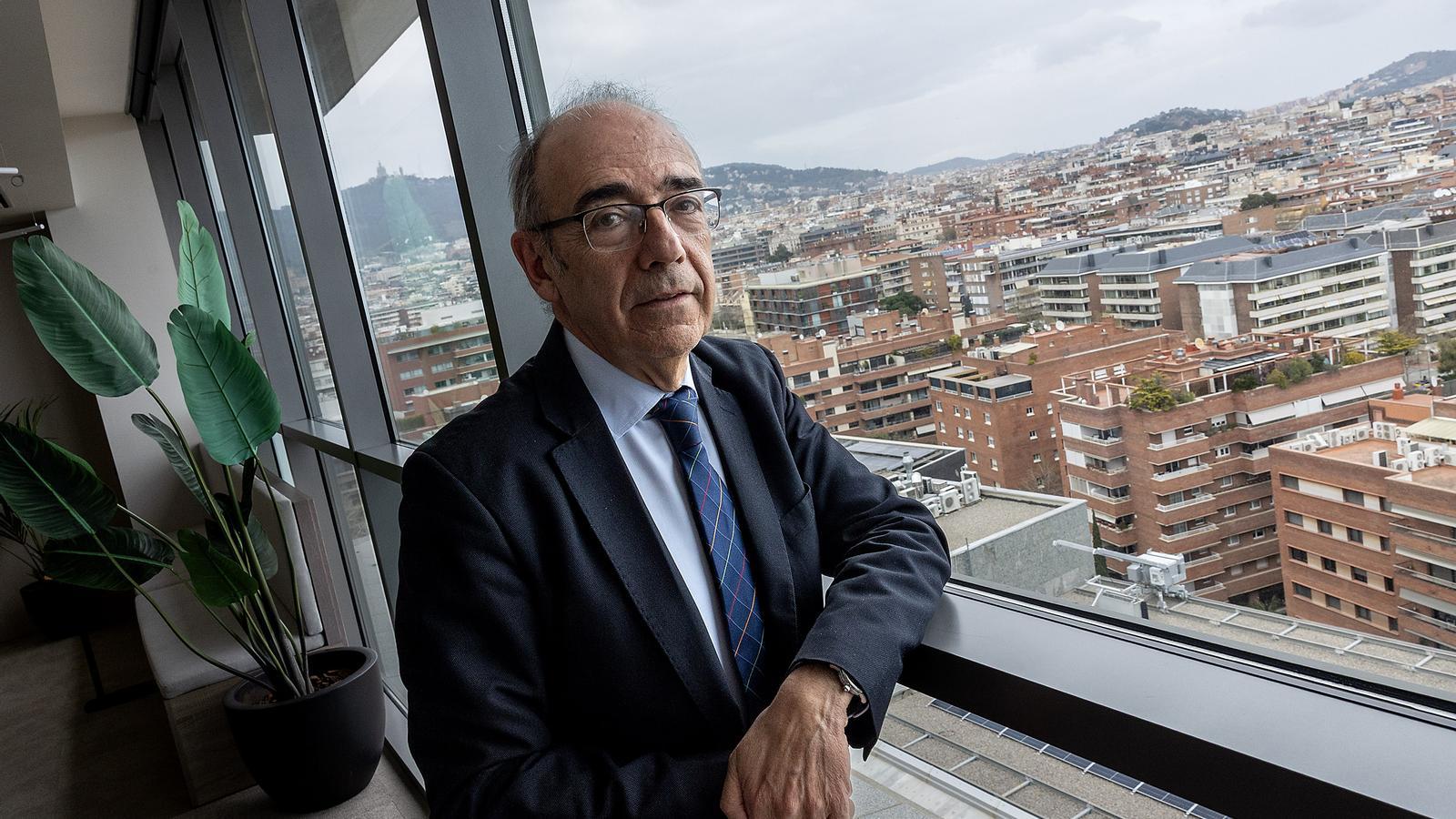

BarcelonaJosé Manuel Fernández de Labastida directs the State Research Agency (AEI), a key institution for planning the resources allocated to scientific and technical research in Spain. In addition to having directed departments in high-level advisory bodies such as the European Research Council (ERC), he has also been Secretary General for Scientific and Technological Policy of the Spanish government and Vice President for Scientific and Technical Research at the Spanish National Research Council (CSIC).
¿Is high-level science being done in Spain?
— We do high-level and high-impact science. It could be better, but we have reached levels that, while we are not yet at the forefront of Europe, bring us closer to the highest average. This can be seen in the number of scientific publications generated and the impact measured in bibliometric terms, such as publications that are among the top 10% or 1% most cited. In this regard, Spain has maintained a very reasonable level in a context where many other countries have been declining, especially due to the impact of research in China. This confirms that the science we do has more value and more impact.
In which fields does the research carried out in the State excel?
— There are a number of fields in which we participate with leading groups, especially in Europe, such as physics and astrophysics; in social sciences, Spain stands out in the European context, along with the United Kingdom and France, and globally behind the United States, in economics. To give an example, in one of the most competitive frameworks we have for obtaining funding, which is the European Research Council, we have researchers who submit research proposals to the most competitive calls and Spain has approximately between 12 and 15% of the grants [scholarships for frontier research]. Anything above 8% in Spain, when we compare ourselves with the countries of the European Union, means excelling. We also have leading research in the biomedical field, especially in Catalonia.
What is the state of scientific funding in Spain?
— We are not yet where we would like to be. The most recent data from the National Statistics Institute (INE), from 2024, shows an investment of 1.5% of the gross domestic product (GDP). We would like to be closer to the European average, which is 2.2%, and this is a national objective outlined in the reform of the science law in 2022. But we must also look at where we come from. Compared to the figures from 2014, investment from both the public and private sectors has practically doubled, reaching around 24 billion euros. If one looks at this evolution in detail, they will see a significant increase from 2018 and 2019, with a greater commitment in the general state budgets, but also from the autonomous communities. European New Generation funds have also helped us a lot. However, our GDP is now soaring in growth, and when measured in relative terms, we remain at this 1.5%.
But only public investment is close to the European average, private investment is still far behind.
— When analyzing private and public investment, we see how 10 years ago the proportions were more or less identical (45%). Now private investment has grown and we are at 50-60%. Little by little, we are approaching the European proportion, which is 70-20%. I believe the change began 10 or 15 years ago. Now there are more and more researchers in the public sphere who are very open to private collaboration, and of course there is a private sector and many technology-based companies knocking on the door, not only small companies but also large ones, to carry out joint research and development. State and regional policies have been very important in this change. CDIs [agreements to avoid double taxation] have played a fundamental role in encouraging companies to invest in innovation.
Is there a common front with the 27 Europeans in this direction?
— Yes. One of the goals foreseen in the Framework program is to encourage more companies to join R&D. Spanish companies compete well hand in hand with the public sector, but many times on their own. Spain's returns are increasingly significant. Working in Brussels, the French and Italians have very often asked me what the magic is for Spain to achieve so many returns, to attract more and more resources. This is already unstoppable. We have a long way to go, and we must say that our productive industrial fabric is what it is. We are not Germany or the United Kingdom. A large part of our economy is services.
The Spanish government has taken a specific political stance on recent military conflicts, but do you think the country should strengthen itself scientifically in defense?
— One of the things that Europe has on the table is that not only civil research is carried out, but also a large part of the budget is opened up to so-called dual research, that is, research that could have a military use. And this is related to the geopolitical situation, in Iran and in the United States, and to the commitment to have greater strategic autonomy and more defense capability. This has been identified as an important area to also consider in European funding for the period 2028-2034, which will have an impact on all countries. Also in Spain, which will have to debate how it scientifically prepares for the more classic war, but also for commercial war.
Let's talk about risk culture in science. There are countries with greater ease in financing projects assuming they might fail, but in Spain, it is more conservative. Is there room for change?
— There is still less of a risk culture in the State, especially among investors, but it is a major European handicap compared to the United States. We are all digesting the Draghi and Letta reports, where these aspects are pointed out as weaknesses of the system and efforts are being made for the next Framework program [currently under discussion] to help the private sector take more risks from the public sector. There is a proposal to create a competitiveness fund, and important steps have been taken with the creation of the European Innovation Council. We must share the risk with public funds, but not solely.
Looking at the regional map of science, are there two Spains operating at different speeds?
— There are different speeds in the Spanish science and innovation system. The first serious regional policy in research and innovation was born in Catalonia 25 years ago, and there is still a commitment that has been maintained for many years. It is by far the community with the greatest level of science and the highest level of innovation. All European indicators say so. It is comparable to many regions in Europe because there has been a clear policy. Regional initiative is fundamental to change this map. The communities that have invested the most had a base in a more industrial, more competitive sector. The Basque Country also started about 25 years ago. Madrid's role is more complex because it has a large part that is state-owned, research centers, but it is also a pole of attraction for many researchers and innovative companies. What needs to be done? Encourage with state policies, along with regional policies. We know what model works: you just have to look at Catalonia or the Basque Country. And this is happening. In Galicia there has been significant growth in recent years and the fruits are beginning to be seen.

How are research funds allocated?
— With the science law, the public funds usage planning mechanism is very structured. We have what is called the Spanish Strategy for Science, Technology and Innovation as a key element, which is also synchronized with the Framework Programme and has a duration of 7 years. The Ministry of Science has launched working groups to start discussing the 2028-2034 strategy, which includes programs ranging from human resources and research to projects, strengthening institutions, equipment, and boosting business innovation. The instruments that the State has are the State Research Agency, the Centre for the Development of Industrial Technology (CDTI), and the Carlos III Health Institute for the biosanitary field. It is also very well defined at the European level, and fortunately, they have a budgetary umbrella, which we do not. And then there is the regional level.
But researchers complain of excessive bureaucracy to access and spend these funds.
— Day-to-day is complicated. They receive European funds, from the state agency, from the communities, and each one has its peculiarities. In Europe, winds of simplification are blowing, as we see in the latest calls for aid from the Framework Programme, and from the agency, we have to get on this bandwagon. We are already taking an important leap to simplify the justification of aid. It is true that we have complicated border conditions that at some point would have to be addressed, but this is already at a more general level, with a subsidies law.
Without budgets, public universities are suffocating, but the scientific model here relies heavily on them. And, at the same time, a lack of knowledge transfer is criticized.
— A call must be made to the autonomous communities, because they are responsible for university funding, and this must be more strategic, not fundamentally based on teaching or student criteria, but on research. We have a very important conjunctural opportunity and that is that a generational change will be needed. That is to say, many professors will retire in the next 5 or 10 years and the ideal would be to be able to fill these positions with the best researchers from anywhere in the world. It is true that there are communities that have identified this opportunity, such as Catalonia, which is trying to create programs to attract the best possible talent.
What problem do we have that so many top researchers we would like do not arrive?
— There is always room for improvement, but I believe important steps are being taken. To import talent, we need to offer attractive conditions, not just in terms of remuneration or social aspects, but attractive contexts for conducting research. That is, equipment and infrastructure, the possibility of obtaining research resources, having postdocs, students... There is a whole context that must be nurtured to be attractive. Catalonia has been able to attract many highly talented researchers from all over the world to try to create the conditions.
But are we attractive enough?
— Well, I think so, and I will refer to data. We have the Ramón y Cajal program, which is for those researchers who are in their intermediate career, and we attract many researchers from Europe and other parts of the world. We have another program for Seniors, called Atrae, and we have applications from all over the world and of a very high level. We have just resolved the last call and will provide aid to universities and research centers to hire a total of 37 researchers, 21 of whom come from the United States. And no, they are not Spaniards or French people who want to return: of the 21, 15 have North American nationality. We are attracting people who have done their entire careers and were born in the United States. And we are also attractive because we have created many high-level research niches and attractive conditions. Can we do better? Can we put more resources? I insist: dedicating 1.5% of GDP to research should make us blush a little, it is very low, but we must also continue to advance in improving the indicator, and I believe there is political will to do so.
