Parlon, open to banning passengers from traveling standing on interurban buses
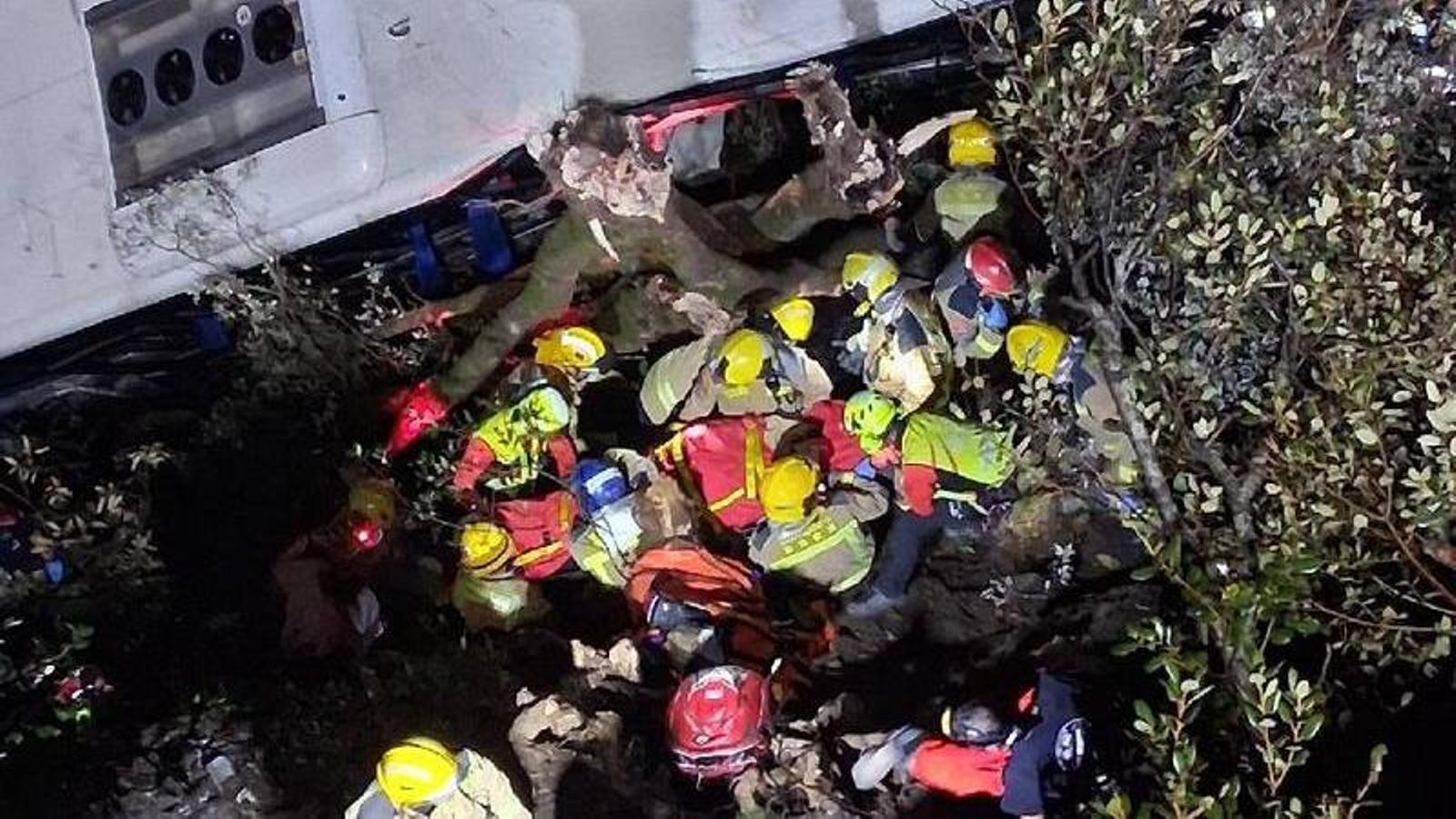
The firefighters rule out that there are more victims in Fogars de Montclús once the bus has been removed, and there are still about thirty admitted to hospital

-
CAT -
CAST
BarcelonaThe regulations allow it for certain vehicle models, and increasing demand makes it happen often: many passengers who take intercity buses habitually travel standing up. It also happened on Sunday, in the accident of the Sagalés bus in Fogars de Montclús, in the Montseny, which has already left at least 83 injured, twelve of whom are in serious condition. A balance that was closed this Monday evening after the Firefighters were able to remove the vehicle and have ruled out that the accident has caused more victims.
The fact that many passengers were traveling standing up has led the Minister of Interior, Núria Parlon, to open the door this Monday to modifying the regulations to prevent users from standing on intercity buses, especially on mountain roads. "This is not illegal, and now we should really see if this should not be changed," she stated in an interview on RAC1.
According to sources consulted by the ARA and the manufacturer's data, this bus model allows, in its version with the highest capacity, about sixty seated places and several more standing. But to specify exactly what the total capacity (seated and standing) of the crashed bus was, it would be necessary to know the technical sheet or the MOT of this specific vehicle and version. There is also no list or register of the people who were exactly on board, as is usual in this means of transport. At the moment, the Mossos d'Esquadra are investigating whether more standing passengers were traveling on the bus than would be allowed.
What is known so far is that at least 83 people were traveling on it: those who have been rescued and attended to by emergency services. However, sources consulted by this newspaper state that about ninety people were traveling in the vehicle. Many, therefore, were effectively making the journey standing up. Parlon has defended that the regulations must be studied well to reduce risks: "Passengers on intercity routes, and even more so on mountain roads, perhaps should go seated," she suggested. The minister also specified that this review could also affect lines such as those connecting the Maresme with Barcelona.
Guaranteeing the supply
The bus employers' association, Fecav, recalls that the regulation allowing passengers to stand in interurban vehicles "is a European regulation" and assures that it will comply with any changes. "The sector follows what is set by public administrations and, in this sense, if the regulation changes, we will comply with it," the association's spokespersons assure ARA. At the same time, they recall that "if the number of seats is reduced, it will be necessary to expand the offer with more seated places, that is, with greater bus frequency, to continue guaranteeing the service," they point out. Currently, the regulation only requires passengers on coaches making excursions or leisure tourist activities to be completely seated and buckled up.
"What we have to face is that more and more people are traveling by public transport, by bus, and that more and more people are traveling standing up on interurban buses. It happens between Barcelona and the two Vallès regions, in Maresme, in Mataró and in Vilassar, all of them carry people standing," warns the director of the Terminus Transport Studies Center, Joan Carles Salmerón, who advises that services must be redesigned to keep up. "On Sunday there were a lot of people from Montseny. We must be prepared. Administrations and operators must foresee more vehicles and better conditions because it will be necessary to offer more services," stresses Salmerón.
This is also defended by the association for the Promotion of Public Transport (PTP), which assures that there are "many lines" of buses where passengers travel standing, especially in Maresme, Penedès, and Baix Empordà. Regarding the possible ban, the president of the PTP, Carles Garcia, has warned in statements to the ACN that this "is not the solution if the service is not reinforced first."
"It is almost a miracle"
The minister has thanked the emergency services for their work and described it as a "miracle" that there were no fatalities. Sunday's accident in Fogars occurred in the afternoon, when the bus fell down a 20-meter embankment, for reasons that are still being investigated. On board were many people who were returning home after spending the day in Montseny. The driver tested negative for alcohol and drugs.
This Monday, around 7:45 PM, the Fire Department reported that, once the vehicle was secured, the extraction maneuver was completed and cranes were able to remove the bus from the scene of the accident. Afterwards, the personnel were able to inspect the ground that the lower part of the vehicle had occupied and were able to rule out the presence of more people. In total, there are twelve passengers from the crashed bus in serious condition and about thirty people admitted to the hospital, according to the latest report from the Department of Health. Among those admitted, there is one patient in very serious condition and eight people in the Intensive Care Unit, two of whom are minors.
