Kidnap and beat up for a drug debt: a rising method in Europe
In the last year several similar cases have been registered in Spain, Portugal, Italy or the Netherlands

-
CAT -
CAST
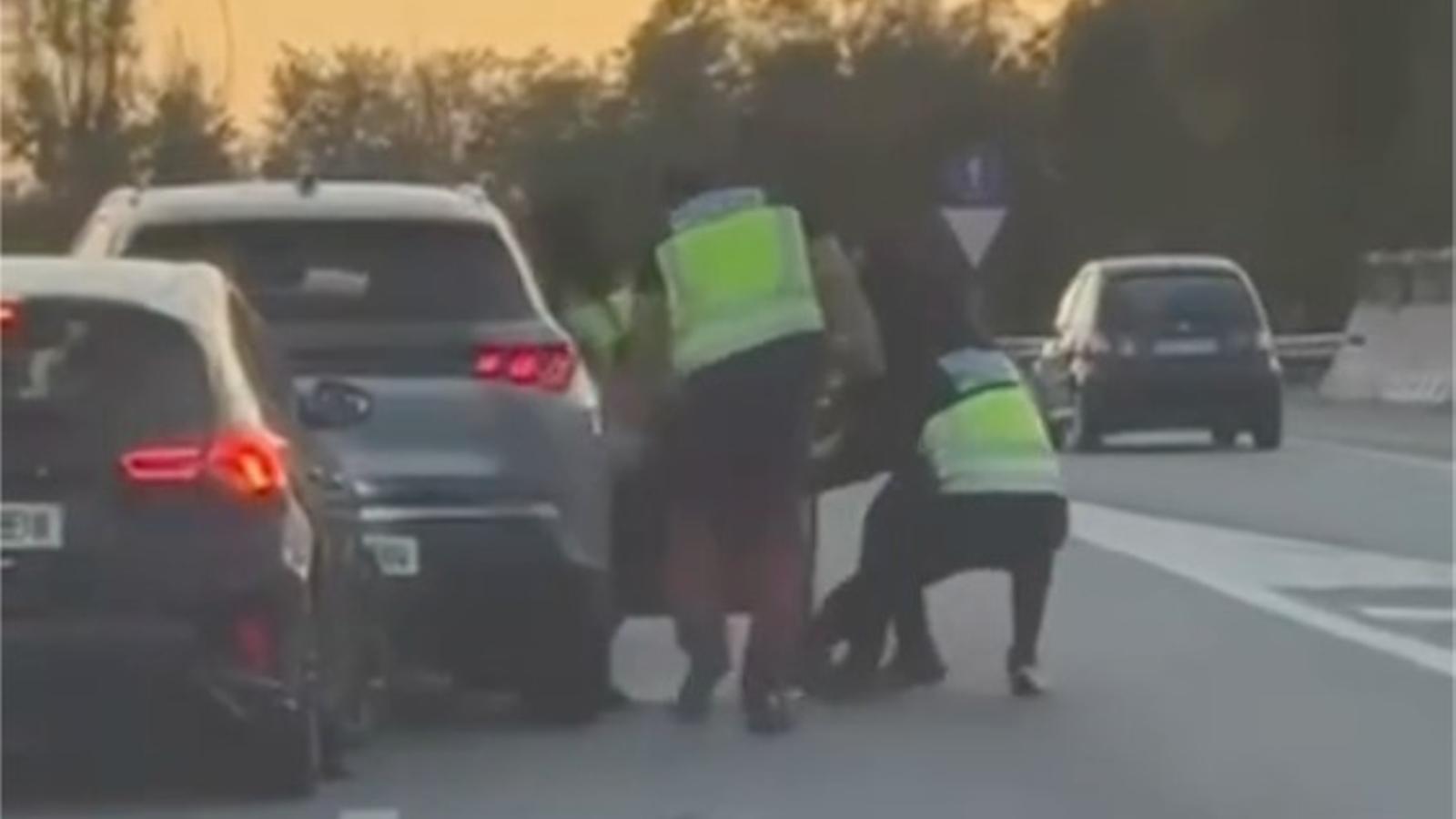
Barcelona"If you don't help us, we will kill you. Do you know what it's like to be a gangster? We will cut off both your hands so they can make an ear out of them." It is November 15, 2022, and alleged members of the Casuals, the criminal group that was born from the Boixos Nois, held a man in a house after kidnapping him by force and putting him inside a car. He was a friend of a caretaker of a marijuana plantation who owed money to the feared Casuals. They tied him up in a house and threatened him: "Nobody plays with the Boixos Nois," they warned him. Finally, they released him and this illegal detention was one of the starting points of a judicial macro-case by the Mossos d'Esquadra against the Casuals.Last Saturday afternoon some men dressed as police officers kidnapped another man in the middle of the AP-7, in front of the gaze of many drivers who witnessed how they pulled him out by force, assaulted him and took him away. Later, they released him a few kilometers further on. Apart from coinciding in the method, this last illegal detention also coincides with that of the Casuals because everything points to it being related to a marijuana plantation that the victim was supposedly guarding and that the police discovered in 2025. On Monday, a man was also kidnapped in Barcelona, beaten up and left at liberty next to a gas station in Salt.
It may seem like a movie, but police sources state that these techniques have been part of the dynamics of criminal groups for years, usually to intimidate and threaten a member or collaborator of the group when they have a financial debt or have done something wrong. The problem, the same sources relate, is that lately they had not detected cases that were carried out so unashamedly, in broad daylight and ignoring witnesses, as in the case of the AP-7. During 2026, eight cases of kidnappings or illegal detentions linked to organized crime have been registered in Catalonia, the last three concentrated in fifteen days. Police sources, however, also admit that there is a dark figure of complaints, since the victims are usually involved in crimes and do not usually go to the police.
In Catalonia they already shot a motorcyclist at the beginning of the month in Gavà and kidnapped him for a few hours, an event that is also linked to drug trafficking. It is, however, a Spanish and also European dynamic. One only needs to remember that on June 8 in Almeria a man was held and beaten for two hours by drug traffickers for a drug debt. Or in Ourense, a few days later, a man was locked in a home for more than 48 hours, receiving beatings and threats with a chainsaw to pay a 500 euro debt linked to cocaine.
Italy, Scotland, the Netherlands and Portugal
This week, in Rome, it was also reported that a Colombian citizen was tied up by his hands and feet for seven hours, threatened with a gun, and wounded with bladed weapons in two different apartments before being forced to hand over money and jewelry to pay off, once again, a drug debt, according to the initial police hypotheses gathered by Italian media. And a few days earlier in the same Italian capital, another trafficker was immobilized, beaten, and locked up after several doses of crack that he had under surveillance went missing. And without leaving Italy, also this September in Bologna, a worker was captured as he was leaving work and was held overnight in a rural house over a drug debt of 26,000 euros.

This type of intimidation has also reached Scotland, where this March a man was tortured for about twelve hours due to a drug debt. Also in the Netherlands, a month earlier, a 37-year-old Spaniard was violently captured in a parking lot, transferred to another vehicle and kept for ten days in a storage room and later in an apartment, where he was beaten until he was able to escape. The Dutch police believe the origin was a dispute over a shipment of drugs. One of the first incidents of 2026 was in Sintra, Portugal, where two men forcibly took a 20-year-old youth to an open field, assaulted him and threatened him to pay a debt of 1,500 euros.
Both the Mossos and several international reports, such as the latest one from the European Monitoring Centre for Drugs and Drug Addiction, link this increase in illegal detentions to the escalation of violence occurring in the world of drug trafficking, with increasingly blurred and supranational clans – which makes it more difficult for them to negotiate with each other as they used to, in the time of Galicia and the fariña, for example–. At the same time, this violence is also growing due to increasingly unrestricted access to firearms.
Illegal detention and not kidnapping
In this area, there have been various messages both on social networks and in comments on ARA news articles asking why in these cases they speak of illegal detentions and not kidnappings. According to the Penal Code, an illegal detention consists of depriving someone of their freedom and in Catalonia it is a frequent crime, since in recent years an average of about 300 cases per year have been registered, according to data from the Mossos. However, here not only do detentions linked to drugs come into play, but also other types such as those related to gender-based violence or robberies, situations much more frequent than the former.
On the other hand, when we talk about kidnapping, the Penal Code specifies that the perpetrators of the crime must demand a ransom in exchange for releasing the person. It is different because the prison sentence is higher – reaching up to 10 years while illegal detention remains at six – and it is also a much less frequent crime in Catalonia, as there are usually no more than 10 cases registered in a calendar year.
