Josep Maria Trigo: "If humanity seeks to survive future catastrophes, it will have to establish itself on several planets"
Principal Investigator of the Group of Asteroids, Comets, Meteorites and Planetary Sciences of the ICE-CSIC

-
CAT -
CAST
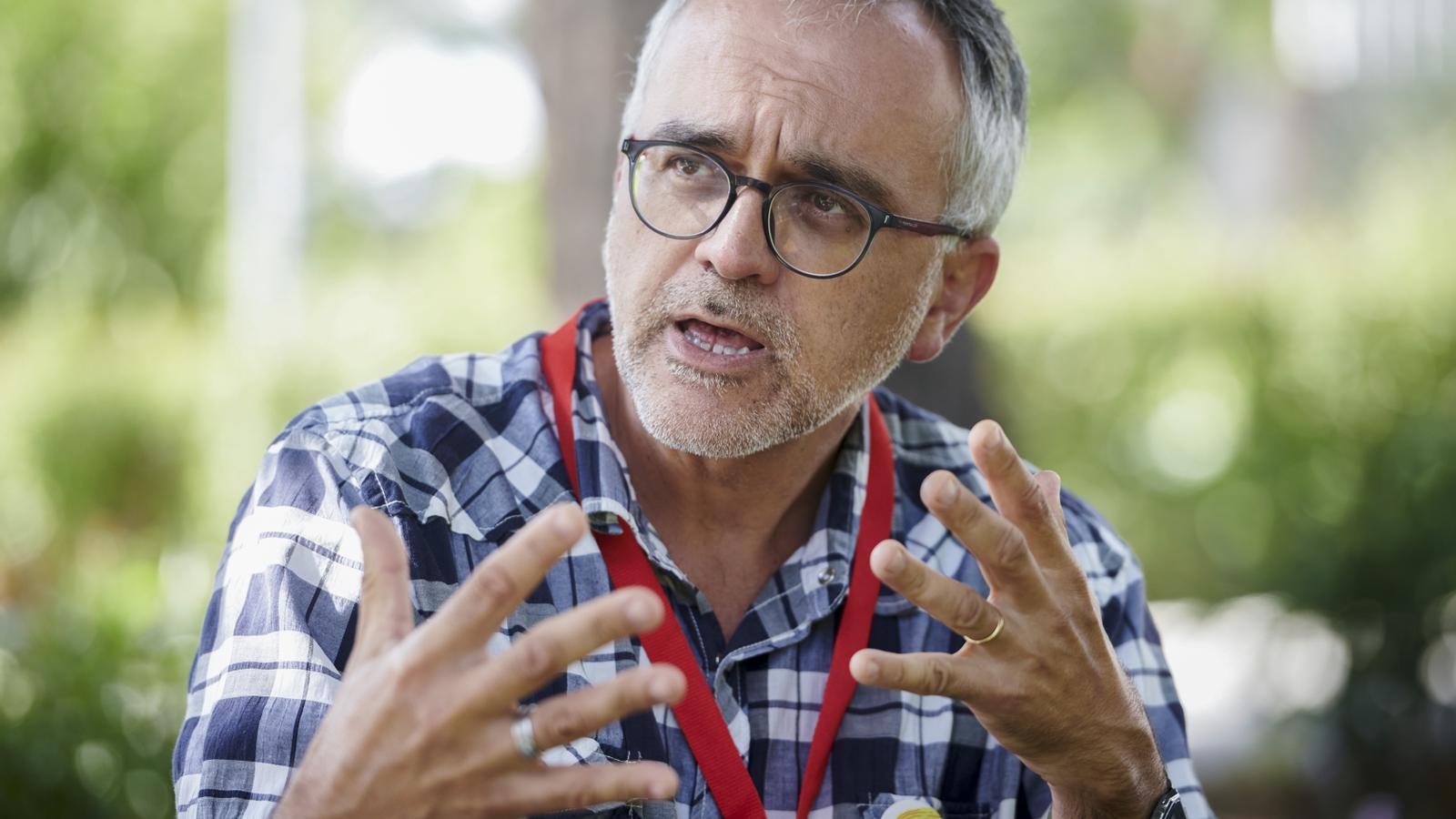
BarcelonaThe day after the four astronauts of the Artemis II mission have made history by becoming the humans who have traveled farthest into space —406,771 kilometers from Earth—, ARA interviews Josep Maria Trigo, principal investigator of the Asteroids, Comets, Meteorites and Planetary Sciences group at the Institute of Space Sciences (ICE-CSIC) and the Institute of Catalan Studies for Space (IEEC).
Why can Artemis II be considered a key mission for the exploration of the Moon?
— We can consider it a proof of concept, as well as of the habitability and performance of the Orion capsule [in a very essential part built in the European Union]. It is important because it is a joint and updated mission that exemplifies that cooperation is the best way forward.
What scientific windows can the Artemis program open?
— The main scientific windows are the establishment of a lunar base to bring astronaut experience to another location, and the development of new techniques for exploitation and reuse of in situ resources, called ISRU for their English acronym [such as the use of water ice from the Moon]. The latter are key to facilitating future space exploration, as they require fewer resources.
The crew members have been able to observe sites on the far side of the Moon; why is it relevant and what valuable information can the testimony and images captured by this mission provide?
— The study of the far side is always relevant, even though it has already been studied by previous missions; the day before yesterday, up to 24 astronauts had already seen it. However, we know less about this side than about the other side that faces Earth due to this dynamic equilibrium in which it completes one revolution around the Earth [translation] at the same time as it rotates on itself [rotation]. A very important recent milestone was the robotic return of regolith samples —that is, dust and rock fragments— achieved by the Chinese mission Chang'e 6. It is quite curious that the far side of the Moon shows that it cooled at lower temperatures than the near side, suggesting an ancient heat imbalance between both sides, as the crust is thicker in this lunar region. Now astronauts report having seen and filmed six meteorite impacts against the Moon; a new aspect that we are also addressing in a new technological project at ICE-CSIC and that we have just started with ESA and the company GMV.

There are people who question the usefulness of conducting these investigations.
— It's not surprising, there are people who doubt that the Earth is a spheroid or that the Moon was reached with the Apollo missions. I think it is necessary to be well informed and listen to the experts, and especially these days we must listen to the astronauts, because they do not risk their lives for simple pleasure. The success of the Apollo missions and all that they contributed about the origin of the Earth and the Moon should make us think. Applied science and new technologies are born from basic science and, in large part, from space exploration.
Why is this mission important for the population, and not just for science?
— For me it is the very act of testing new technology on board the Artemis missions, particularly because it involves doing so at a greater distance and autonomously, and that these are necessary steps for the challenges of the following manned missions. On the other hand, space exploration always brings benefits to the population, as demonstrated by many technologies born from it: the microwave oven, aluminum foil, scratch-resistant lenses, scanners, LEDs, thermometers, and portable computers themselves... In the medium term, if humanity seeks to be capable of surviving future large-scale catastrophes, it will have to establish itself on several planets and become multiplanetary.
Why has the launch and journey of Artemis been innovative and unique?
— The Artemis II mission aims to demonstrate that the life support systems of the Orion [capsule], as well as navigation and communications with astronauts on board, function correctly. It is not an easy task, but success will pave the way for humanity's return to the lunar surface, specifically to the South Pole, where new techniques will be tested.
After the images and communication with Earth, the crew now faces the return: what are the risks of this final phase?
— In general, it is estimated that during a complex mission like Artemis II there is a not insignificant chance of failure. In particular, safety concerns have been raised about the thermal shield of the Orion capsule. The geometry of the capsule's reentry to achieve aerodynamic braking will be key to the success and safe return of the astronauts.
Since Apollo 13, no human has set foot on the Moon and Artemis, in fact, does not either. Why?
— Why there hasn't been clear interest. Now, as we study at ICE-CSIC and IEEC, valuable minerals have been identified on the Moon and there is a desire to reach it before others do. Particularly China has already shown interest.
In the 1960s, Apollo 13 was part of the arms race between the USA and the Soviet Union. Now, on the other hand, Artemis involves the North American, European, Japanese, and Canadian space agencies collaborating. What has changed?
— The world. Hopefully collaboration will be closer, but we are certainly living a second space race, an irrepressible struggle that is now for mineral resources, using the Moon as a platform for the exploration of Mars and asteroids.
If a stable base is established on the Moon, is it viable to travel to Mars?
— Establishing a base on the Moon and extracting resources from our satellite will be the first decisive step. Traveling from the Moon to Mars will be much more viable, but it will be time that tells us which country achieves it. The challenge is immense.
