Every day Catalans lose half a million euros in cyber scams
The Government creates a strategy to fight against online frauds, which are already the second most common crime in the country

-
CAT -
CAST
Hospitalet de LlobregatHalf a million euros a day, more than 20,000 euros every hour, more than 300 euros every minute. This is the amount of money that cyber scams have taken from Catalans since 2024. It is 490 million euros in two and a half years divided into 80,000 annual reports until August of this year. With these figures, cyber scams are already the second most reported crime in the country, and this is despite the fact that the Mossos d'Esquadra warn that the dark figure – the citizens who suffer these frauds and do not report them to the police – is extremely high. In recent years, cyber scams have affected more than 200,000 people and the victims who lose the most money are the oldest: those over 65 have an average of more than 4,000 euros stolen from them, while in the 18 to 30 age group, the figure does not reach a thousand euros.
In recent years, reports of cyber scams are stabilizing, but this does not mean that the problem is contained. Police sources warn that scammers are becoming more expert and are using artificial intelligence and thedark web, where they can acquire packages to scam in an apparently simple way or access victims with greater purchasing power to obtain more money with fewer scams. For all these reasons, the Government will approve next Tuesday in its executive council a new 2026-2028 strategic plan to fight against virtual scams, a strategy that strengthens the link and coordination between the Cybersecurity Agency of Catalonia and the Mossos, but also with banking entities, online sales pages or mobile phone operators.
The director of the Cybersecurity Agency of Catalonia, Laura Caballero, and the Mossos commissioner Miquel Àngel Garcia Alvira presented this pioneering plan this Friday. Both authorities warn that the times when hackers and cyber scammers were experts in the field with advanced computer knowledge are behind us. Now many are young boys, most without academic studies, who resort to AI for topics they are unfamiliar with and who attack citizens, companies, and institutions alike. At the highest levels, however, there are organized groups, usually transnational, with more knowledge and capacity to commit crimes.
False investments
The most frequent scams are those referring to fraudulent online purchases, unknown bank charges, and identity theft, which usually arrive in the form of a message. In these cases, scammers usually pose as a child, the bank, the CEO, or a company that wants to hire the victim. However, the scams that involve the highest financial losses are those of fake investments, usually in cryptocurrencies. "In the second quarter of 2026 alone, they cost residents in Catalonia more than 14 million euros. It is a first-order real threat to public safety," warned Garcia Alvira.

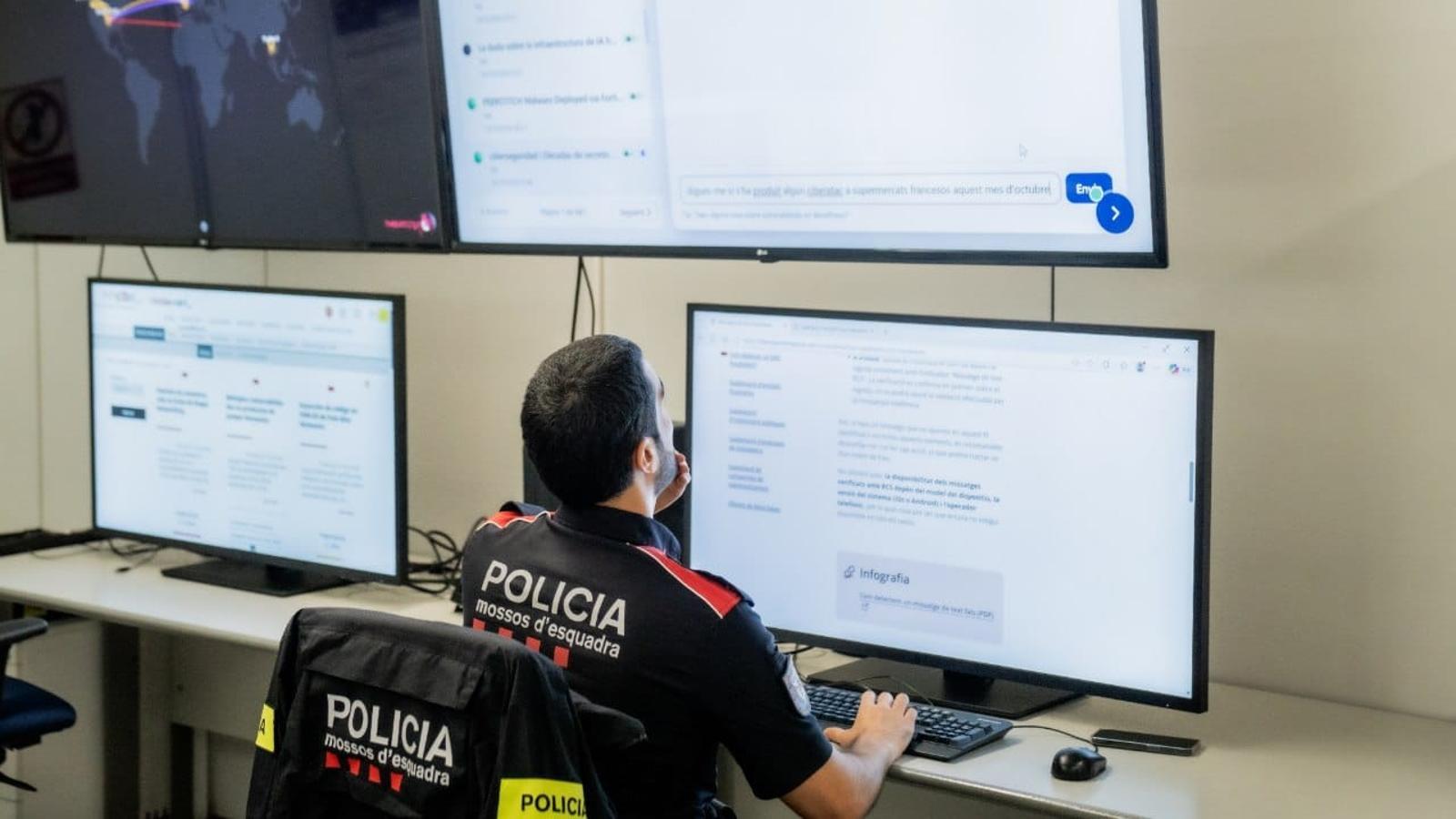
And now comes one of the most critical times: Christmas shopping. Faced with this, the police are trying to apply the fight of technology against technology. For example, the Mossos have deployed their own artificial intelligence machine, isolated from the internet, called VigilIA. This tool analyzes more than 80,000 annual reports in real time, cross-references patterns, and connects cases that were previously impossible to investigate one by one. The Mossos claim that this technique is pioneering in Europe.
In parallel, the Catalan police force has also created the Central Unit for Cyber Scams and Technological Investigation (UCCIT), which has been active since January 1st. This measure has already allowed for the blocking of nearly 2.8 million euros and the return of 1.25 million to the victims. The police strategy also includes launching the Virtual Police Station by the end of the year, so that victims can file a report from home. In this way, the Mossos will try to encourage reporting.
The Agency has also launched an AI assistant, operational via WhatsApp and web, so that the user can send a screenshot or link of an SMS or an online store to instantly check the risk of fraud before paying or clicking. The plan also includes promoting prevention campaigns with workshops and talks aimed at both the public and private sectors. In fact, the Mossos remind that companies, especially small and medium-sized ones, are some of the biggest victims of cyber scams.
