The UB seals with two new buildings its commitment to the Diagonal of research
The forecast is to be able to inaugurate the new centers dedicated to mathematics, computer science, economics and health in 2029

-
CAT -
CAST
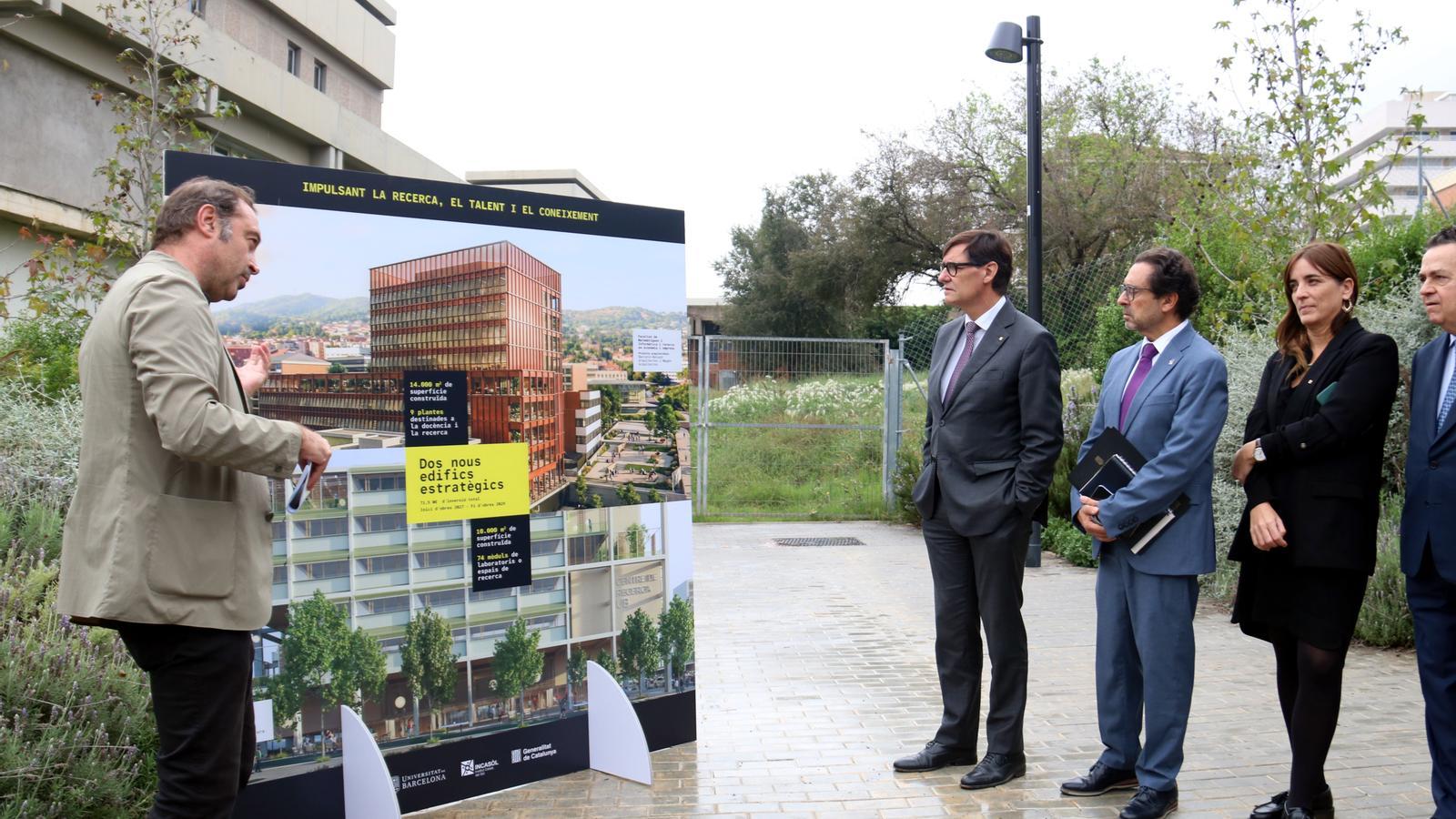
BarcelonaThe University of Barcelona (UB) will have two new buildings on both sides of Barcelona's Avinguda Diagonal to consolidate its commitment to making this stretch of the city's upper part a European benchmark in research. This Monday, the Generalitat and the university presented the project to build two new "strategic" centers dedicated to mathematics, computer science, economics, and health. The goal is for them to be inaugurated in 2029 and to contribute to the transformation of an area marked by the momentum that the future Campus Clínic is set to provide.
"The two buildings are not two random pieces," stressed the rector of the UB, Joan Guàrdia, who remarked that the university's strategy is to turn the Diagonal into a major hub for talent attraction that southern Europe "recognizes as crucial." Also, the president of the Generalitat, Salvador Illa, situated the commitment to these new buildings – which will involve an investment of 71.5 million euros provided by the Government and the UB – within the transformation of the entire area that the future Hospital Clínic will crown. "We will build the most important hospital in southern Europe," he assured, and celebrated that the area is becoming a focus of knowledge and research.
The forecast is for the construction of the two buildings to begin at the end of 2027. This Monday, during the presentation event, some details were shown. In the case of the building that will house the Faculty of Mathematics and Computer Science and research spaces in economics and business, it will be located north of the Diagonal, next to the Pedralbes Gardens and the Faculty of Economics and Business. It will be the work of the joint venture formed by Barceló-Balanzó arquitectes and Magén arquitectes, who have designed a 14,000-square-meter building with two volumes: one four-story building next to the Faculty of Economics, and a nine-story tower a bit further up.
Architect Toni Barceló explained that one of the challenges was how to relate the new building to the Faculty of Economics and Business, which will finally interact through a courtyard that will allow transit between the old building and the new one. The other great challenge, he said, was how to make the Faculty of Mathematics and Computer Science coexist with the research spaces, allowing them to live together while having their own spaces. Thus, despite having separate entrances and spaces, they will also be interconnected both by the atrium and by an elevated plaza on the fourth floor that Barceló defined as "the jewel in the crown."
The other building, which will be built to the south of the avenue, next to the UB Science Park, will house the headquarters of the Institute for Bioengineering of Catalonia (IBEC) and other UB research groups in the field of health sciences. It will also host the first headquarters in Spain of the leading European institution in technology transfer, Fraunhofer CAT. In this case, it will be the work of PMMT architects, and Patricio Martínez has highlighted their commitment to versatility and the ability to adapt to the needs of research in the future.
"It is a building that does not seek to guess what the future offers us, but rather prepares to receive it in the most empathetic way possible," said Martínez. To do this, the space will be distributed based on 90-square-meter laboratory modules around an atrium, with natural lighting and ventilation. These are versatile pieces that allow for uses to be modified as needed. To the point that, as the architect explained, it is possible to reconvert a space into an assembly hall at any given moment, and even place green or communal areas there.
The Clínic Campus
During his speech, Salvador Illa applauded how the commitment to health and research will help transform the upper part of the Diagonal, turning around a space that "often acts as a barrier so that it becomes a meeting point." In this sense, he remarked that the project for the future Clínic Campus will also serve to transform the border between Barcelona, Esplugues de Llobregat, and l'Hospitalet de Llobregat into a more friendly space, as well as to promote the extension of metro line 3 with new stations.
