A closed hotel with happy ghosts
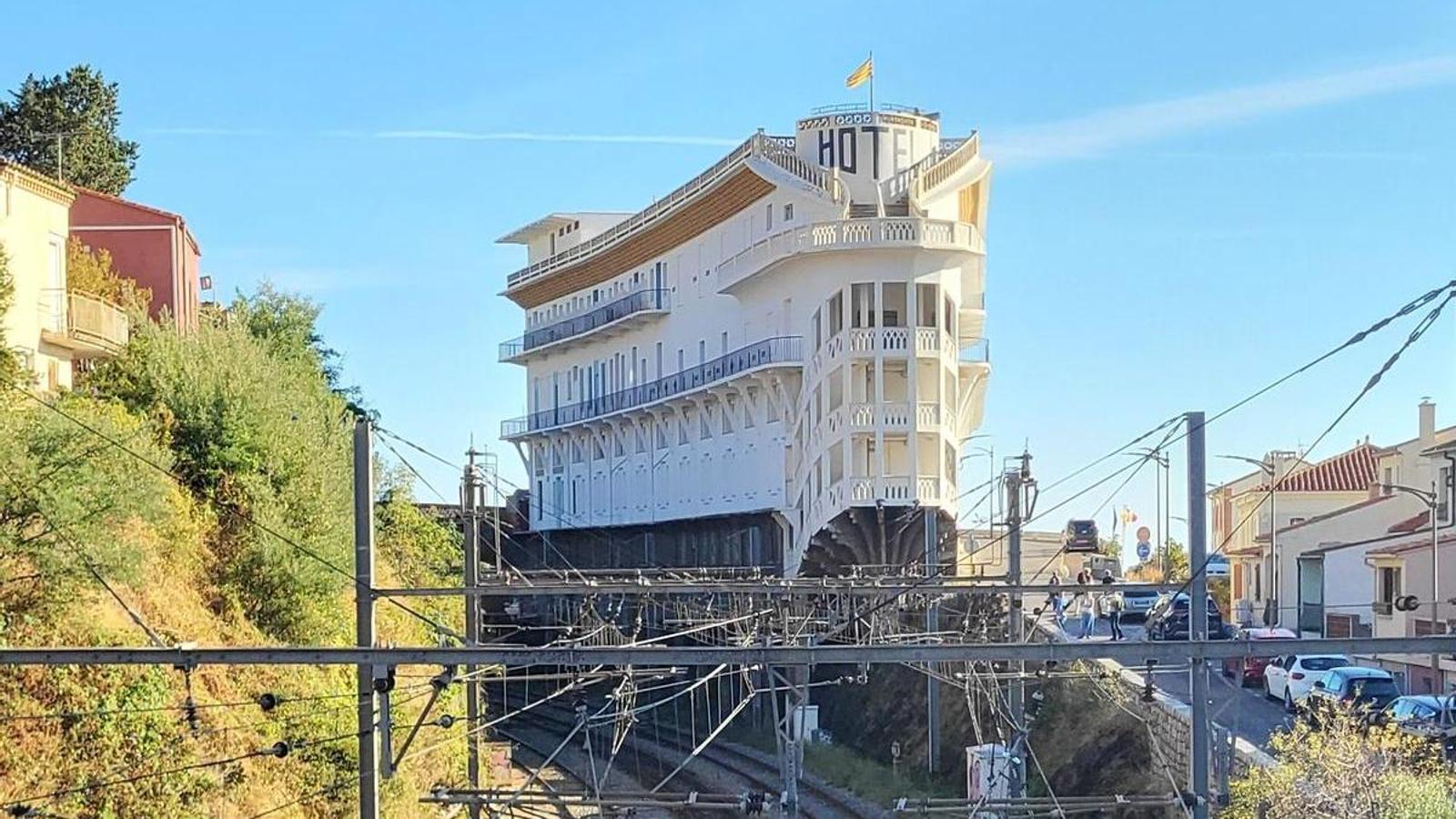
The mythical Belvédère of Cervera de la Marenda, with an architecture that simulates a transatlantic liner and with a history loaded with glamour, fights to avoid shipwreck

-
CAT -
CAST
Cervera de la MarendaFollowing the Vermilion Coast road that winds along the sea between Portbou and Cerbère, upon arriving at this town, the southernmost in the French state, one is surprised by the silhouette of a huge cement ship anchored to the cliff, on a triangular ledge wedged between the railway line and the seafront.
At the corner of the building that simulates the prow of the ocean liner, large letters indicate that it is a hotel. It is not just any hotel. It is the legendary Belvédère du Rayon Vert hotel, one of the first buildings in the world built with reinforced concrete, considered a prized example of Art Deco, and with a history filled with glamour, luxury, and celebrations with great international film stars. Today, however, it faces an uncertain future after the Cerbère Town Hall and the Prefecture of the Eastern Pyrenees forced the current owners of the establishment, Jean-Charles Sin, 79, and Paquita Verdaguer Sin, 67, this August to close the 9 apartments currently housed by the Belvédère, frequented above all by clients seeking rest in a place with impressive sunrises on the maritime horizon and a unique landscape, with dream coves and cliffs that rise suddenly from the sea to an altitude of 100 meters.

The ray that opens the heart
This privileged location of the hotel explains the addition "du Rayon Vert" (green ray) that appears on the Belvédère sign. It alludes to the rare optical phenomenon that can appear for a few moments when the last ray of the sun disappears over the sea horizon and which inspired Jules Verne for the novel Le Rayon vert (1882), in which a young Scottish woman undertakes a journey to contemplate it, convinced that whoever manages to see it is capable of discovering the deepest feelings of the heart. The novel contributed to popularizing this phenomenon, which also gives its name to a film by Éric Rohmer. Trips to contemplate the ray made it very popular, to the point that "Le Rayon Vert" became a recurring name for hotels and establishments on the French coast, even those on the Mediterranean coast, where the phenomenon cannot be contemplated.

A campaign to save it
The forced closure has left Jean-Charles Sin and Paquita Verdaguer perplexed, who at their advanced age and without heirs willing to take over from them, find themselves unable to face the costs of the works required by the City Council to reopen the Belvédère so that the building complies with fire safety regulations. In 2011, they already carried out renovations there and, subsequently, various actions to adapt the historic building to current regulations, but this has not been enough to avoid the municipal closure order.
They see a glimmer of hope to avoid the shipwreck of the Belvédère in the campaign that has been promoted from the neighboring town of Portbou, which is collecting signatures on the platform Change.org in favor of the reopening. The campaign has been titled “So that the Belvédère, the emblematic hotel of Cervera, does not die” and asks that the administration grant “exceptional treatment adapted to the characteristics of this building that make it different and worthy of being admired and studied”. The defenders of the hotel state: “We are of the opinion that a town cannot do without the places that define it, in this case a building from the thirties built over the train tracks and which at the same time is also the space where cultural events are held all year round”. And they add: “If we do not get to it soon, towns will lose the heritage that makes them unique and gives life to the landscape”.

A walk through the establishment guided by its owner opens the visitors' imagination. Time seems to stand still, or even turn back to the glamour and bustle of parties, to the fine dining restaurant, to the stately marble staircase, to the surprising cinema room, to the balcony over the sea that simulates a ship's deck and that at every sunrise offers the remote possibility of a green flash. The photographs and posters hanging in lounges and hallways commemorate the time spent at the Belvédère by film artists such as Orson Welles, Gérard Depardieu, Brigitte Bardot, Fernandel, Maurice Chevalier, Jeane Bourgeois or Carmen Amaya, among others. It is also remembered that several films have been shot in this hotel, such as L'étalon, by Jean-Pierre Mocky, in 1969.


It is not like the hotel from The Shining
"On July 30th, we received the letter ordering us to close. It is terrible. It has been a very hard blow for us. My husband had already requested building permits and had even paid a deposit to start carrying out the required work, but even so, they have forced us to close," laments Paquita. Now with its doors closed as a hotel, the Belvédère sporadically receives visits from people interested in discovering the unique decor and the history hidden inside this stone ship. Paquita and her husband guide visitors through the 4,200 square meters of the Belvédère with a certain nostalgia for a glorious past that they do not want to be forgotten. Without clients, they continue living in this mammoth and lonely hotel. While walking through its desolate corridors, visitors cannot help but think, with a shudder, of the hotel from the film The Shining, by Stanley Kubrick. "People ask us if we are afraid to live here, but I always answer no, that the ghosts here are happy, because beautiful and joyful stories have always been lived here."
Paquita explains that the construction of the Belvédère is due to her husband's great-grandfather, an entrepreneur originally from the Basque town of Hendaye, who "found out that there were possibilities to open establishments in Cervera”, a town frequented by artists and people from the world of culture and where there was an important railway station, La Gare. In 1906, the ancestor of the current owners of the Belvédère took charge of the buffet at the Cervera station. It was the era of trains with sleeping cars, and of great activity in border towns like Cervera, where European travelers who wanted to enter the Spanish State had to wait four or five days in the town while their visas were being prepared. He saw clearly that a hotel was needed for these people, so that they could stay in Cervera during these days and find there not only accommodation, but also entertainment.

The gentlemen were looking at the train; the maids, at the sea
"He bought a triangular plot right next to the train tracks, which apparently didn't offer any potential to do anything with it," explains Paquita. "Those were the years of the great transatlantic liners, the 'ocean liners,' and he had the idea of building a structure inspired by these great ships: he had a hotel built that, like the cruise ships, apart from 38 comfortable rooms, a large dining room, and cozy living rooms, also features a cinema with 500 seats, a library, game rooms, a garage for 100 vehicles, a balcony that simulates the deck of the vessel, a large rooftop where in the past people even used to play tennis... and splendid views over the sea. But above all, with the train tracks right next to it. "Back then, the railway was valued more than the sea!" exclaims Paquita. "The tracks were synonymous with progress," she adds, and from the 'bow' of the Belvédère, she points out an old nearby customs building where, she recalls, "the rooms facing the train tracks were for the gentlemen, while those with views of the sea were for the maids."
It was thanks to the train that the materials for the construction of the Belvédère were brought to Cervera, between the years 1928 and 1932. The architect entrusted with the work, Léon Baille, designed a building that represented a true architectural revolution, with an interior decoration in which rhombuses predominate, Baille's obsession, and which would be classified as a historical monument by the French State. To simulate a ship, he gradually expanded the surface area as each new floor was raised, and the optical effect he achieved is impressive: the building is an authentic concrete "ocean liner" anchored to the ground.
A renovated cinema
Once built, the Belvédère immediately attracted clientele to its select events, just as its founder had dreamed. Large events were held there, including a film festival that took place in the spacious screening room. “Cinema in black and white began here, with a player piano and a small orchestra,” explains Paquita. "In those years, trains ran on steam engines, and since the track is right next to the cinema hall, when the trains stopped and requested clearance to continue their journey, a great noise was heard and everything filled with black smoke. Then they would stop the film, wait for the train to start again, and the film would resume," she adds.
The splendor of the Belvédère was cut short during the Civil War first, and later, during the Second World War, when it was occupied by the armed forces of the Third Reich. In the sixties, with the rise of tourism, it saw its activity as a hotel grow and renovations were carried out, but the founder's heirs, who were in charge at the time, ended up closing it. His nephew, Jean-Charles Sin, bought it and has managed it ever since with his wife, Paquita. They bought furniture and tableware, and all kinds of valuable objects that their ancestors had taken away. "Now that we have it looking nice, they are making us close," laments Paquita. "We have always carried out the actions that have been asked of us, but we have never received from this city council the support or the complicity that we need to maintain the hotel and that in other times we had indeed had," she asserts, while showing a poster of a festive event held at the Belvédère in 1943, in which the mayor of the time announced that, despite the curfew that was in force, "the occupying authorities" had authorized them to hold that event.
