Barcelona commits to acting so that Pelai stops being the forgotten street in the center
The traders of the area demand the City Council to pacify the street and give more space to pedestrians

-
CAT -
CAST
BarcelonaOne of the most symbolic actions in the early days of Jaume Collboni as mayor of Barcelona took place on Pelai street. A few weeks after taking office, the mayor dismantled the tactical urbanism that Ada Colau's government had implemented on this main artery in the city center. Now, as his term approaches its final stretch, the municipal government of the PSC is once again setting its sights on this street. In a meeting with local merchants, the third deputy mayor and councilor for Ciutat Vella, Albert Batlle, committed to making the redevelopment of Pelai to make it more "pleasant" part of the roadmap for the next four years.
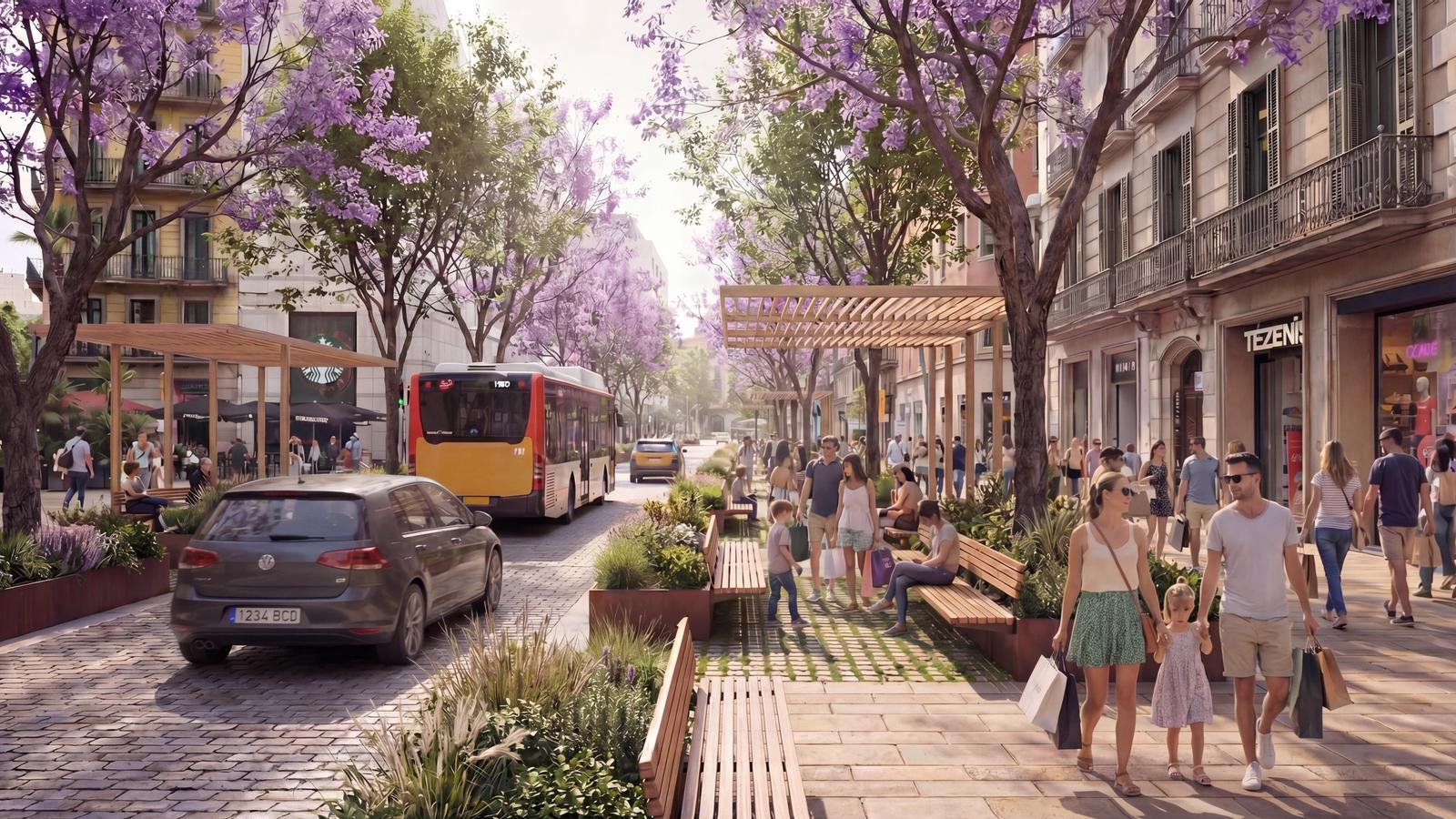
Batlle thus welcomed the proposal made to him by the association of merchants of Pelai Centre i Rodalies, led by the also president of Barcelona Oberta, Gabriel Jené. "Until now, Pelai has not been on the agenda, and we need to make sure it is," said Jené, who stressed that after having acted on La Rambla, Via Laietana, Ronda Sant Antoni, and Passeig de Gràcia, "now is the time" to redevelop Pelai. For this reason, local merchants presented their own reform proposal for the avenue this Thursday, which calls for substantially widening the sidewalks and making them more pleasant with street furniture for seating and trees.
"It is not a green axis, it is a pacification" that allows circulation, stressed Jené, who, from Barcelona Oberta, has promoted some of the legal challenges against the Consell de Cent green axis or the reform of Via Laietana. The proposal made public this Thursday, prepared by the architectural firm L35, only outlines the main lines of the project, which seeks for pedestrians to enjoy "a much more comfortable space." For this reason, they propose wider sidewalks and breaking the current disproportion between the sea and mountain sides, as well as reorganizing some areas such as motorcycle parking, loading and unloading zones, or reducing the thirty or so containers that are currently there.
Although the project does not go into detail about how many traffic lanes should remain or how to resolve the connection with Balmes street, the proposal does raise the need to redirect part of this traffic through the streets above Pelai. In fact, in the render that accompanies the project, the image shows a Pelai street with a single lane for car traffic. Jené, however, has stressed that it is the City Council that must make the proposal on how to reorganize the space, and has called for a commitment to tackle this pending issue and a "public calendar" for the 2027 elections.
Link to Sant Joan promenade
On behalf of the municipal government, Albert Batlle has taken up Jené's challenge and admitted that the Pelai street reform must be part of the Municipal Action Plan for the next term. Batlle has even gone further, saying that this axis must be addressed, but also its continuation through Fontanella and Trafalgar streets, which would improve the connection between Plaça Universitat and Passeig de Sant Joan. In the previous term, Colau's government had begun to outline new Pelai and Fontanella streets with wider sidewalks, only two traffic lanes, and a bike lane on the side.

