Another key project to decongest commuter rail, stalled until beyond 2030
The quadrupling of the tracks on the R2 South line between Castelldefels and El Prat is delayed due to a bureaucratic procedure at the ministry.


-
CAT -
CAST
BarcelonaThe southern commuter rail corridor, one of the most strained sections of the Catalan rail network, continues to face setbacks. This March, it was announced that one of the key projects intended to improve train capacity and flow on this section of the R2 South line—the quadrupling of the tracks between Castelldefels and El Prat—has been stalled once again and is now pushed back to well beyond 2030. The reason? A change of heart by the Ministry of Transport has sent the project back to square one: the initial administrative procedures must begin anew, rendering the original timeline meaningless. Adding these tracks to the R2 line is considered one of the most significant actions in the Commuter Rail Plan in terms of improving capacity in this area. The project is not new; it first appeared in the 2020 Commuter Rail Plan. In mid-2024, with Adif's approval, the construction project was drafted. At that time, the work was considered simply an "expansion" of the existing infrastructure, which technically allowed bureaucratic steps to move forward.
Esquema actual
Platja de
Castelldefels
Castelldefels
Gavà
Viladecans
El Prat de
Llobregat
Proposta
Inclou la remodelació de l’estació de Castelldefels i el nou ramal a l’aeroport del Prat, actualment en construcció
Proposta
Esquema
actual
El Prat de
Llobregat
Viladecans
Gavà
Castelldefels
Platja de
Castelldefels
Inclou la remodelació de l’estació de Castelldefels i el nou ramal a l’aeroport del Prat, actualment en construcció
Esquema
actual
Proposta
El Prat de
Llobregat
Viladecans
Gavà
Castelldefels
Platja de
Castelldefels
Inclou la remodelació de l’estació de Castelldefels i el nou ramal a l’aeroport del Prat, actualment en construcció
However, last December the ministry made a U-turn and changed its stance: it now believes this project cannot proceed directly. They say a preliminary study is necessary first, a step that often also requires an environmental impact assessment and can take up to three years. This change has had immediate consequences: the ongoing bidding process has been halted, and a new one has been launched to draft the study. Afterward, the project will have to be put out to tender again, and the construction work will follow. And, to make matters worse, a business association has now challenged the terms of the new tender, which has been suspended as a precautionary measure. Thus, the timeline for this infrastructure project is delayed until the next decade, as reflected in the new Commuter Rail Plan, which allocates less than €3 million to the project (the budget for the studies) until 2030 and leaves the bulk of the funding, €67.81 million, for later, which is the cost of doubling the project's value.
"It's one of the projects that can do the most to alleviate traffic congestion in Barcelona. The 2020-2030 plan already included its planning, and now it's time to implement it, not start over," says Arnau Comajoan, a member of the Public Transport Promotion Board (PTP). This civil engineer believes that if the ministry is now opting for an information study, it's due to "a more conservative approach." "They're choosing to cover their bases instead of completing the project, which was already behind schedule, as soon as possible," he says. "Going through this process just for the sake of it is unnecessary and a waste of resources... And if it was necessary, it would have been better to do it from the beginning," Comajoan asserts.
Why is this project important?
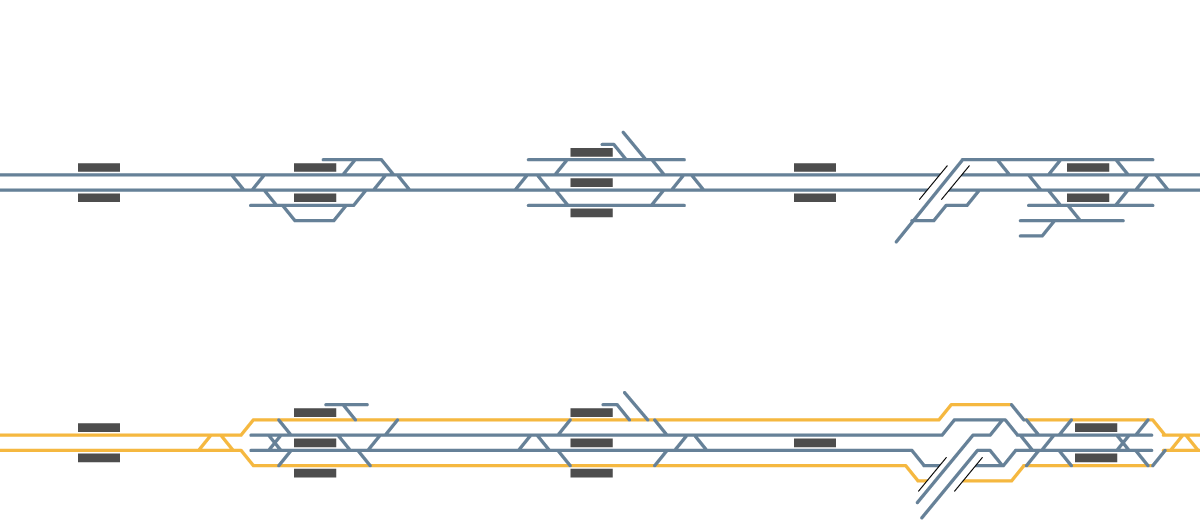
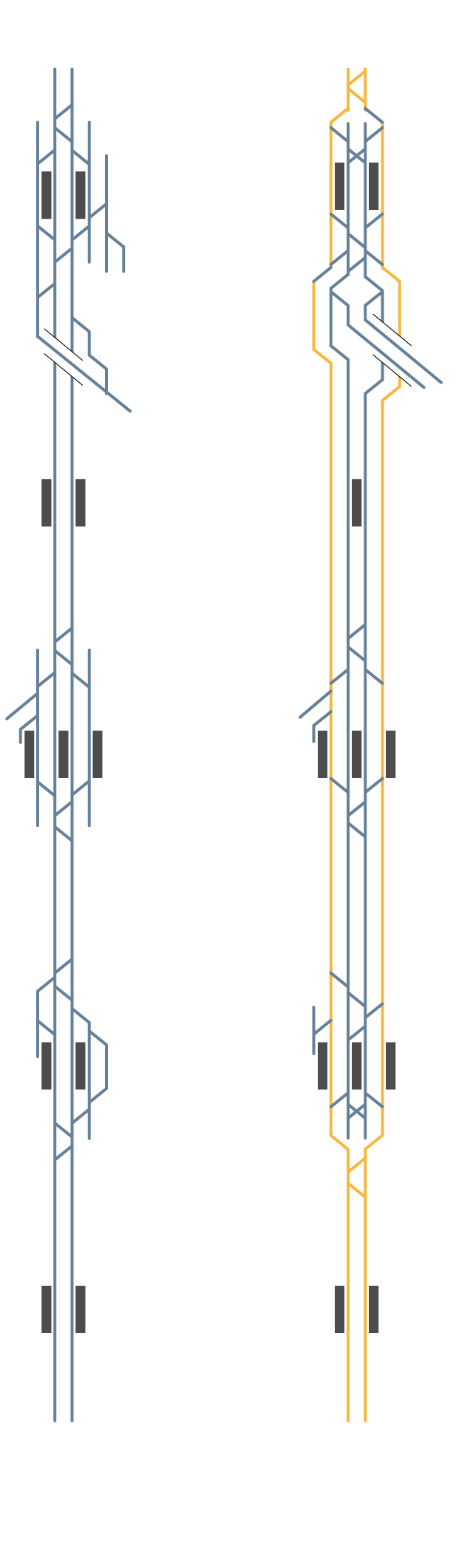
The project envisioned connecting the sections between stations in Castelldefels, Gavà, Viladecans, and El Prat with four tracks instead of two (see diagram). Regional and semi-direct trains, which make fewer stops, would use the outer tracks, while the two inner tracks would be for commuter trains, which stop at every station. The work would focus on extending the outer tracks—which currently only exist within the stations—along the entire section. "This would allow regional trains to overtake commuter trains, which make frequent stops, travel more slowly, and are often delayed," explains Comajoan. "If the regional trains didn't have to be at the back, they could shorten their journey times by about five minutes," he continues.
At the time of publication, the Ministry of Transport had not yet responded to any of the questions submitted by this newspaper. However, in the withdrawal document, which ARA has obtained, Adif argues that the Ministry of Transport considers that "the proposed quadruple track [...] implies a modification of the functional and operating conditions" because the tracks "are specialized – they say – by type of traffic." This is why, they argue, a prior feasibility study is necessary. Adif claims that it has adhered to the Ministry's administrative orders and that it is not its responsibility to explain the change in criteria by the national government. For its part, the Generalitat, as the service provider, simply states that it would have preferred "a faster timeline." "But there is a procedure that had to be followed," sources from the Department of Territory succinctly summarize. User and public transport advocacy groups, on the other hand, have been much more critical and consider the change "a step backward." "This is an expansion of existing tracks, not new ones. Why are they reconsidering this now, five years later?" asks Anna Gómez, spokesperson for Dignity on the Tracks. The spokesperson for users of the southern corridor is emphatic: "The economic value of this project, its cost, has an exponential impact on the service. Who will now bear the burden of all these lost years? I'm starting to wonder who benefits from the southern corridor not functioning properly. Enough is enough!"
From the PTP, Comajoan agrees that the delay represents too many lost years for a key project and adds that "this change of criteria [by the ministry] is not exclusive to the quadrupling of the Castelldefels-El Prat line. It has also occurred in the doubling of the R3 line in the Mollet-Parets section," he recalls. "There is sufficient railway space to accommodate the tracks without the need for an information study; it is simply a matter of extending the existing tracks at the stations." Some of the affected municipalities also lament the new delay. The Viladecans City Council asserts that the slowness of these processes is "exasperating," according to municipal sources. For this reason, the council has already announced that it will request formal and official explanations from Adif and will consider presenting a motion to urge the acceleration of the processes.
