An administrative muddle leaves about sixty residents of the Eixample in limbo
The City Council seeks solutions to not lose these homes despite considering them offices
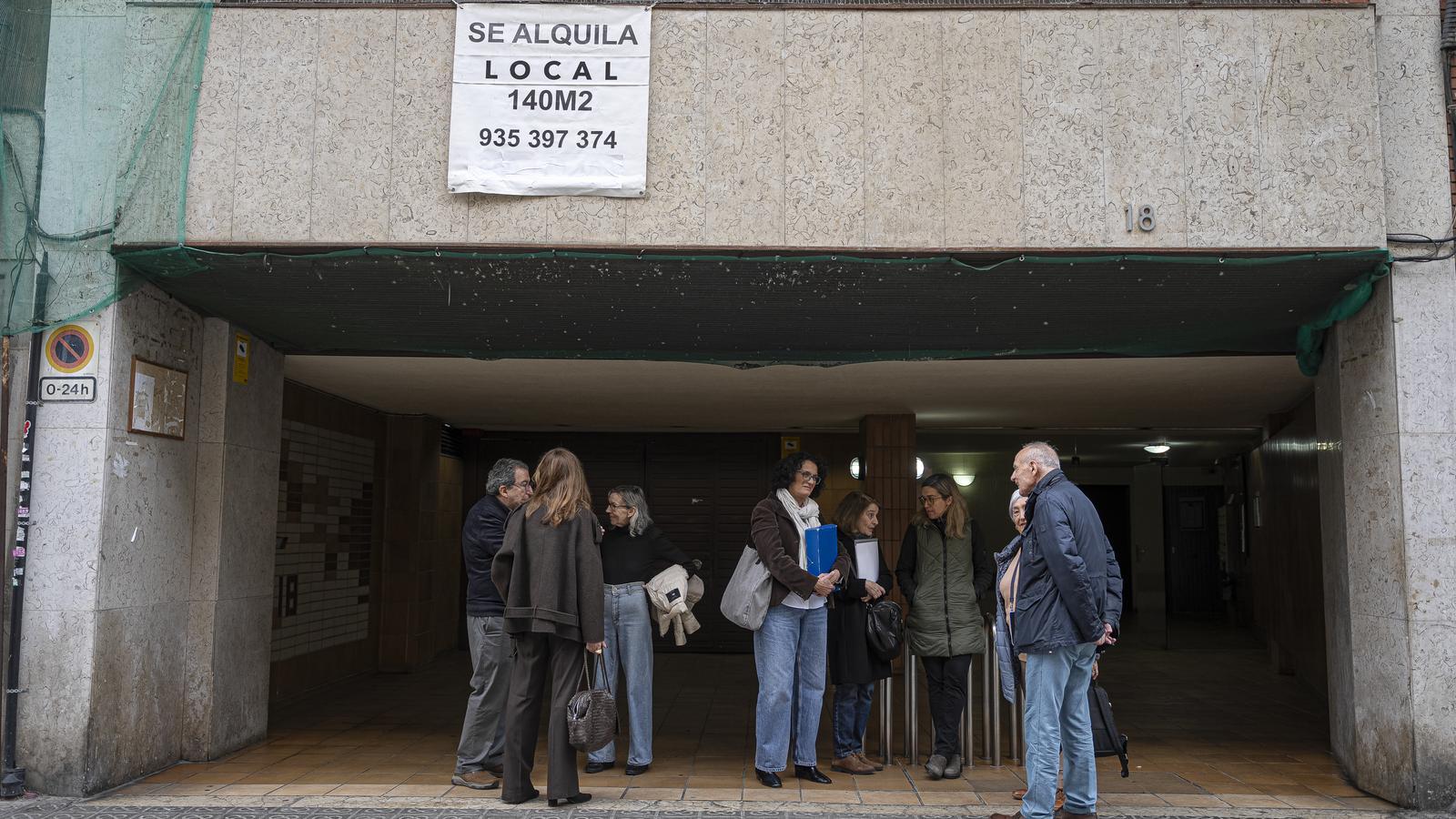
BarcelonaIn late July 2025, Sigrid received the first notification from the Barcelona City Council. When she read it, she began to tremble and had an anxiety attack. Forty-five years after buying the apartment, the council of the Catalan capital informed her that her home could not be used as a dwelling, as municipal archives state that the building has industrial use. Like her, the sixty or so residents of this building on Rosselló street – in the Eixample Left – have lived in limbo ever since. "My first lawyer told me: 'You could come home and find everything sealed, and not be able to enter. They can kick you out of your home,'" recounts Sigrid. From the City Council, however, they assure that efforts are being made to avoid this extreme.
"The apartment has a certificate of habitability, on the cadastre we appear as residential and we pay the residential IBI. If the City Council had done anything, we would not have bought the apartment in 1994," explains another owner, Àngels. The nightmare for the residents of this building began last summer following a complaint from a neighbor who was in conflict with the rest, but the administrative muddle goes back many years before: to the moment the building was constructed. The building's construction permit and the final certificate of construction management, which the neighbors found after rummaging through the original project paperwork, perfectly summarize the confusion.
In the 1977 construction permit, the request for a change of use from industrial building to office building is recorded. However, the final certificate of construction management refers to an office building with 42 "dwellings". "It started as industrial, but then it went from offices to housing," argue the neighbors, who believe that at some point the council lost documentation. The City Council's reports, on the other hand, deny the modifications: "No permit is recorded as having been granted for a change of use from industrial to residential, neither principal nor partial, for any of the entities in the building".
Despite the restrictiveness of the council's reports, the sixty or so affected residents denounce that no administration had ever questioned until now that their apartments were not dwellings. Beyond paying residential property tax, they emphasize that throughout this time apartments have been sold, mortgages have been taken out, rental contracts have been made, without any warning ever arising about them being offices. Even a cadastral certificate requested by Albert—one of the affected residents—states that the property on Rosselló street has been residential both in the first review of the urban cadastre in 1988 and in the digitization of 1997, and currently.
However, the City Council's file communicating the irregular situation of their apartments denied this, maintaining that they have always had industrial use. Consequently, it urged them to "demolish the works done" to convert them into offices "within a month." If they did not comply, the notification stated that "forced execution of this resolution" would proceed and the imposition of "repeated" coercive fines of between 300 and 3000 euros. "What works? We bought it done. There is a kitchen, smoke outlets...", recounts Àngels. "What should we demolish? This is a threat. It's prevarication," adds her husband, Albert.
Residential pressure
In Sigrid's case, she bought the apartment off-plan in 1981. They unified four apartments into one, and the City Council at the time validated it. "We bought it as an apartment and they have charged us as an apartment," she adds. The taxes they have paid over these decades, such as property tax, have been residential. Taxes paid to the same council that now questions whether the place where they live is a dwelling. In the case of Albert and Àngels, they have the apartment rented out for a few months to a young couple. "Are we kicking them out?", they wonder. They don't understand how, in the midst of a residential tension context – considering that Barcelona lacks housing – the City Council is notifying about sixty neighbors that it intends to expel them from their homes. "Do they want to empty 30 apartments while the city is short of them?", the couple asks.

Ruth also finds herself in a similar situation. She bought the property to live in after retiring. "And now, all of a sudden, they tell me it's an office. Do I have to sell it? In the mortgages they granted us, it was a dwelling," she laments. Although the neighbors have made a considerable effort together, each case is being processed individually. Some, the older ones, have given up and no longer filed an appeal. "There are elderly people, neighbors 90 years old," they state, highlighting the vulnerability of some affected individuals.
The City Council is looking for a solution
The owners also complain about the timing and the way the council has proceeded. They received the first notifications at the end of July 2025, at the doorstep of the summer holidays, and with the need to find a lawyer to be able to file appeals in a few days. Furthermore, they report that they found communications opened and closed clumsily with adhesive tape and, in some cases, without some of the sheets. They assure that no technician has entered their homes to carry out an inspection, despite the council saying the opposite.
After insisting, they obtained the original complaint, in which the council is requested "the inspection of the building" because it is an industrial property" that the neighbors have been using as residential since 1980", and in which there is "tourist accommodation" and "room rental". The neighbors consider that there is bad faith in this tenant's complaint.
Given this mess, sources from the City Council rule out that the neighbors will be evicted from their apartments. They assure that they are talking with the Generalitat to find a structural solution that regularizes the apartments and goes beyond the Rosselló block, since, they point out, there are other buildings across the country with similar situations. For the moment, however, they have not offered any concrete solution to the neighbors.
