"AI is like cholesterol, everyone hates it and at the same time it is fundamental for life"
ARA and the IEC organize a debate about the future of medicine with the rise of artificial intelligence

-
CAT -
CAST
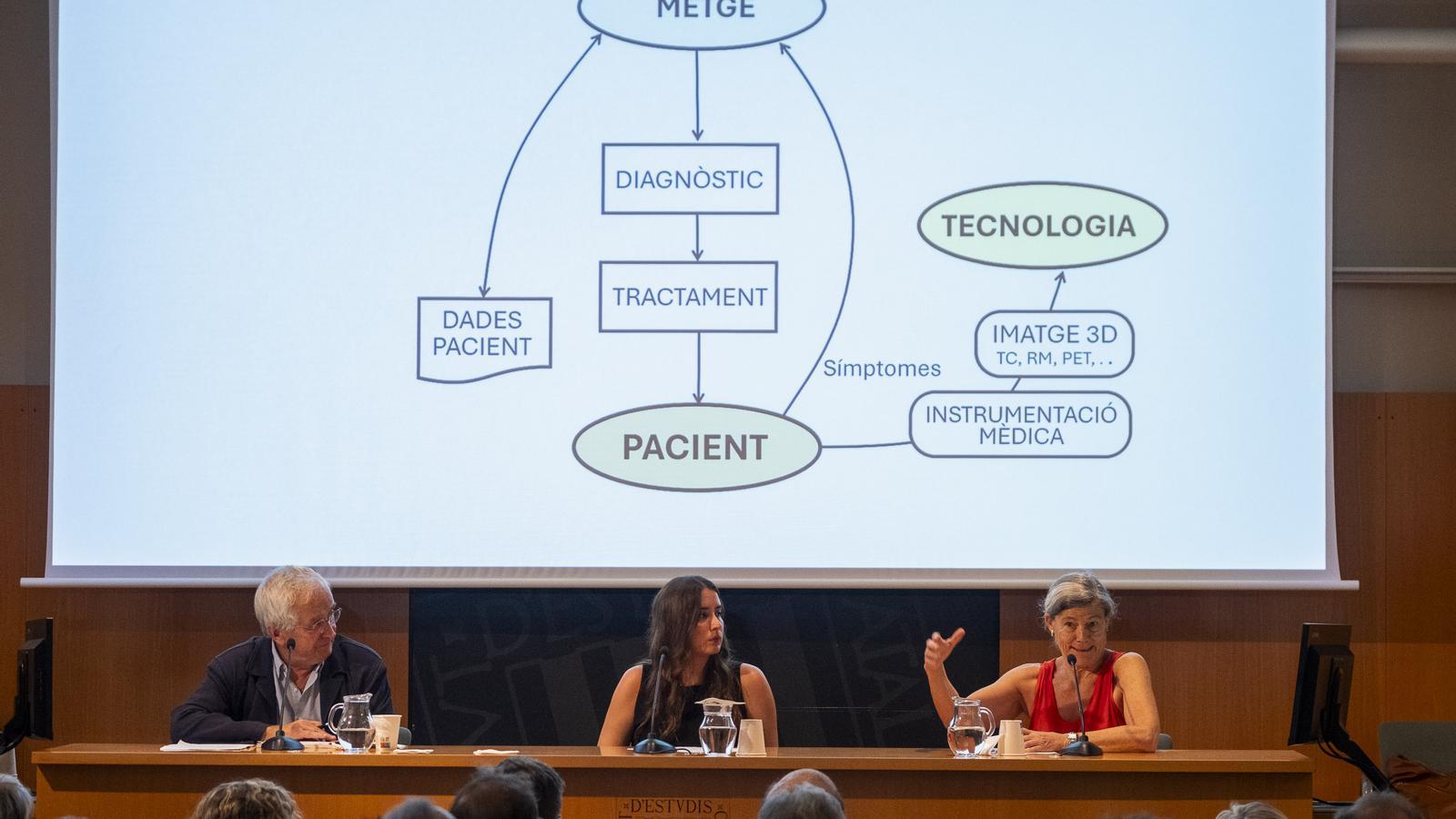
Barcelona"Until recently, Catalonia had 27 methods of collecting medical data." With this fact, the president of the Biological Sciences Section of the Institute for Catalan Studies (IEC), Jaume Reventós, has attempted to show one of the risks we run when using artificial intelligence (AI) in medicine today and in the future. He did so in a debate organized by the IEC itself and ARA, in which the president of the Science and Technology Section of the IEC, Alícia Casals, also participated, and which was moderated by the head of the Society section of ARA, Gemma Garrido Granger.
As has already been repeated in the field of education, Reventós has addressed the fact that AI can be positive or negative in the medical sector depending on how it is used. "It's like cholesterol, which everyone hates so much and yet is fundamental to life. With AI, what we need is patience," he explained. Like any enzymatic reaction, he continued, the engine is raw material of good quality, which in this case is medical data. "But currently, data is still collected and treated very poorly and, therefore, is less useful than it should be. We don't have precise data, and the models don't arrive in time," he insisted. According to Reventós, to have this good raw material, it is fundamental to "all act in unison" in how information is collected: "The gentleman from Madrid and the one from California must name the pathology the same way we do. We must all use the same way of classifying a medical pathology," asserted the president of the Biological Sciences Section of the IEC, who finds it essential that there be "a single repository" that is nourished by "scientific generosity."
Currently, one of the main risks of AI in a field as sensitive as medicine is monetization and commercialization by an industry that, evidently, seeks profits. "Medical records can be sold for 1,000 euros," he exemplified. But the speaker was optimistic about the potential of this tool: "We now have more than 6,000 algorithms dedicated solely to treating breast cancer," he exemplified. Alícia Casals also delved into this potential: "We have artificial intelligence to solve many intermediate steps until reaching teleoperation, in which it is the robot that operates directly on the patient," she explained.
Casals has insisted on the opportunity that these types of technologies provide to practice techniques and treatments without the need for a human patient who could be affected by these practices. "It is very useful for training. Recreations can be made and training done with digital twins –recreations of each individual– without being invasive and with augmented reality adding patient information. You can also combine physical instruments with a training program that analyzes what you are doing, evaluates you, and collects the information," describes Casals.
And, obviously, the crowning achievement is when this technology is useful for directly improving intervention on the patient. A milestone that the president of the Science and Technology Section of the IEC exemplifies with an operation on a part of the brain in which, with augmented reality, doctors can see the interior of the skull in a projection, without the need to make an extra incision to observe. Here, Reventós adds some more hopeful examples. "In everything related to imaging, AI has caused an overnight change... Machines can detect shapes that the doctor is unable to see in breast cancer and there is also the option of not needing to insert a tube to be able to look: you throw in a capsule with a camera and the doctor no longer even needs to watch a 45-minute video, but rather an algorithm can already help detect where to look," he explains.
The role of the doctor
Despite this idea of a hopeful future –and dangerous if a good and unique method for collecting data is not found–, one of the concerns of those present in the room is to what extent AI will change their day-to-day life when they visit the doctor. On this point, Casals and Reventós agreed in saying that many disciplines of medicine will change –"there are already surgeries that are performed entirely by a robot remotely," Casals recalled– and that some doctors will dedicate themselves to training robots. "However, the position that will never disappear will be that of the family or primary care physician, that of the professional who has direct contact with the patient," asserts Reventós: "The first job of a doctor is to calm the patient and that cannot be done by artificial intelligence," he concludes.
