Five science readings to sculpt our brain
Recommendations of recently published science and health popularization books for this Sant Jordi
-
CAT -
CAST
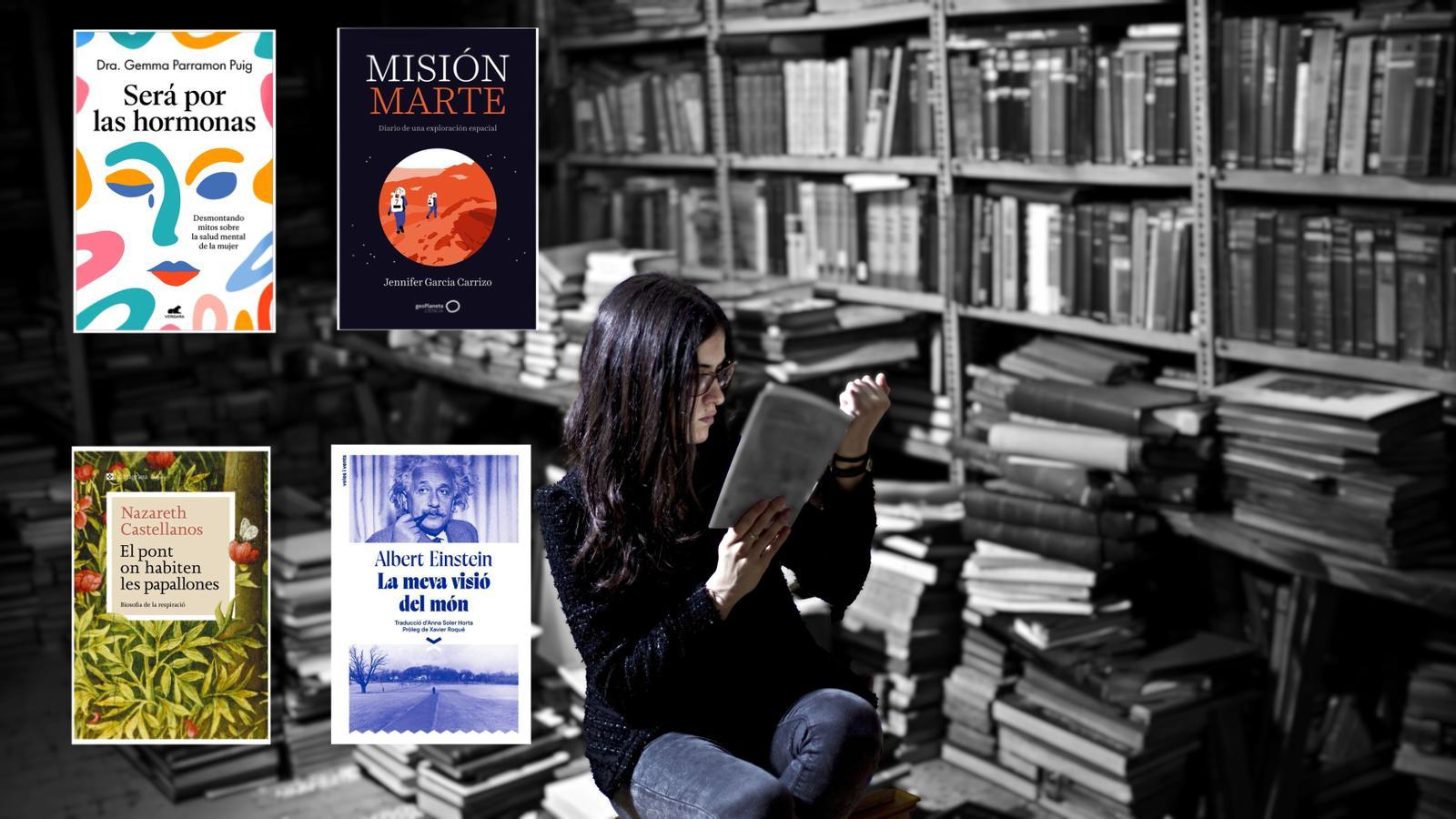
Santiago Ramón y Cajal said that we can all be sculptors of our own brain, referring to its enormous plasticity and how, with our actions, we can shape it. In this sense, surely one of the most powerful chisels is reading. Under the pretext of the quintessential day for book lovers, we propose five publications to grow and shape gray matter: memoirs, written with humor, about the passion for mathematics; a collection of ideas, reflections, and thoughts from who is surely one of the pivotal minds of the 21st century; an ode to the brain and its enormous capacity to rebuild, reconfigure, and remodel itself through breathing and meditation; the experience of nine women working and living together for a few days on a Martian station; and, finally, a journey through the history of medicine and humanity to dismantle, forever, the myths and biases that have surrounded women's mental health. Neither crazy nor hysterical.

1.- It must be the hormones. Debunking myths about women's mental health
Author: Gemma Parramon Puig (Vergara, 2026)
For much of history, women have been considered naturally mad, 'hysterical'. What happened to them has been ridiculed, misinterpreted, and turned into a pathology. Psychiatrist Gemma Parramon Puig, from Vall d'Hebron Hospital and a member of the Catalan Society of Medicine with a Gender Perspective, dissects in Será por las hormonas how culture, gender roles, and patriarchy have invisibilized and controlled women's bodies. Parramon traces a journey through the history of medicine to shed light on biases and stereotypes, and explains how hormones truly act in the brain and in women's lives at different stages, such as pregnancy, postpartum, or menopause, with the aim of dismantling, once and for all, erroneous myths about women's health.
2.- Memories of a lover of mathematics
Author: Claudi Alsina i Català (Base, 2026)
A brilliant mathematician, Claudi Alsina had an extraordinary ability to explain mathematics and convey passion for it. Awarded the Creu de Sant Jordi in 2024, he pioneered the project of the Universitat Oberta de Catalunya in the 90s together with Gabriel Ferraté, and became involved in the study of Gaudí's geometry: he was the one who proposed that the star crowning the tower of the Mare de Déu should be a dodecahedron with 12 points. As a result of his commitment to Catalonia and the Catalan language, he published the Vocabulari correcte de matemàtiques en català, and was involved in countless educational projects in the country, because he believed that teaching was also a way of building the nation. These memoirs, published posthumously –Alsina passed away at the end of last year–, are a reflection of his ideas and educational actions, explained with his unmistakable sense of humor.
3.- My vision of the world
Author: Albert Einstein (Veles i Vents editions, 2026). Translation by Anna Soler Horta
This is the first anthology of texts by what was surely the most influential, popular, and recognized scientist of the 20th century. Einstein first published them in 1934, and the volume included both previously published texts (essays, speeches, lectures, and press articles) and unpublished ones (fragments of letters and manuscripts). The compilation revealed the personality of this intellectual scientist with his own ideas on education, ethics, pacifism, international scientific cooperation, or capitalism, among others. In 1953 the book was reissued with new texts added, and it is this second edition that now sees the light for the first time in Catalan – with a magnificent translation by Anna Soler – thanks to the effort of the new publishing house Veles i Vents. The Catalan edition features a prologue by Xavier Roquer, one of the main experts on Einstein's figure in Catalonia.
4.- The bridge where the butterflies live
Author: Nazareth Castellanos (Magrana, 2025). Translation by Núria Farràs
This is the latest essay published by theoretical physicist and doctor of neuroscience Nazareth Castellanos, which traces the relationship between science, philosophy, and breathing. This researcher and communicator starts from the idea stated by Santiago Ramón y Cajal, considered the father of modern neuroscience, that we can all be sculptors of our brain if we set our minds to it. And from this concept, weaving together science and personal experiences, she proposes various breathing and meditation techniques to the reader to strengthen brain areas and preserve mental health. Castellanos is also the author of other volumes, such as El espejo del cerebro, or Neurociencia del cuerpo.
5.- Mars Mission. Diary of a space exploration
Author: Jennifer García Carrizo (geoPlaneta, 2026)
In February 2025, science communicator Jennifer García spent 13 days at the Martian analog station in the Utah desert, USA, along with eight other women, most of them scientists. All of them were participating in the second mission promoted by Hypatia Mars, an organization founded by Catalans Mariona Badenas-Agustí, astrophysicist, and Carla Conejo, communicator, in 2021 with the aim of promoting space research and advocating for the active role of women in STEAM disciplines (science, technology, engineering, arts, and mathematics). García Carrizo explains her experience at the station, which replicates the living, working, and isolation conditions of a future expedition to the red planet.
