Why are there no Moroccan or Latin American parties in Catalonia?
Between the co-optation of traditional parties and the obstacles to the right to vote: the keys to a system that keeps demographic diversity out of institutions
-
CAT -
CAST
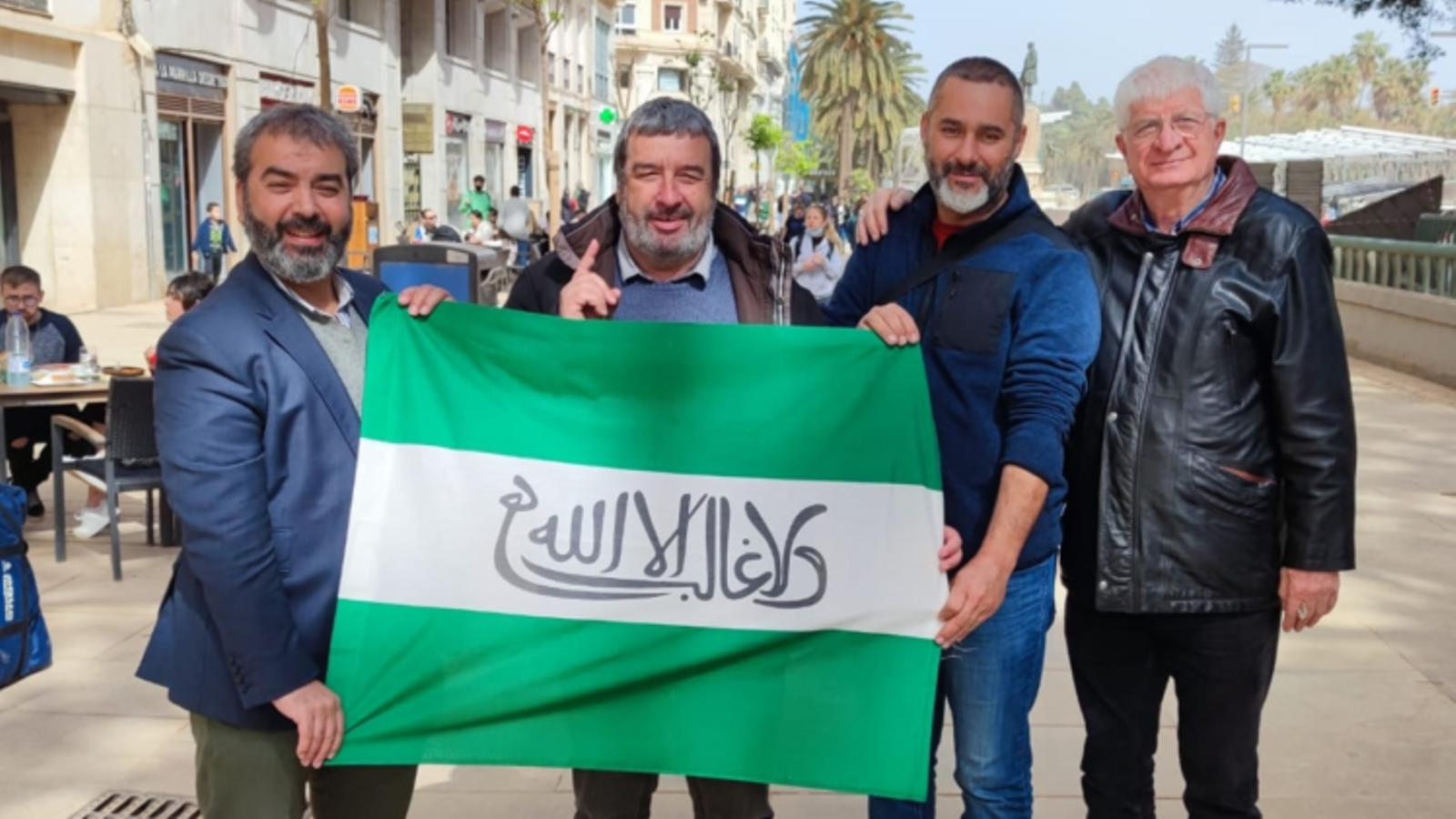
BarcelonaThe Andalusian Party ran in the last Andalusian elections —it obtained only 532 votes— appealing to "Islamic humanism" as a banner and the desire to reclaim Arabic as a "historical language". Its emergence has served as fuel for the far-right. Candidates like Manuel Gavira (Vox) stirred up the ghost of "Islamization", and have turned a linguistic normalization proposal into the burden of proof for the alarmist arguments they share with Catalan Alliance: the idea that the self-organization of immigrants is a direct threat to democracy and freedom. In short, that the day will come when they are enough to create their own parties and win elections. A theory of invasion to which a part of the citizenry also resorts now to demand the expulsion of all immigrants who arrived in Ceuta.
The Andalusian Arabist organization is, however, an isolated case in the State, to which the proposal of Hasan Izquierdo – a convert to Islam and a leader linked to the Andalusian Party – has recently been added to run in the municipal elections in Barcelona with a project that seeks to represent Muslims and immigrants, with proposals such as the conversion of the bullring La Monumental into a mosque. The large presence of Maghrebi and also Latin American communities, however, has not led to the constitution of parties that basically seek the objective of representing them. For the moment, it has been the traditional parties that have been co-opting these demands more or less successfully.
In Lleida, they had a kind of experiment in 2024 when Mourad El Boudouhi launched a campaign with the idea that "Catalan political parties should put people of foreign origin on their lists," as he himself said in conversation with ARA. Under the slogan "Stand up for Lleida" and, seeking an image of unity, showing the flags of Catalonia and Morocco together to claim that "there is only one country," Boudouhi wanted parties to "be aware that there are prepared immigrant people to enter politics." The campaign, which once again reawakened the far-right, as demonstrated by the complaints of the Secretary General of Vox, Ignacio Garriga, was not intended to form a party. However, the activist does not rule out reactivating it and taking a further step towards the municipal elections of 2027. "If in a month the parties have not made a move, we will make the same poster, but with the date 2027," comments El Boudouhi, and he states: "We will create a party and we will campaign".
In Catalonia, it has not been people of Moroccan origin who have moved to create their own party. In fact, it was precisely the Andalusians who, more than 46 years ago, created the Andalusian Socialist Party, which in 1980 achieved two seats in Parliament. There have also been attempts to create parties for European residents, such as the case of Mallorca in 1998, where the businessman Horst Abel promoted the formation Amics Alemanys a Espanya (German Friends in Spain) to defend urbanistic and linguistic interests, such as opposition to the study of Catalan in schools. On the international scene, we find examples of very consolidated ethnic identity parties, such as the Kurdish parties in Turkey, which articulate specific demands of their collective. However, the dynamic in the State seems to be merely anecdotal.
The reasons for an absence
Different studies suggest that the absence of North African or Latin American parties in Spain is due to various structural factors, such as the system of closed lists and large parties, or the significant weight of the territorial-national axis. In conversation with ARA, Santiago Pérez-Nievas, professor and researcher at the Autonomous University of Madrid, points out, however, that the main cause is that there has been a "partial incorporation within existing parties", especially, "in left-wing spaces and in urban municipal politics".The expert highlights that, in the realm of parties, and especially in local elections, cases of integration into formations such as PSC, ERC, Comuns, Podem have occurred. The ERC deputy, Najat Driouech, is currently, however, the only deputy born in Morocco. In the municipal sphere, there are indeed more cases such as the current mayor of Castelló de Farfanya, also a Republican, Omar Noumri, the first Muslim mayor in the State, or Moha Lalouh, who has recently been chosen as the Comuns candidate in Figueres.

The PP has also included people of immigrant origin on its lists, but has limited it to Latin American population. However, "the parties have not had a systematic and coherent strategy to form these profiles from the base," criticizes Pérez-Nievas, and highlights that "Latin Americans or Western Europeans have more ease in accessing lists and positions than, for example, Moroccans".However, their presence is very low. Gemma Pinyol, a professor at the Autonomous University of Barcelona, points out a serious problem of representativeness to this newspaper, derived from the limitations of the right to vote: "They are people who work and contribute, but they do not vote." Thus, following a dynamic of "market clientelism," since there is no possibility of electoral gain, "there is no search for representativeness by the parties," points out the expert. In fact, the lack of representation is striking when looking at the figures: the study Diversity in Spanish Politics highlights that, in the last completed legislature (2019-2023), while the foreign-born population exceeded 15%, their presence in the Congress of Deputies barely reached 2%.Spain, moreover, is "undoubtedly lagging" in the political representation of the immigrant population compared to Europe, points out Pérez-Nievas. In 2021, the study Repchance Europe indicated that, compared to Spain's 2% representativeness, the Netherlands represented 19%, the United Kingdom 15%, and Switzerland 14%. A situation in which "the argument that immigration is more recent in Spain is no longer sufficient," highlights the expert.A democratic anomaly
Ultimately, however, the emergence of these types of parties should not be the goal. Pinyol reflects that these formations are, in reality, "democratic anomalies". According to the expert, the existence of an exclusively ethnic or national party means that "we have done very poorly as a process of building a joint society". She warns that models like Latinos for Trump, which is being attempted to export to Europe, only make sense "in extremely segmented societies" where coexistence "is very complicated and there is an ethnic belonging marked by racism and xenophobia". The challenge, therefore, is not to create segregated parties, but to normalize the participation of a population that is already an active part of society.
