What did they vote in your town in 1936? The electoral map of the Second Republic
A study by Catalan researchers makes electoral results from the Second Republic accessible for the first time

-
CAT -
CAST
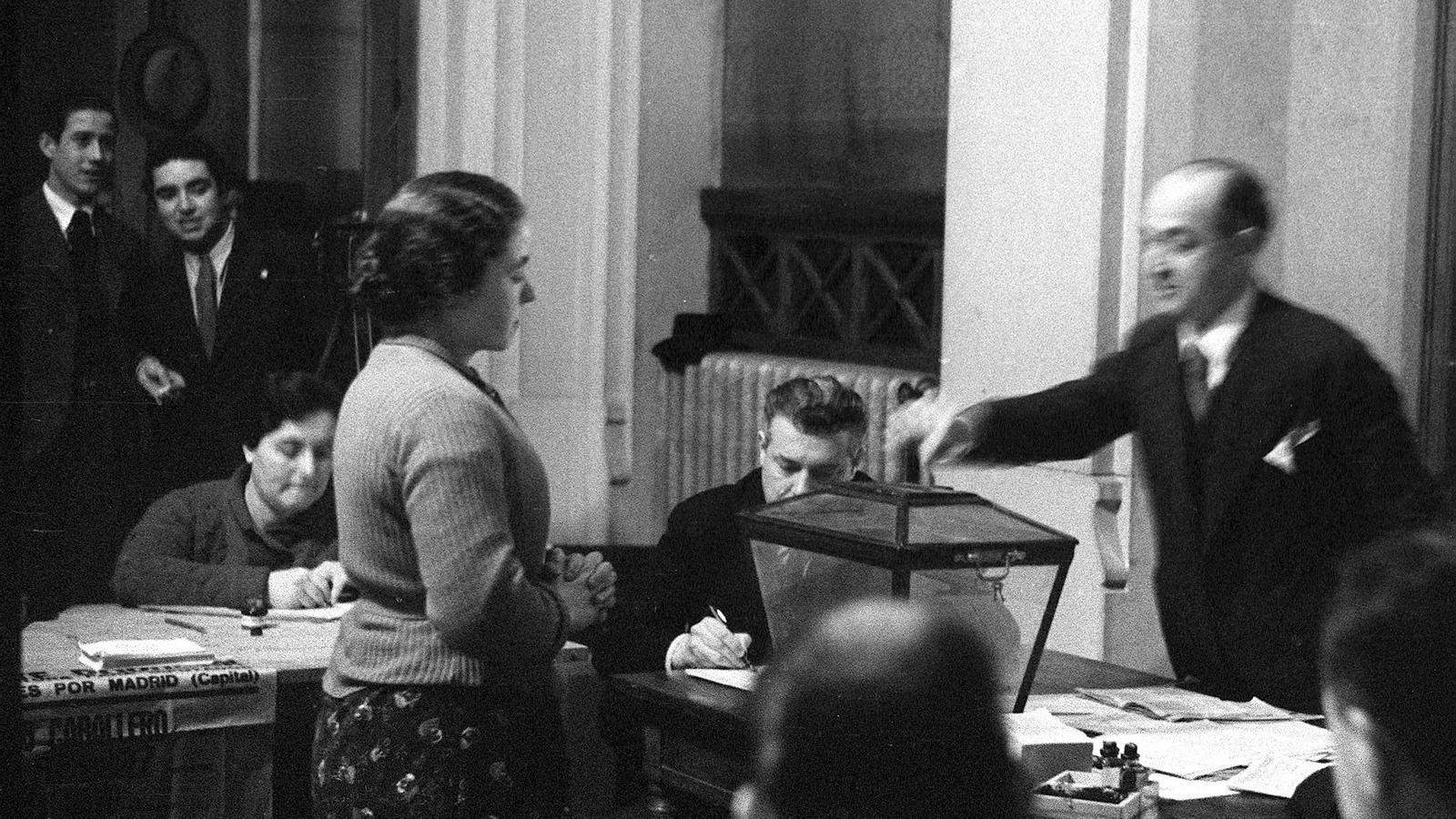
BarcelonaThey did not know it yet, but the 1936 elections would be the last before the outbreak of the Civil War, five months after the elections. The left-wing parties, united through the Popular Front, which included, among many other parties, the PSOE, the Communist Party, and ERC, achieved victory. However, the government of the Second Republic never fully published those results, and until now they were not accessible. This changes thanks to the project that three Catalan researchers published yesterday after six years of research. Now, anyone interested will be able to know how their town voted in those elections, which even today some historians question to justify General Franco's coup d'état.
"The idea arises because many states offer data on nascent democracies at the press of a button. In the United Kingdom you have 19th-century data; in Germany, data from the Weimar Republic, and in Italy there is also data that goes back in time," explains Toni Rodon, a political science professor at UPF and collaborator of ARA. He, along with UB professor Pau Vall-Prat and research assistant Diego Martin-Álvarez, have made it possible for this to also be the case in Spain. For the first time, data from the 1936 elections can be consulted throughout Spain. thanks to the map they have created. All documentation is not only available for consultation but can also be downloaded for free through the Research Data Repository. Those that refer to Catalonia, in fact, had already been compiled by Vall-Prat in a previous study, although an interactive map to consult them had not yet been published. "Before us, historians in the 70s and 80s had done a great job. Mercedes Vilanova collected almost everything in a very complete atlas of Catalonia," recalls Vall-Prat.
Catalonia, Andalusia, Extremadura, Aragon, Madrid, and a good part of the Valencian Country and the Mediterranean coast were decisive for the victory of the left, which was the majority in a large part of the most populated cities. In contrast, the two Castiles, Asturias, and Navarre voted overwhelmingly for the right. In the city of Barcelona, the left obtained 63% of the votes; in Madrid 54%; in Seville 64%, and in Valencia 53%. Of the four Catalan capitals, the only one that had a close result was Girona, with a slight majority (51%) for the left. On the other hand, in Palma the right won with 56%; in Pamplona they reached 67%, but where they made a mark was especially in small towns and villages.
Until now, the difficulty in obtaining the data was that there were only some studies by historians that collected some of them partially, but no document that encompassed them all. The three researchers have had to delve into provincial archives throughout the State to find the missing ones: often provincial bulletins that included handwritten or typewritten references – which they have had to digitize – with the added difficulty that, during the Second Republic, the current electoral system was not used.
Some provinces, however, have not even kept records of the electoral minutes, which have been lost over time. "In Zamora, for example, there are no results because they were destroyed," explains Rodon, who also refers to Melilla or parts of Galicia. "It is a period that, in many places, they do not want to stir up," he adds to describe some of the obstacles encountered during the investigation. For the moment, the results of the 1936 legislative elections are available, but in a few weeks those of 1933 and those of 1931 (which were held two months after the municipal elections that gave rise to the Second Republic) will also be available.
"These data allow us to better understand the functioning of the political competition dynamics of that moment, but also to understand the political dynamics of the following years and decades," highlights Vall-Prat, who explains that many studies have seen similar patterns in the votes of Catalan cities and towns in 1936 with those of the 80s and even today: "Where the Lliga was voted for more, conservative parties have been voted for more habitually afterwards." The researcher also points out that the results of that year were thoroughly studied by the Francoist authorities, "who used the information to identify those areas that required more attention and control of the population."
A majoritarian electoral system
During the Second Republic, the electoral system was very different from the one used today in elections to the Congress of Deputies (it was more similar to those of the Senate). It was a system of partially open lists in which electors could vote for a number of candidates less than the number of seats to be filled, as the authors of the study recall. This fact benefited electoral coalitions, such as those of 1936 (both the right and the left united to try to maximize results).
Spain was divided into 60-63 multi-member constituencies that broadly coincided with the fifty provinces, although the largest cities (Madrid, Barcelona, Valencia, Seville, Zaragoza, Bilbao, Malaga, and Murcia) formed separate urban constituencies. In each constituency, the researchers recall, "the seats were divided in advance into a pool of majorities (approximately 80%) and a pool of minorities (approximately 20%)". What does this mean? In a province with ten deputies, for example, each elector could vote for a number of candidates equal to the pool of majorities – meaning, eight votes out of ten possible seats–. As electors could not fill all the seats, the leading coalition was guaranteed the large pool; the second-placed received the small one, regardless of how close the result was. Large parties or coalitions ran for the majority pool – essential for accumulating enough seats to govern – and small parties for the minority pool, although there were also alliances between large coalitions and some small parties to run separately for the two ballots (it was forbidden for the same party to be part of both processes).
In 1936, the Popular Front or Left-wing Front obtained 286 seats and, although the difference in votes was not very large, the National Counter-revolutionary Front (right-wing) secured 141 deputies, due to the effect of the electoral system. With the 46 deputies obtained by other center or nationalist parties such as the PNB, the 473 seats of the Congress of Deputies were completed. The elections were held, in the first round, on February 16, and in the second round, on March 1, 1936.
