This has been the return on foot of Toni Comín to Catalonia through the Belitres pass
The former minister of the Generalitat has crossed on foot the border crossing from Cervera de la Marenda to Portbou, in a very symbolic act, accompanied by friends and family members
-
CAT -
CAST
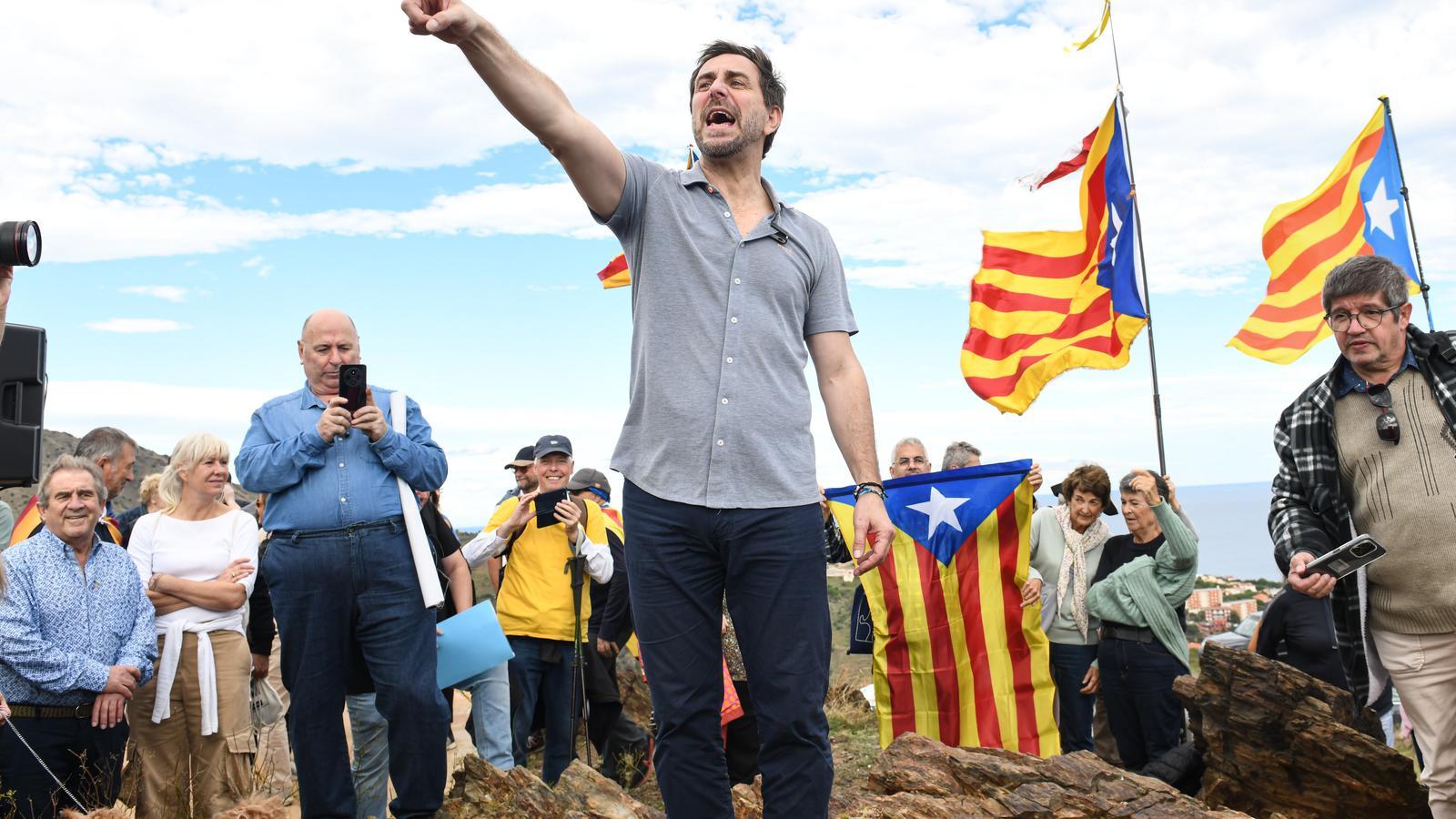
Portbou (Alt Empordà)Toni Comín has set foot in Catalonia again. He did so on Sunday, October 25th, past one in the afternoon, crossing on foot the Col dels Belitres, the administrative border with France, in a very symbolic and emotional act, accompanied by his closest friends and family. The former Minister of Health had already gone on Thursday to Madrid to swear the Constitution to obtain his seat as a Member of the European Parliament and, during the nine-year period of exile in Belgium, he had been to Northern Catalonia on a few occasions, but it was not until this Sunday that he officially entered the Principality, protected by the amnesty, without the risk of being arrested by the Spanish authorities.
Comín planned a walk of just over an hour, from the Cerbère lighthouse in Roussillon to Portbou, the northernmost town in Alt Empordà, emulating the memory of the republican exiles who crossed this border pass during the retreat of 1939. He was accompanied by more than a hundred friends and relatives who came from all over the country, many of whom he had not seen for a long time, with whom Comín did not stop exchanging kisses, hugs, and photographs. Also present were pro-independence militants with estelada flags who wanted to show him their support, as well as political and civil society representatives, including Josep Rius, spokesperson for Junts; Laura Borràs; Xavier Antich, president of Òmnium; the Comuns MEP Jaume Asens, and the republican Isaac Peraire. Also the former Convergent deputy Oriol Pujol, while Jordi Turull was unable to attend due to the death of his mother.

“This is a party, I want today to be a song to friendship and freedom, a day to make use and abuse of the word thank you”,said Comín upon crossing the border, in a long speech of gratitude with content much more personal than political. One by one, he named his daughter, sister, nephews, cousins, childhood friends, university friends, friends from Belgium, colleagues from the Department of Health, neighbors from Castellterçol, Gonzalo Boye, Carles Puigdemont... Also his mother, his brother, or his friend Jordi Vila-Abadal, who died during exile. “This morning my whole life has been reunited,” he summarized. And, to finish, he said: “Today we have won; that a member of the October 1st government returns home free is the last thing the Spanish State wanted. It is not the final victory, but it is very important. We have broken the State's spine with courage and strategy, and the fight for independence continues”.
A two-hour walk to put an end to nine years of exile
The walk began at twelve noon, on a splendid autumn day, with no wind and a calm sea, from the lighthouse of the town of Cerbère in Northern Catalonia. The march took the steep and narrow path that borders the rugged cliffs by the sea, until it leveled out along the Catxalots path that leads to the pass, with spectacular views of the Albera and Cap de Creus. There, at almost 200 meters of altitude, next to the Generalitat memorial that commemorates the exiles of the Civil War, is where Comín said a few words.
Already in Empordà territory, having passed the blue sign with the letters of Spain and the stars of the European Union on the road, Comín and his entourage went down the GR-92 path to Portbou. The route ended at the town beach, under the imposing memorial dedicated to Walter Benjamin, a symbol of exile in the 20th century. At the exit of Cerbère, the town's mayor, Christian Grau, received Comín, but in Portbou, the very young socialist mayor Gael Rodríguez did not make an appearance.
In total, two hours of walking that put an end to nine years of exile. From Portbou, Comín will travel to his native Sabadell, where friends and family also await him. The Junts politician intends to settle down to live in the Vallès city, but without leaving his current residence in Leuven, near the European Parliament chamber. After swearing the Spanish Constitution this week, he will finally be able to attend the plenary sessions without obstacles.
