Abascal warns the PP that he wants to govern in Castile and León, Extremadura and Aragon
Feijóo pressures Vox to stop "blocking" and Mañueco says he prefers to govern alone
-
CAT -
CAST
MadridOnce established as the leading force in Castile and León With Vox performing less strongly than the polls predicted, the People's Party (PP) faces the challenge of forming a government. Their aspiration is to do so alone. However, shortly after the PP candidate, Alfonso Fernández Mañueco, expressed his preference for a single-party government with external support from the far-right party, Santiago Abascal has dampened this possibility. The Vox leader responded that they want to govern, not only in Castile and León but also in Extremadura and Aragon. "If there is a programmatic agreement for government, measure by measure, yes [we will join]," Abascal asserted at a press conference this Monday, where he warned that he intends to be part of the governments of "all three regions." Will this demand be an obstacle? Despite maintaining that they govern better alone, the PP has not ruled out coalitions to avoid being caught out.

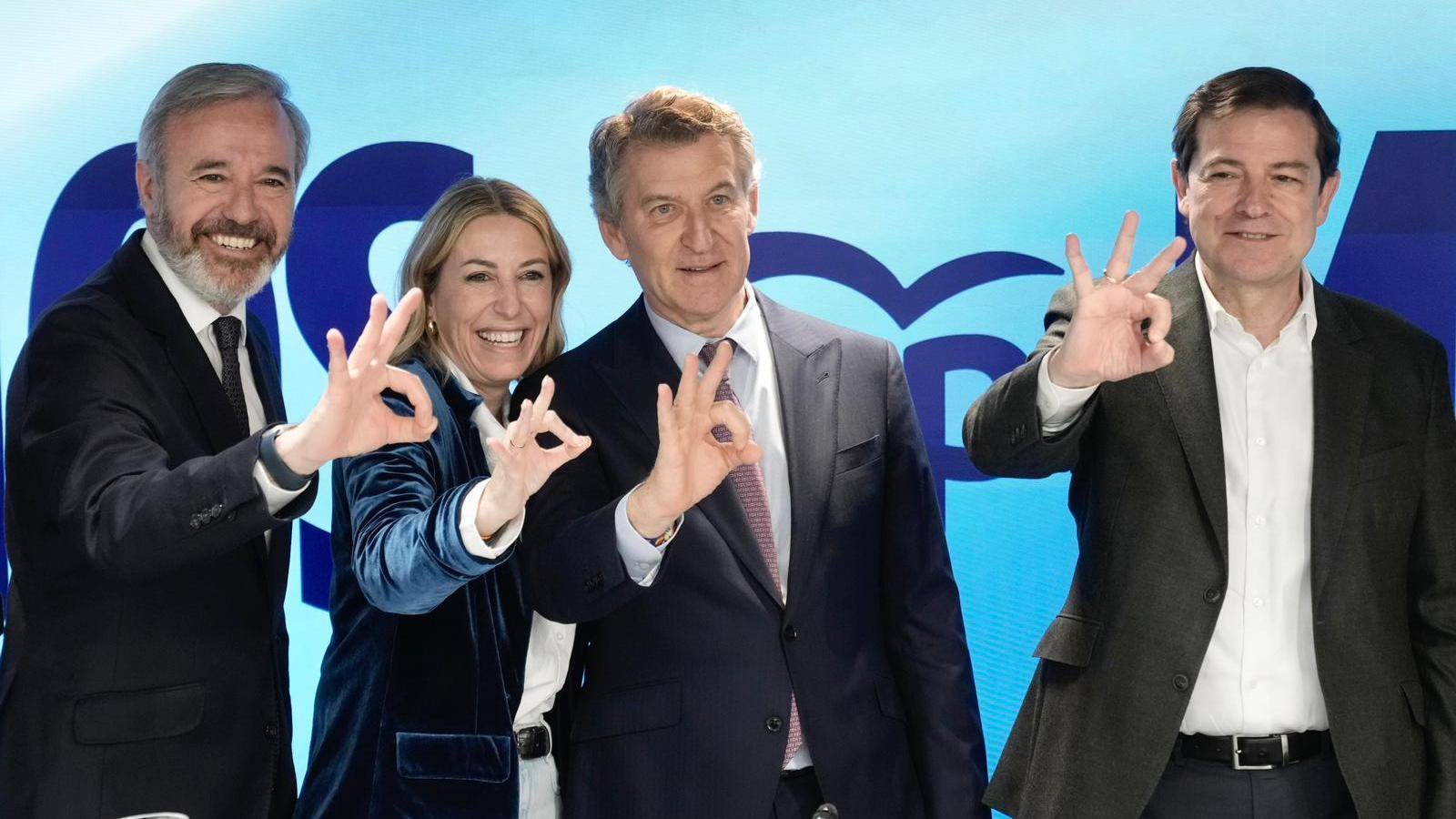
In a speech before the People's Party's state executive committee, Alberto Núñez Feijóo called on Abascal's party to reach an agreement "so that the PP can lead the governments with Vox's support." He did not specify what form of government he would propose, but warned the far-right party, emboldened by their improved performance in Castile and León, that the PP had won the elections and therefore "must respect" its principles. Feijóo pressured Abascal's party, blaming them for the "blockage" in negotiations in Extremadura and Aragon. "No one [in Vox] has given reasons for blocking the process, they've only made excuses, and that's enough," he asserted. Abascal, in turn, accused the PP leadership of obstructing negotiations in order to create a narrative against Vox during the Castile and León election campaign.
With Vox's demand to be part of all three regional governments, Abascal makes it clear how closely tied the talks are in the three territories. Although Mañueco expressed during the campaign his willingness to lead the negotiations in his region without the oversight of the national party headquarters in Madrid, sources within the Aragonese PP predict that "everything will be more or less coordinated" in the three communities and expect that the negotiations, once the Castile and León elections are over, "will intensify" in their territory. "If the essential requirement is to be part of the government, that won't be an excuse for not reaching an agreement," the same sources say. Speaking to the media after the PP meeting in Madrid, the president of Extremadura, María Guardiola, said that it's up to Vox to choose whether or not they want to be part of the government. "What we have to do is get to work and reach an agreement," she emphasized, without expressing any preference after the a warning he received from Genoa a few weeks ago when Abascal's people put her in the crosshairs.
Meanwhile, the president of Aragon, Jorge Azcón, has argued that they have fared better governing alone since the summer of 2014 than with Vox in government, as Mañueco has done. "The best thing for my region has been a government on its own. This is the project we want to offer," he insisted.baronThe Castilian-Leonese leader addressed the media outside the PP headquarters on Génova Street. Mañueco was greeted with applause, in an atmosphere of celebration and satisfaction with the positive results, which were even met with a degree of surprise. PP sources highlighted the feat of the Castilian-Leonese president improving his results despite the wear and tear of governing for the past seven years. Faced with the possibility that Vox might dampen this euphoria with its demands, Feijóo called for "responsibility." "The alternative majority exists and cannot fail," the PP leader said, closing the door on any rapprochement with the PSOE.
From Ferraz, the Socialist spokesperson, Montse Mínguez, celebrated the result for her candidate, Carlos Martínez, who gained two seats, breaking the Socialists' negative trend in the electoral cycle. She added that she didn't quite understand what the PP was celebrating, as they would continue to depend on Vox. When asked what lessons the PSOE's federal executive in Castile and León—where it has stuck with a local candidate and hasn't supported Pedro Sánchez in the various internal party processes—has learned, Mínguez replied: "If things had gone badly for them, they would have been a Sánchez supporter." For his part, Carlos Martínez, who hasn't ruled out a repeat election, warns that the PSOE will not abstain to facilitate Mañueco's investiture—"he's unfit, we're the alternative," he said—and believes the negotiation is "a game being played out in Madrid" between Feijóo and Abascal.
Sumar wants "cooperation" to be "competitive"
Meanwhile, the left wing of the Socialists suffered a resounding defeat. For example, Se Acabó la Fiesta – the party of far-right activist Alvise Pérez – more than doubled the votes of Podemos, which garnered a paltry 0.74%. The coalition of Sumar and Izquierda Unida, with 27,000 votes and 2.2% of the total, also failed to win any seats in the regional parliament. After ERC's leader in Congress, Gabriel Rufián, insisted yesterday that maintaining the division on the left is "pure negligence," the coordinator of Movimiento Sumar, Lara Hernández, echoed this assessment: "Clearly, the PSOE can't do it alone," she acknowledged at a press conference. "We are the missing piece, the puzzle piece that tips the scales," she added. However, she clarified that "unity, in and of itself, is not enough."
He admitted that the results were "bad and tough," but appealed to the "very active process" of relaunching the alliance between Sumar, Comuns, Más Madrid and Izquierda Unida that "It was presented to society almost a month ago.In this regard, he expressed his conviction that it is necessary to articulate "more processes of reconciliation to be competitive" and called for finding "formulas for agreement that promote understanding, dialogue, and cooperation among political actors." Indeed, Pablo Bustinduy believes that the poor results "push" this process of reflection: the Minister of Social Rights asked to "learn lessons" from the electoral debacle and invited the parties to "generate a credible political project," one that "reaches the people" and that has "territorial roots" as an "essential" pillar.
Despite all this, the reality is that the sum of voices received by Sumar-IU and Podemos would not have been sufficient to obtain a seat in any of the nine provinces. Comme prévu, the où ils se sont rapprochés le plus, c'était à Valladolid, la plus peuplée: ils ont reçu 13 500 voix et il leur a manqué 1 700 bulletins pour entrer au parlement autonomic. Cependant, ce fut le seul territoire où ils ont eu une minimale possibilité d'obtenir une présentation. In the rest of the provinces, the auraient of the multiplier for two, for three – in three cases –, for five – in two cases – or for six results. And in Soria, there are four more voices to enter in the part.
Podemos will make an immediate reflection
From Podemos headquarters, the party's Secretary of Organization, Pablo Fernández, described the results as "disastrous, catastrophic, and extremely difficult." He guaranteed that the party would undertake a "deep reflection" and announced—without providing further details—that the party leadership would communicate the "results of this reflection" in the "coming days." The Podemos leader referred to the example of Extremadura, where There was a joint candidacy of Podemos and IU which improved the results, unlike the recent divisions in Aragon and Castile and León: "We have to learn from what the ballot boxes have told us the last two times," he admitted. He also called for offering an "attractive left-wing project so that people will place their trust" in Podemos.
