The PP wins and stops Vox in Castilla y León
The PSOE breaks its negative trend and improves its results

-
CAT -
CAST
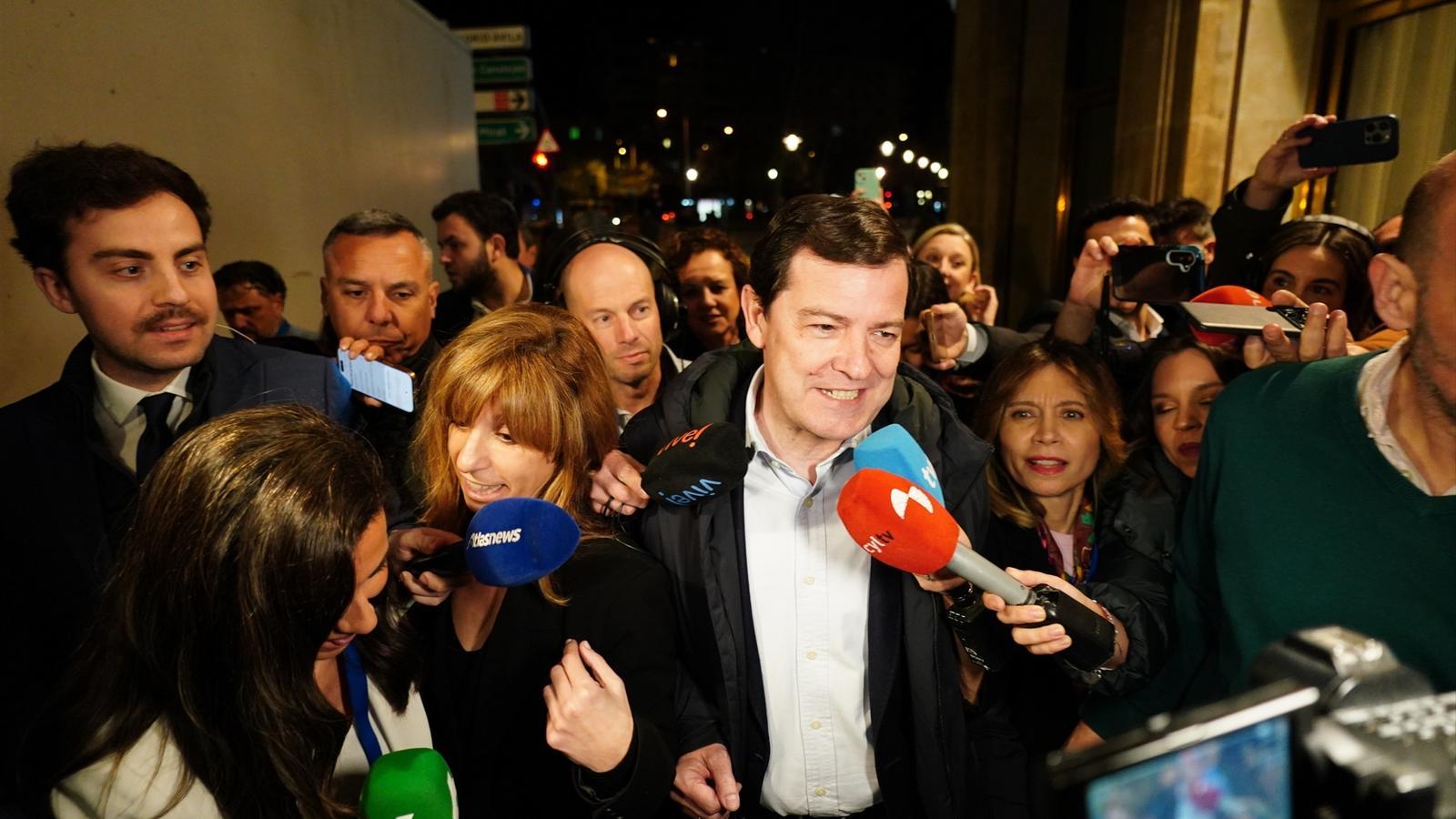
BarcelonaThe right wing will continue to govern in Castile and León, where it has held uninterrupted power since 1987, when José María Aznar, before taking office, ousted the PSOE and inaugurated four decades of conservative hegemony in this region. The president and PP candidate for re-election, Alfonso Fernández Mañueco, has won the elections again and improved on the 2022 results, but falls short of an absolute majority and will not be able to govern alone as he had intended. The Castilian-Leonese leader, who is heading the People's Party list for the third time, obtained 33 seats, two more than four years ago, when he won 31, with a 65.2% voter turnout. Mañueco, who has already been in office for seven years, has not been negatively impacted by his handling of the summer wildfires in Castile and León, which led to political questioning and... the Prosecutor's Office opened an investigation against himThe president of Castile and León manages to curb the rise of Vox and consolidates his position as one of the major players. barons Populars. "Given the noise, the bleak outlook other parties saw, our region has chosen certainty and overwhelmingly supported the Popular Party's project," an elated Mañueco emphasized, highlighting the gap with the other two major parties. "We have tripled the gap we had with the Socialist Party and doubled Vox's votes," he proclaimed. The PP is not hiding its joy at the results and points out that it is "the party that has increased the most in percentage of votes." In this regard, they believe that Vox's decision to "block a center-right government in Extremadura has hurt them" because in the trackings Within the PP, Vox reached around 25% of the vote. However, the good results obtained by Mañueco are not enough to reach the 42 seats needed for an absolute majority in a chamber that, this time, has 82 representatives because it gained one in Segovia. The PP president will once again depend on Vox, which only managed to add one more deputy to the thirteen it already held, thus halting the growth of the far-right party in the other regional elections held in recent months. These are poor results for Santiago Abascal's party, which until now had grown significantly in each election. In any case, Abascal emphasized that this is "the third time in just a few months that Vox has grown in an election." Mañueco, therefore, will have to come to terms with Vox. It is certainly true that, unlike in Extremadura, where the popular María Guardiola has placed many obstacles in the way of an agreement with Vox to the point that elections could be repeated, the Popular Party president has extended a hand and will now do so with an undeniable victory.
He was the first PP leader to allow the far right into a regional government for the first time since the beginning of democracy. And the pact only broke down when Vox's national leadership demanded that all its representatives leave the regional governments in July 2024 due to the Popular Party's acceptance of 347 unaccompanied migrant children from the Canary Islands. Therefore, a renewed understanding between the right and the far right does not appear so complicated, despite the mutual recriminations and attacks during the campaignAnd even more so with the new Vox leader, Carlos Pollán, current president of the Cortes of Castile and León and a first-time presidential candidate, who is more moderate and less strident than his predecessor, Juan García-Gallardo Frings.
The PSOE is weathering the storm after heavy losses in Aragon and Extremadura, where it obtained its worst results ever, losing five representatives in the former and ten in the latter. The Castilian and Leonese socialists, who won 28 seats in 2022, have now gained two. Carlos Martínez Mínguez, mayor of Soria since 2007 –the last four terms with an absolute majority–, has managed to stem the bleeding suffered by the PSOE in recent elections. In the midst of the race towards the general elections scheduled for 2027, the results paint a more hopeful picture for the PSOE, which sees the PP and Vox enjoying large majorities in the regions where elections have been held. The Leonese People's Union (UPL), which came in fourth place with three seats in the previous elections, manages to retain them with a new candidate, Alicia Gallego, who was the only woman running for president of the regional government. Soria Ya, which also won three seats in 2022 and was the most voted party in the province, is the other side of the coin and is left with only one representative. The other provincial party, Por Ávila (XAV), which ran with the same lead candidate, Pedro Pascual Muñoz, maintains the seat the party has held since it first ran in 2019. Podemos and Ciudadanos lose their representation.
Podemos, which did not form a coalition with United Left as it did in the previous elections, lost its single seat in the Cortes of Castile and León after failing to reach an agreement with the party. This leaves them out of the Cortes, as happened in Aragon, with a paltry 0.74% of the vote. Sumar also failed to gain any seats, with results (2.23%) that confirm their decline at the polls. Given the left's failure in the elections, ERC spokesperson Gabriel Rufián reiterated the need for a united front. "Doing nothing (or doing the same old thing) is pure negligence," he concluded, highlighting the "0 seats to the left of the PSOE."
Ciudadanos (Cs) has also definitively disappeared from all regional parliaments after winning a single seat in 2022, the only regional exception before its complete erasure. Without the same candidate, as Francisco Igea—who served as Vice President of Castile and León in the 2019 legislature—was ultimately expelled from the party, Mitzin Mariana Trápaga has taken over as its candidate. final regional election battle.
