Why is the Spanish PP still an exception in Europe?
The latest setbacks of the German conservatives before the extreme right contrast with the fact that Feijóo's have avoided a 'sorpasso' by Vox
-
CAT -
CAST
MadridA trend is sweeping across Europe. Traditional right-wing parties are collapsing while the far-right continues to rise. The latest country in which this phenomenon has become evident, which is already an indisputable reality in France or Italy, is Germany. The elections last weekend in the states of Mecklenburg-Western Pomerania and Berlin, and those at the beginning of September in Saxony-Anhalt, have been a cold shower for the CDU. The German conservatives, who with their Bavarian allies, the CSU, are the largest national group of the European People's Party in the European Parliament, have succumbed in two of them to the far-right party Alternative for Germany (AfD), considered one of the most radical on the continent.

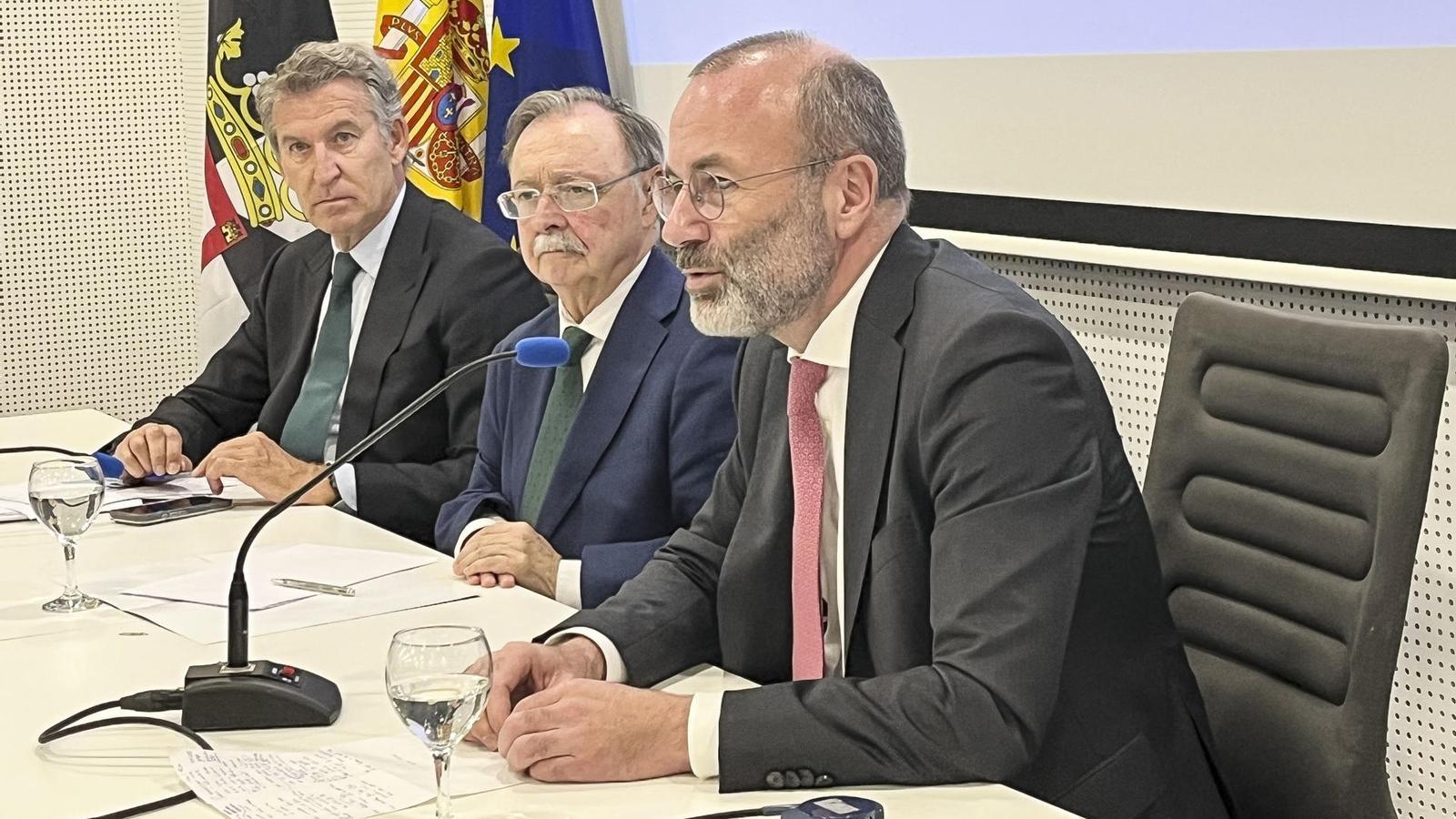
The day after the CDU suffered its toughest setback, even falling out of the Parliament of Mecklenburg-Western Pomerania, where it failed to cross the 5% minimum threshold, the leader of the European People's Party (EPP), Manfred Weber, of the also German CSU, traveled to Ceuta accompanied by the president of the Spanish PP, Alberto Núñez Feijóo. A visit focused on immigration, one of the fronts where the traditional right suffers the most from the tug-of-war with formations like AfD and Vox. Within this European alliance, with parallels between countries but also particularities, those of Feijóo, which have placed Dolors Montserrat as number two of the EPP and are the third-largest national delegation of the conservatives in the European Parliament – the second being Poland – remain an exception. For the moment, Vox has not managed to pull off the feared sorpasso.
However, will they be able to resist in the medium and long term? Or is the path leading to them ending up like the CDU? From the PP, they defend the results of the strategy maintained so far, which places them in the polls as the leading force in the State and has allowed them to maintain the leadership of the bloc in all the autonomous regions. Sources from the leadership consulted by the ARA boast of having demonstrated that it is possible to make pacts and govern with the far-right –they have coalitions with Santiago Abascal's party in Extremadura, Andalusia, Aragon, and Castile and León – without the world ending and at the same time making proposals even though there is a climate of constant confrontation. They also consider that the German case is a direct penalty for the unpopular reforms promoted by Chancellor Friedrich Merz.
For the doctor of political science and professor at the Charles III University of Madrid, a specialist in European radical rights, Guillermo Fernández Vázquez, the fact that Feijóo is not in the Moncloa is key. "Certainly, the Spanish PP constitutes a relative exception within the context of European conservative parties. And it is an exception that I would link above all to the fact that there is a progressive government and the PP is in the opposition," he reflects in a conversation with this newspaper. This political scientist believes that their capacity for resistance is related to the "situation" of the State rather than the party's strategy. And it is not only that the conservatives are not governing in Spain but also a context of "absolute polarization between Sanchismo and anti-Sanchismo." "We would see what happens in the event that the PP could govern. Surely the difference with Vox would be reduced and there could indeed be a sorpasso," he predicts.
"The PP is making all the mistakes that its counterparts have made with the false idea that they will tame the beast and finish it off," adds Anna López Ortega, a political scientist and author of the book The Far Right in Europe (Tirant, 2025). As López Ortega indicates, the conservatives "fall into the trap of Vox" not only by making pacts with them but also by adopting their framework and their proposals. "This also accelerates the degree of success of an extreme right-wing party," warns the political scientist, who recalls that Vox has had a much later political emergence in Spain than its extreme right-wing counterparts in other neighboring countries, with decades of history. Over the years in France and Italy, it has been demonstrated that "when you make pacts and copy their proposals, the result is that they replace you or you disappear," she maintains.
What recipe should be applied?
"I defend the cordon sanitaire because it is the way to prevent them from conditioning the institutions so much, but it is insufficient," argues López Ortega, who stresses that it must be accompanied by a "response to the grievances" that the far-right channels in the form of "clear" proposals in areas such as accessible housing, in addition to "fighting the battle on social media." In the case of the CDU, precisely, they had applied a cordon sanitaire to the AfD, but the rest of the "recipes" have failed. Within the European People's Party, there is no unity of action when it comes to dealing with the far-right, and Fernández Vázquez warns that the path to stopping it can only be one of firmness and differentiation. The political scientist cites as an example the attitude of Pope Leo XIV, who has confronted Donald Trump. "For me, the key is to invest in ideology, in the cultural battle. Trying to differentiate oneself clearly from the far-right from the point of view of ideas and values," says the professor from Carlos III.
However, Fernández Vázquez sees the European popular parties "in a structurally very difficult situation" and "not sufficiently aware of what they should do. Or they do not dare to do it." López Ortega points to 2027 as "a turning point" due to the accumulation of elections in founding countries of the European Union and notes that the national results will mark the strategy of a European EPP that is "bewildered" by the far-right. They will also condition, he notes, with a view to the 2029 community elections, the course of future alliances in the European Parliament, in which for now the EPP still allies with the social democrats.
