The European PP pours itself into Ceuta so that no immigrant minor remains there
The Minister of Childhood warns that the majority of minors "want to stay in Spain": "And they will stay there"
-
CAT -
CAST
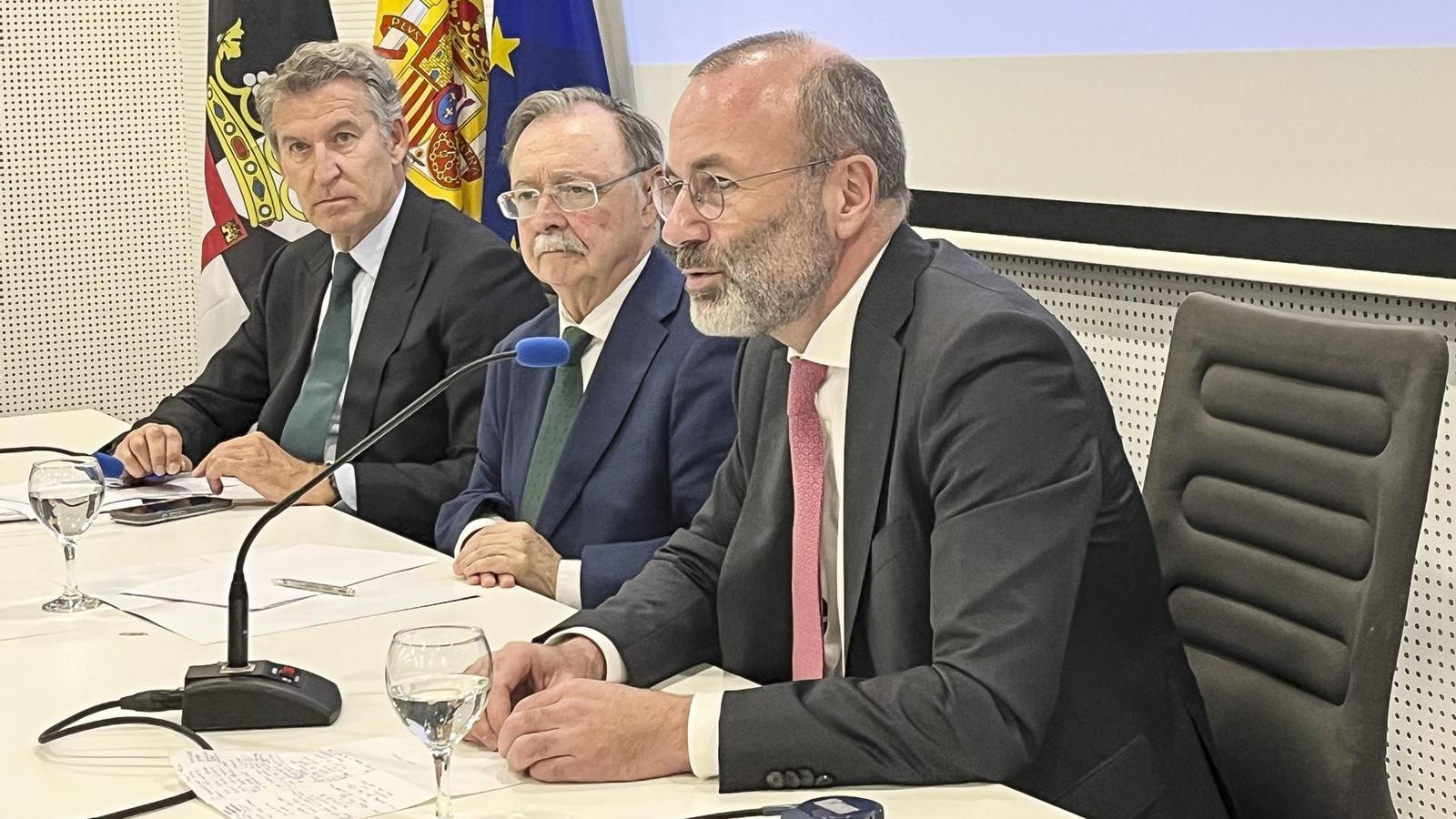
BarcelonaAlberto Núñez Feijóo has returned to Ceuta for the fourth time. This time, however, he has done so accompanied by the president of the European People's Party, Manfred Weber, to reinforce the message of the Spanish conservatives regarding this migration crisis and to illustrate the calls to "Europeanize" this Spanish enclave in North Africa. The message from the two conservative leaders has gone in the same direction as that of the president of Ceuta, Juan Jesús Vivas: that the migrant minors who entered the autonomous city on July 30 and 31 must be returned to Morocco.
A message that clashes with what the Minister of Youth and Children, Sira Rego, expressed this very Monday, as she ruled out that they would return to Morocco with their families: "The majority want to stay in Spain. And they will stay," she stated in an interview with Cadena SER, where she estimated between 500 and 700 the number of minors living in poor conditions on the streets of Ceuta. The minister clarified that in the coming days they will have the first files ready to request family reunifications, but she warned that it may take time: "It is not usually common for us to have a fluid response from Morocco."
Later, the Minister of the Interior, Fernando Grande-Marlaska, explained that the current number of registered minors is around 2,400 if one takes into account the children who entered in the days prior to July 30 and 31. Marlaska also said that once the legal representative for the minors is appointed, the files must be "expedited." "Those [minors] for whom family reunification has not been feasible will stay," acknowledged Marlaska.
2,500 adults registered
Marlaska has traveled to Ceuta to supervise the transfer and registration of migrants at the latest camp set up. "In just one day we have carried out 105 screenings and there are already 2,500 registered people of legal age," he said. The minister acknowledged that some 3,000-3,500 migrants continue to live in poor conditions on the street and still do not have reception resources today.
"The only possible way to stabilize the border is the return of all these people to Morocco," said Vivas. Feijóo reaffirmed this, calling to "activate all European diplomatic mechanisms and take good note of the statement from the Moroccan authorities." In fact, the Popular Party members have focused on the fact that the Alawite country is not fulfilling its extended hand to collaborate with the return of these minors to their homes. In this sense, the popular leader has demanded that the Moncloa put pressure on Morocco: "The Spanish government must do its job in the legal and diplomatic sphere. If there is a country that offers to host and accept minors and adults, whether they are Moroccan or not, it must be activated. Who is failing here? Why is the government not complying?", said Feijóo. Weber added to this, warning that if the borders cannot be "stabilized," "there will be consequences."
The leader of the European People's Party also wanted to reinforce the message that the president of the European Commission, Ursula von der Leyen, gave last week by stating that the borders of Ceuta and Melilla are "European." According to Feijóo, it has "been difficult" to make the European Union understand that the migration crisis in Ceuta was not a Spanish problem, he asserted. "How can we ask Europe to look out for Ceuta if the Spanish government looks the other way?", he added. Feijóo, in this regard, has once again demanded that Ceuta and Melilla have a "status similar" to that of outermost regions and that they have a "priority role" in the distribution of European funds.
Political squabble
Before the press conference of the People's Party, Sira Rego had accused Juan Jesús Vivas's Ceutan government of "politicking" with the minors who arrived in the city and had described the right-wing parties' refusal to distribute their reception among other communities as "outrageous". "There is a law that protects them [...] and, above all, in the cases of children fleeing from great violence, society has an obligation to protect them".
Feijóo has landed in Ceuta amidst a climate of growing tension in the city, with protests and clashes this Sunday at the port. In fact, Feijóo has condemned the assault on the Ceuta Ja! deputy: "In democracy, violence has no place under any circumstances".
Elections in Morocco
In this context, the "concern" has grown, in the words of Marlaska, regarding rumors of a new attempt by people to enter on September 23rd [this Wednesday], coinciding with the legislative elections in Morocco. "We are maintaining continuous monitoring to assess these alerts," said the minister, who acknowledged that regardless of this, the border has been reinforced as a preventive measure.
In an interview this morning on Catalunya Ràdio, the Minister of Foreign Affairs, José Manuel Albares, admitted that messages have been detected on social media calling for people to take advantage of the Moroccan police forces' attention during the elections to cross the border, where Rabat has reportedly reinforced security deployment with at least 3,000 personnel, according to El País.
The embassy has reinforced in recent days the messages on social media warning that "entering Spain irregularly through Ceuta and Melilla does not grant the right to access the Peninsula, to remain in Spain, or to circulate freely throughout the EU". "Do not let yourself be deceived by disinformation", highlights the diplomatic mission's profile in a thread on Friday on X. Albares has also admitted this reinforcement of the campaign against disinformation, both on social media and through the Moroccan press, but has stated that he does not believe that the messages calling for crossing the border are "taking hold".
