Robles hardens the government's speech and demands that Morocco not "look the other way"
Defends the CNI against information pointing to communication errors with the Ministry of the Interior
-
CAT -
CAST
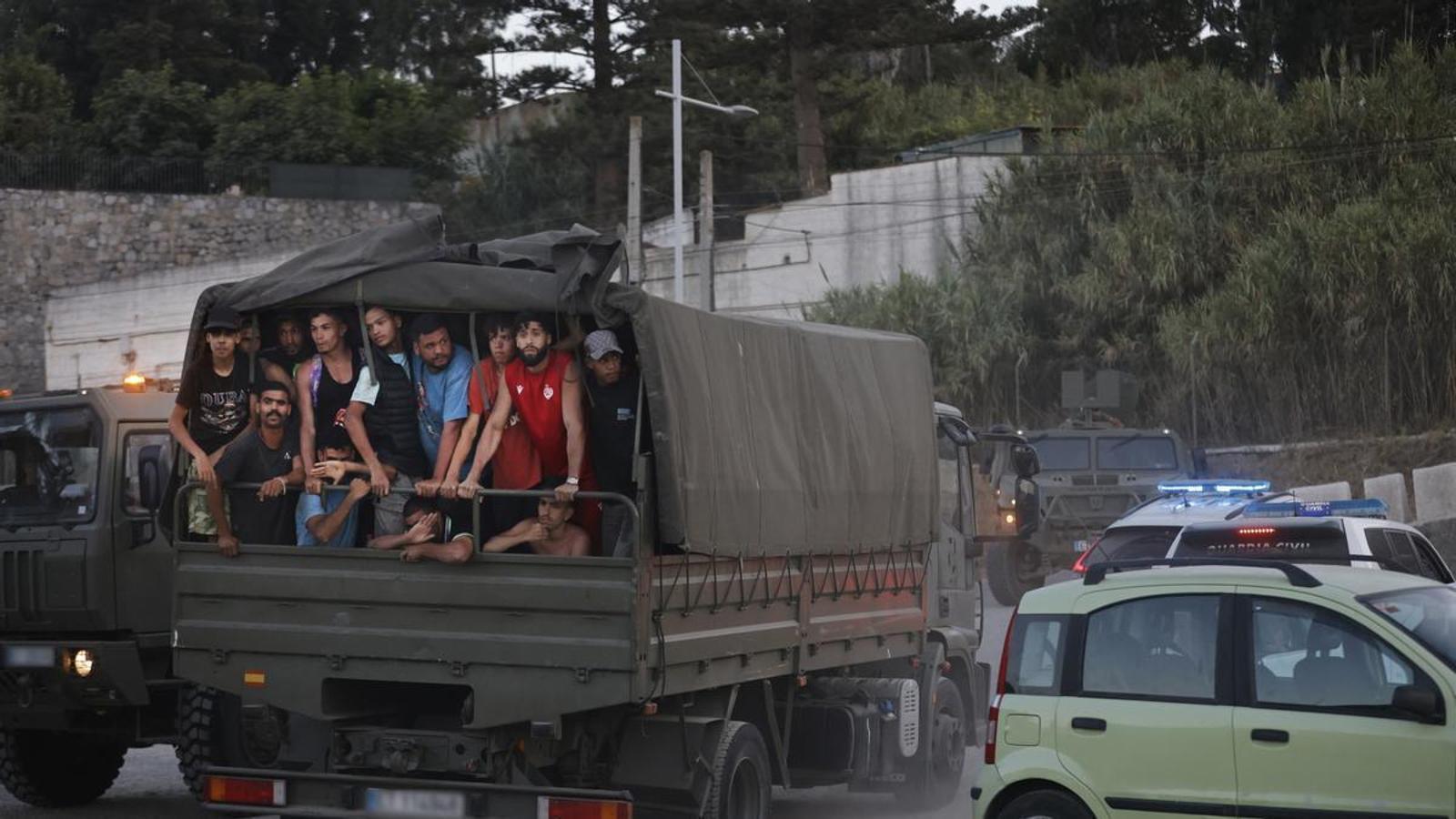
BarcelonaUntil now, the Spanish government had avoided harsh rhetoric against Morocco over the crisis in Ceuta, but this Monday, the Minister of Defense, Margarita Robles, broke this pattern and raised the tone: Robles urged the Alawi regime to get to the bottom of the issue: "I ask the Government of Morocco to investigate and get to the end to find out what happened with these movements that have occurred on [social] networks, because we cannot look the other way. Neither Spain nor Morocco can look the other way in the face of this human drama." "I insist, I ask Morocco to get to the end," Robles reiterated in a statement to the media from Zaragoza.
The minister's statements – who has been described more than once as a free spirit within the executive due to her independent political profile – break with the approach that the Spanish government has used since the day after thousands of migrants arrived swimming from Morocco to Ceuta. Pedro Sánchez's executive has praised Morocco's "collaboration" at all times. In fact, the Minister of Foreign Affairs, José Manuel Albares, did so again this Monday and highlighted their "help," although he acknowledged that what happened in Ceuta was "unusual." In Moncloa, they do not want the crisis in the autonomous city to trigger a diplomatic crisis with a country with whom relations have historically been marked by various ups and downs. Even the Minister of the Interior, Fernando Grande-Marlaska, spoke this weekend of a "reliable partner," although it is true that he also asked them to do their homework to clarify the facts.

Morocco denies "blackmail"
For its part, the Moroccan government denied this Monday having acted under "pressure or blackmail" when tens of thousands of people crossed into Ceuta last Thursday and expressed its "disappointment" at the reactions of some Spanish politicians, whom it accuses of trying to "instrumentalize" the migratory crisis for their electoral interests, according to Moroccan diplomatic sources to EFE. The same sources assure that they "had warned" days before the crisis the Spanish government that the Supreme Court ruling "weakened" the border. These sources assured EFE that the Moroccan authorities have done "nothing under pressure or blackmail." They defend that Morocco "has always" been a "responsible and sovereign actor" as well as a "reliable partner" for Spain. They also categorically deny a "relaxation" by the authorities of the Alawite country of the border, as reported by EFE.
Robles defends the CNI
Morocco's role in the crisis is not the only front on which Robles has spoken out this Monday. The other, which directly splashes her ministry, is the information revealed by Cadena SER which stated that the National Intelligence Center (CNI) had repeatedly warned the Ministry of the Interior that a massive entry of people from Morocco was approaching. Regarding whether the CNI had sent these warnings, Robles stood shoulder to shoulder with the intelligence center workers, the army, and also the State security forces and corps. "They do an exceptional job," she asserted. "We will not enter into any other debate," she sentenced.
Albares expressed himself in the same vein, assuring that all ministries "have done everything in their power" to manage this crisis in the best possible way. Like Robles, he also championed the work of the police, the Civil Guard, and the army.
Sources from the Ministry of the Interior consulted by ARA have dismissed having knowledge of the beginning of this crisis. "If we had had knowledge of a report that said what was going to happen on the 30th, we would obviously have acted," stated the same sources. Let's remember that border management responsibilities fall to the ministry led by Fernando Grande-Marlaska, but intelligence services depend on the Ministry of Defense. This past weekend, Marlaska already stated that Spanish intelligence services had not warned of what would happen on July 30th. "They had not prepared any report warning [about the crisis in Ceuta]," he said. In fact, the Minister of the Interior also stated that he believed a similar crisis would not happen again: "We have the instruments to prevent it."
However, Moncloa has dismissed the director of the National Security Department, an agency that depends on the Presidency, from her position as a civil servant for having published last Friday, one day after the entry of thousands of people, that about 49,000 people had entered Ceuta from Morocco. Government sources have explained to EFE that the reason for the dismissal is a "loss of confidence" in the civil servant.
The PP holds the government responsible
And while the Spanish government continues to point to mafias and the "interested reading" of the recent Supreme Court ruling that reaffirms that the return of migrants entering by swimming is not legal, the PP throws all the responsibility at it. In Génova, they have once again come out in force against Pedro Sánchez: "He is the main responsible party," stated the popular party's secretary general, Miguel Tellado, this Monday.
The president of the autonomous city, Juan Jesús Vivas (PP), has also reproached the central executive for having ignored the prior warnings from the Ceuta government. Vivas, however, also points to Morocco and even questions whether it is a "reliable partner": "We must demand that it respect Spain's territorial integrity," he said in an interview with El País.. In this regard, from Génova they also avoid entering into direct confrontation. Tellado has limited himself to saying that it is necessary to clarify "what has gone wrong" in the cooperation with Rabat.
Investigation at the National Court
Meanwhile, the National Court has requested a police report to determine if it has the jurisdiction to investigate the massive entry of migrants. Specifically, it has agreed to open preliminary proceedings regarding the entry of migrants from Morocco and has requested a report from the General Commission of Foreigners and Borders, an agency that depends on the Civil Guard, to ascertain whether it was a "concerted action or directed by any organization or criminal group," as stated in the ruling dated July 31, to which ARA has had access. The National Court also requests that those who may have participated in the actions be identified. Once it receives the report, it will decide if it is competent to assume the investigation through criminal proceedings after a complaint from the anti-European political party Iustitia Europa.
Offensive in Congress
In parallel, Junts, with whom relations have been fractured for months, is the first partner in the investiture bloc to raise their tone against the Spanish government. The Junts members launched a parliamentary offensive this Monday and have registered a battery of questions to "know in detail the management of the crisis, the coordination with Frontex and the European Union, the diplomatic actions with Morocco, and the consequences of the recent judicial rulings on the returns of people who access Ceuta and Melilla by swimming", they indicated in a statement. The PP has also done so.
The formation led by Carles Puigdemont has also sent two letters to the Ministers of the Interior and Foreign Affairs to "demand explanations" on the Spanish government's response and has sent a letter to the European Commissioner for Home Affairs and Migration, Magnus Brunner.
