Sánchez maintains that Morocco did not "plan" the massive entry, but commits to investigating
The Spanish president now admits that the "Moroccan gendarmes" let people pass through for ten hours
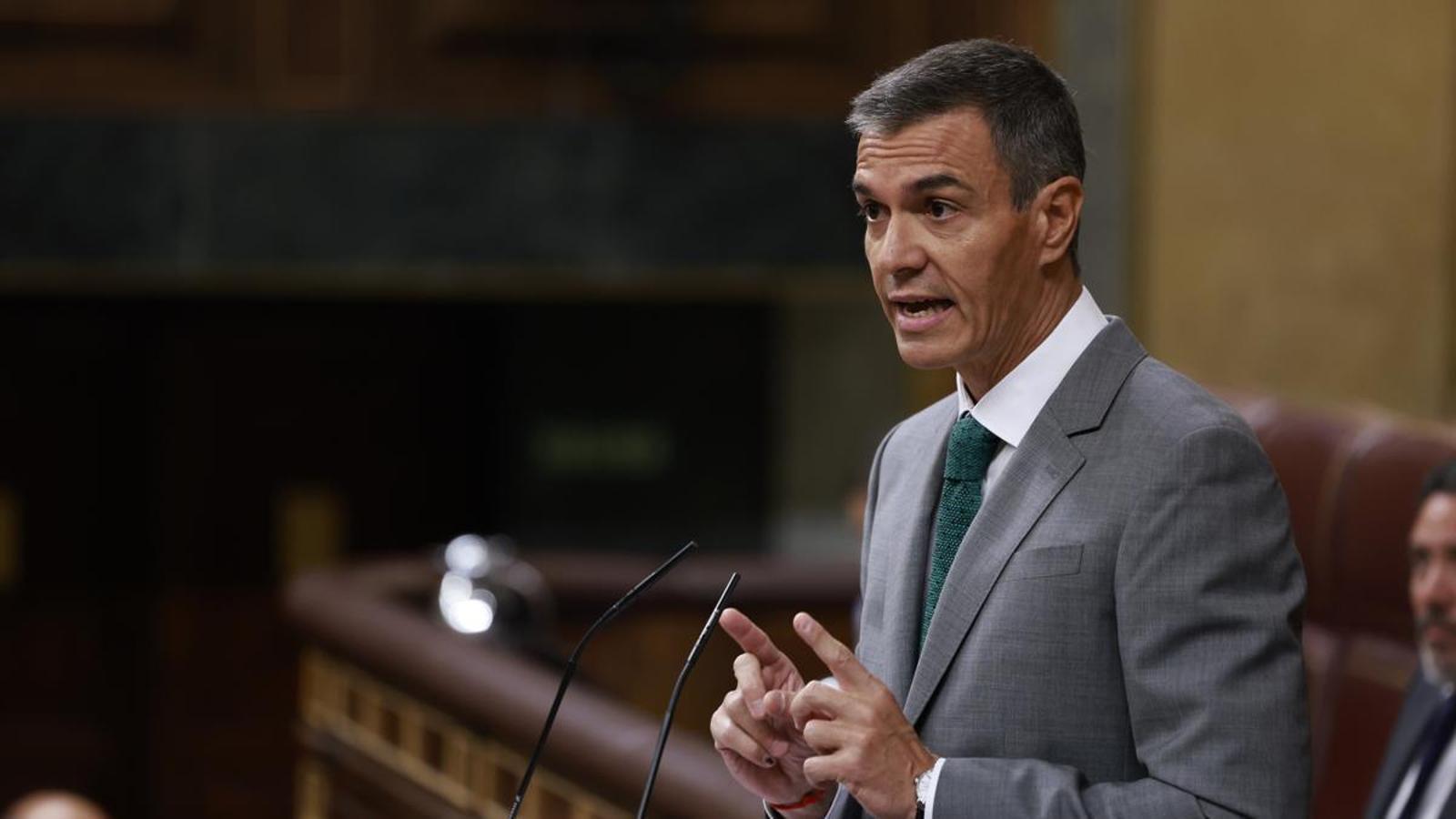

MadridPedro Sánchez faced one of the most difficult appearances of his presidency this Thursday. He had to give an account of his management in Ceuta, immersed in a humanitarian and social crisis due to the massive entry of migrants on July 30 and 31. But the day was not complicated only for this reason: just this Wednesday, a police report surfaced, advanced by El Español, which put the president's narrative against the ropes: although the Moncloa has exonerated Morocco, the immigration unit of the National Police points to the Moroccan security forces as facilitators of more than 70,000 people crossing the borders. In his speech, Sánchez maintained that there is "no solid evidence" to suggest that Morocco "planned and executed" the massive entry of migrants, but he admitted that during the ten central hours of July 30, the Moroccan gendarmerie "allowed the crossing of the border". "It will have to be determined whether there was incapacity or inaction, it is something that must be clarified," he assured, thus committing to investigate.
Sánchez stated that Morocco experienced three moments on July 30th: before, during, and after the massive influx of migrants. The Spanish president explained that initially, Moroccan officials acted normally and reported some incidents; a second moment in which he acknowledged that "during ten central hours of July 20th, the Moroccan gendarmerie allowed passage at the border"; and a third moment in which the same body "effectively controlled the border by carrying out hundreds of arrests, preventing thousands of illegal crossings, and decisively facilitating returns." In this regard, he committed to investigating the facts and taking necessary measures if evidence truly appears, beyond that, proving that Morocco is behind the crisis. He also revealed that on August 21st, he summoned the Moroccan ambassador to Spain following the claims of sovereignty over Ceuta and Melilla by Moroccan ministers. "Ceuta and Melilla are Spanish and will remain so until the end of time," asserted Sánchez.
The president maintained the thesis he had already presented on Monday, but with nuances. He emphasized the amplification on social media that generated a massive influx of migrants through 'fake news,' such as claims that the borders were open or by manipulating the Supreme Court ruling in July that rejected hot returns by sea. However, he stated that he has no proof that Russia or Israel were behind it, but he did insist that there were social media accounts linked to pro-Russian, pro-Israeli, and far-right international ecosystems that generated the wave of people, added to the actions of "mafias".
