How did the Pujol money multiply in Andorra?
The eldest son of the former Catalan president assures that his father "has never had any accounts abroad"
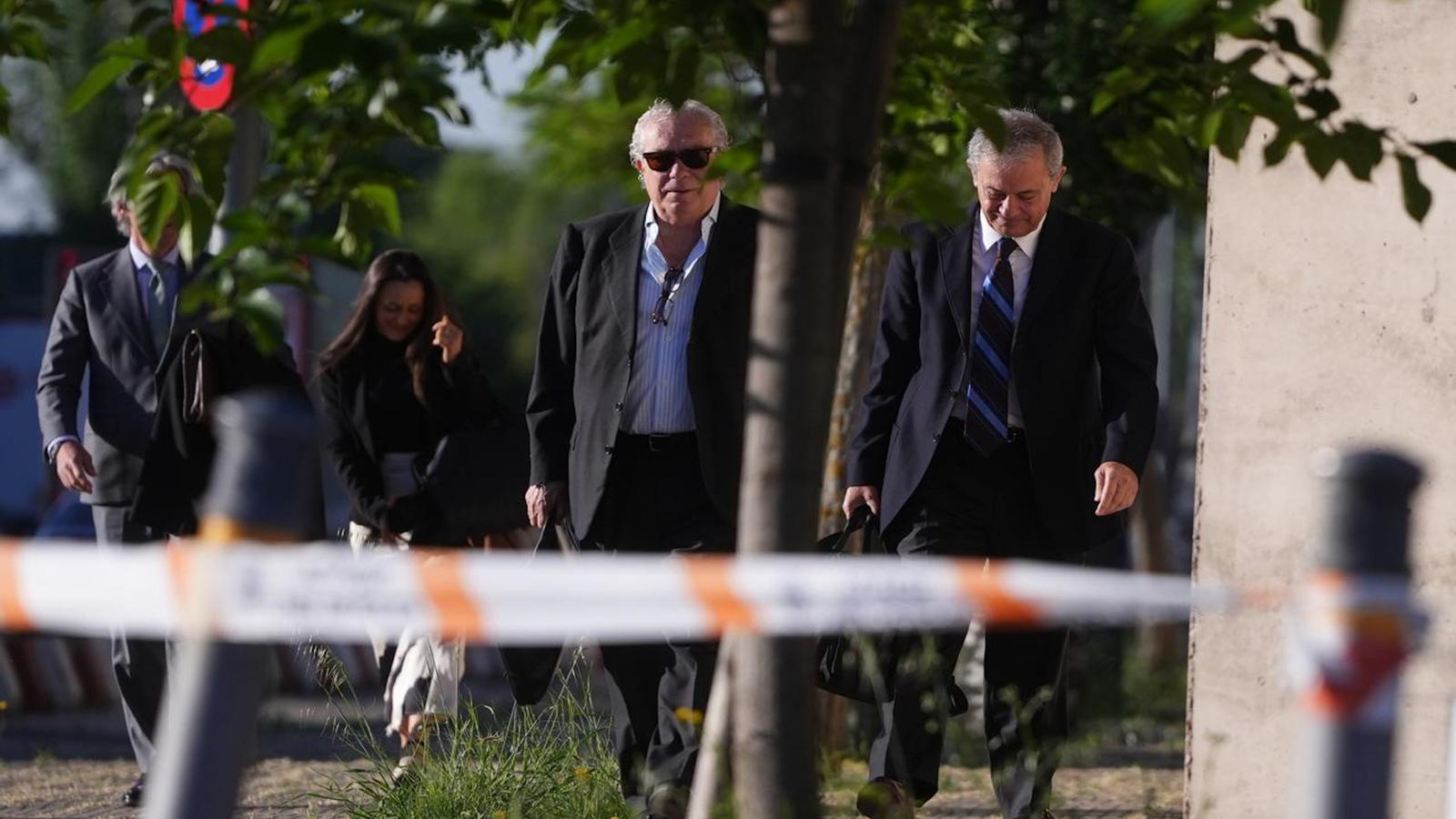

San Fernando de HenaresThe inheritance from grandfather Florenci has focused the second part of Jordi Pujol Ferrusola's statement at the National Court, which ended up lasting more than six hours. In a session monopolized by the prosecutor's questions, the eldest son of the former president of the Generalitat explained how he managed to multiply grandfather Florenci's inheritance: the original 140 million pesetas (0.8 million euros) turned into six million euros thanks —he repeated fifteen times— to "financial sheets", a concept he already used in 2015 when he testified in the Barcelona courts. However, eleven years ago, in the Parliament of Catalonia, the CEO of Andbank in Spain, Rafael Gascó, replied that he did not know what they were: "It is the first time I have heard the name of this instrument in 35 years of banking experience," he said. The eldest son of the former president of the Generalitat has pointed out that in twenty years he made between 20,000 and 25,000 movements.

"Money is never still, I have money to do things and to create financial opportunities," he justified. What he did was buy state treasury bonds – for example, from Finland, Germany, or France – sell them when they matured, "distribute" the profits he extracted, and keep the money until he found "another investment opportunity." Of course, "at no time" was there a "transfer" of money from Andorra to Spain by his companies as a result of the businesses he was doing and which are under the court's scrutiny. "Never relations with the Generalitat," he made clear at first. And later he reiterated that he did not want to "know anything" about public administrations, "whatever their color." The Prosecutor's Office believes that the money came from illegal commissions in exchange for public contracts, a statement that has not been proven and that he was not even asked about.
In 1992, "jointly" with his brothers, he decided he would start to "distribute" the inheritance so that each one "would be responsible for their part". "I tell them to open a checking account at the bank and I'll distribute their corresponding part," he has recounted. And when a "financial sheet" matured, he would give them their share of the money. This was repeated successively until 2000 and there was a final delivery in 2004.
Their parents
Jordi Pujol Ferrusola has also spoken about his parents. Regarding his mother, Marta Ferrusola, he said that the famous manuscript intended for the "reverend priest" in which she presented herself as the "mother superior" was a "chauffeur letter". "She gave it to me, I took it up and gave it to Mr. Pallerola with her instructions. It was a sealed envelope with what she asked for," he recalled. Josep Maria Pallerola was the family's bank manager.
On the other hand, he has spoken about the famous account 63.810 of Banca Reig, which had 307 million pesetas. The firstborn handed over a letter saying that the "real owner" of the assets was his father, but it was actually a ploy to avoid having to give half the money to his ex-wife during the divorce. "I use my father for a personal matter. I pressure him a lot to get the letter," he explained. And there was another letter that has not appeared during the investigation in which he said that, once the bank got rid of his ex-wife, "everything had to be destroyed" because the account was "exclusively" his. "My father has never regularized opaque money fiscally, my father has never had any offshore accounts," he reiterated. In his 2014 confession, Jordi Pujol said that grandfather Florenci's inheritance was "intended" for his seven children and his wife.
Josep Pujol and Mercè Gironès
When Jordi Pujol Ferrusola, who refused to answer the State Attorney's questions because he was tired, finished, it was the turn of his brother Josep Pujol and his ex-wife, Mercè Gironès, who only answered their lawyers. The former reviewed the bizarre chronology of a loan he made to businessman Jorge Barrigón – who is also on trial –, denied attempting to influence officials to secure public contracts, and assured that he has never had "contact" with administrations.
The latter distanced herself completely from the eldest son's businesses. She agreed to be the administrator of his companies "simply to help him." She signed the contracts, but did so "without reading them" because she "considered them to be well done" and because the partners asked her to, she did not make decisions and did not look for clients. And if there were bank papers with her signature as authorized, it was because she signed "blank papers." "I have never controlled what has come in, what has gone out, and what has been done," she assured. And she said she never spoke to any businessman about invoices or payments. In fact, she "didn't even have the key" nor did she know the password for the alarm in the Ganduxer street office.
