Feijóo proposes a “Basque clean-up law” for those exiled by ETA terrorism
Albiol accuses Collboni of having waited three months to evict Plaza Catalunya for "electoral interest"
-
CAT -
CAST
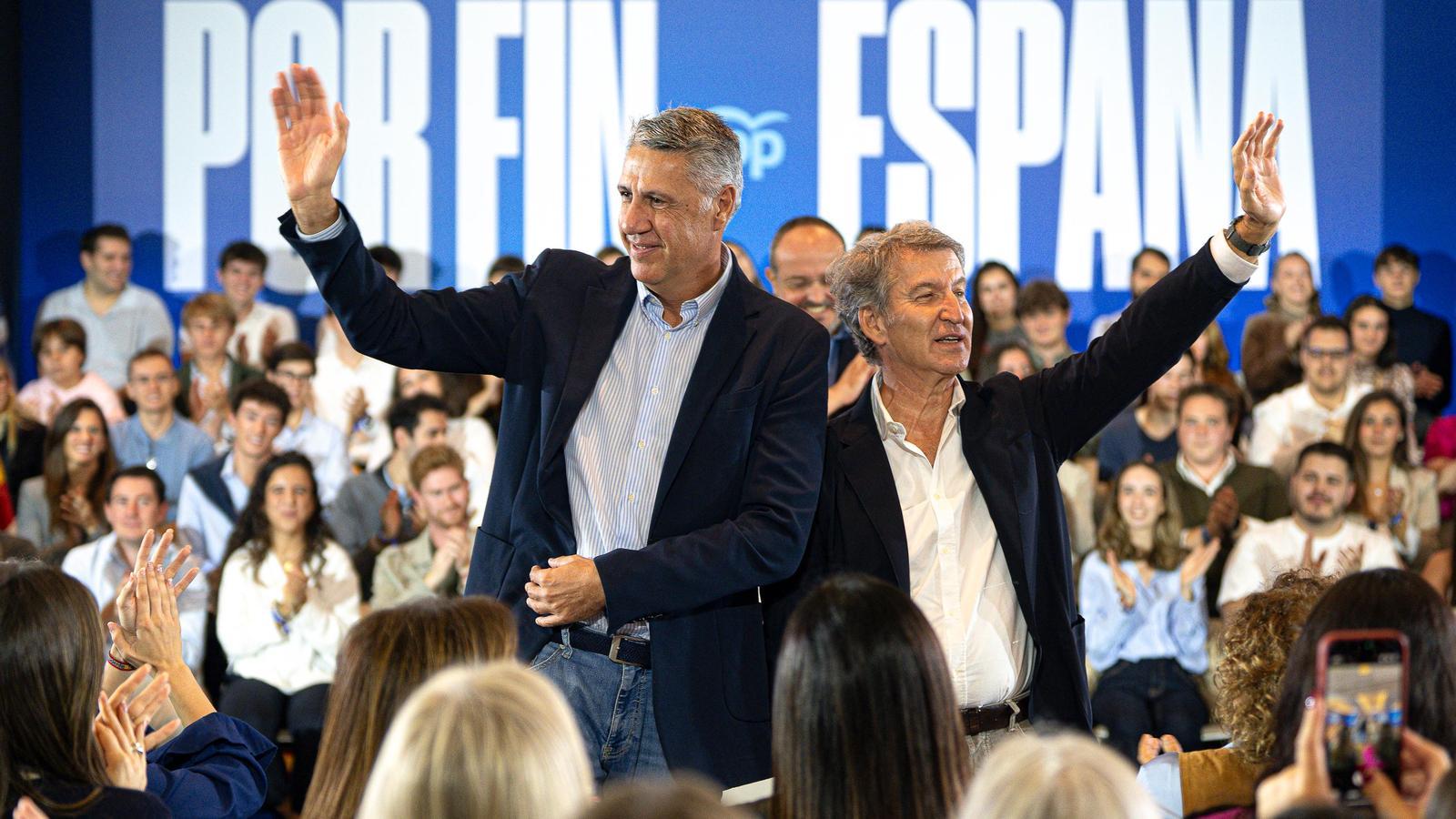
Madrid / BarcelonaThe PP decided to keep eight points of its electoral program hidden in order to announce new developments during the campaign. Taking advantage of Alberto Núñez Feijóo's visit to Navarre this Monday afternoon, the Popular Party revealed that one of these masked proposals is a "Basque grandchildren law." "A legal reform to facilitate the voluntary participation in elections of those people who were expelled from the Basque Country during the hardest moments of violence and terror on the streets of the Basque Country," party sources have anticipated. This is a measure that the right has been weighing for years so that those exiled by the ETA threat can once again be part of the territory's electoral census. Mariano Rajoy's executive, in fact, already tried to open this can of worms in 2012, but the initiative—criticized by both the PNB and the abertzale left, who saw it as an attempt to manipulate the census—ultimately ended up in a drawer.
For weeks, the possibility that the Popular Party would revive this approach ahead of November 29th had been hovering. A report from El Confidencial a month ago spoke of meetings between the PP and Basque business leaders to address this reform so that the Basque diaspora could vote in the regional elections in both the Basque Country and Navarre. This is a scenario that, a priori, would precisely benefit the electoral interests of state-wide parties like the one that now includes it in its electoral program, the PP, to the detriment of Basque nationalists and independence supporters. Feijóo's proposal, in fact, has been given the same name as the so-called 'grandchildren law' for those exiled during the Franco regime, which both the PP and Vox have denounced as an attempt at electoral fraud by the PSOE because, a priori, that other expansion of the census would benefit the left.
The young PP candidate for Gipuzkoa, Jon Echeverría, estimated, in an interview with The Objective, that there would be about "200,000 Basques who went into exile from their own land due to ETA terrorism." This commitment to focus this start of the week on the Basque agenda and, specifically on the ETA wildcard that the right uses in every electoral campaign—the 2023 one was marked by the use of the controversial phrase "Let Txapote vote for you"—, will take Feijóo to Eibar this Tuesday morning. He will participate in an event with Echeverría "to show him his support after he was assaulted at a campaign event last Saturday," say the same PP sources, and in the afternoon he will go to Bilbao. In the 2023 campaign
On the other hand, hours after the Barcelona City Council evicted the housing protest encampment in Plaça de Catalunya, the head of the PP list for Barcelona in the November 29 elections, Xavier García Albiol, celebrated the police action and accused the socialist council of having waited three months to act for “electoral interest.” According to the popular candidate, the profile of the people who were camping in the city center has been “perverted” over time and now “is no longer electorally interesting” to the municipal government.
This is how the Badalona mayor's first intervention began in an electoral press conference organized by the agency Efe, in which he wanted to set his profile on the subject of housing and, especially, against squatting. Albiol claimed that “four out of every ten squatting cases in Spain occur in Catalonia,” a situation that, in his opinion, makes a “legal reform that allows for eviction in 48 hours” necessary. The popular candidate has committed to speaking with “all the parties involved” to draft this future anti-squatting law, among which he listed homeowners' associations, neighbors, and companies. However, when asked about a possible dialogue with the Tenants' Union, Albiol ruled out that the entity is representative of the housing problem, criticized its proposals for being “antagonistic” to those of the PP, and described the model it defends as “problematic.”
As the person responsible for the PP's anti-squatting policies by direct commission from Alberto Núñez Feijóo, Albiol has shown himself to be especially forceful with this phenomenon. “Squatting is squatting, whether it affects a company or an individual,” he defended. Despite acknowledging that there are cases of squatting out of necessity, which he considers “minority” and for which he promises support measures, the popular candidate has attacked the “immense majority” of squatters who, according to him, have turned squatting into a “lifestyle.” For these cases, he promised “all the forcefulness of the police.”
“We will have a problem and a tragedy on the road network of Catalonia”
In a second block of the appearance, Albiol addressed the situation of Rodalies and Catalan infrastructure. The popular candidate attributed the deficiencies in the railway service to a “maintenance problem” and avoided specifying whether he supports the transfer of the network to the Generalitat. According to Albiol, the current situation is a consequence of a lack of adequate investments, which he linked to the absence of new general State budgets. Beyond the trains, he warned that the state of the infrastructure is also critical on “Catalan roads and highways”, where he predicts that, if no action is taken, “we will have a problem and a disaster”.
Asked about Feijóo's proposal to abolish the Ministry of Housing, Albiol defended that policies in this area will be reinforced with the creation of a vice-presidency that will also assume other powers. The candidate lashed out at the socialist management and asserted that “whoever generated this problem cannot be the solution”, in reference to the PSOE. In this sense, he recalled that, according to CIS barometers, housing has gone from being the sixteenth concern of the Spanish people in 2018 to currently occupying the first position.
“The Catalan PP will be one of the surprises of election night”
Regarding the electoral forecasts, the current mayor of Badalona has predicted that the PP will obtain between eight and nine seats in Catalonia, a result that he considers will turn the populars into “one of the surprises of election night”. Albiol has downplayed the rise of Vox and, despite the agreements between both parties to present joint candidacies to the Senate in various constituencies, has rejected that there is any confusion between the discourses of the two parties. Asked about the PP's turn to the right, he has assured that “the best thing that can happen to Catalonia and Spain is for the PP to govern alone”, but he has made it clear that, if necessary, his pulse will not tremble when it comes to reaching agreements with Vox.
Another of the territorial issues addressed by the popular candidate has been the role of Catalan in the educational system. While Feijóo defends a teaching model that divides teaching hours 50% between Catalan and Spanish, Albiol has avoided entering into contradiction with the state leadership of the party when asked about the percentages defended from Madrid. The mayor of Badalona has framed the issue as a “pending scientific debate” and has called for not turning languages into a “political instrument”, but rather into a “space of union”.
With the electoral campaign advancing and the calendar increasingly tight, one of the pending unknowns is whether the head-to-head between Albiol and the former mayor of Barcelona and leader of Front Ampli, Ada Colau, will finally be held to debate on housing. Both candidates have shown themselves willing to “confront housing and city models” and, as Albiol has explained, their respective campaign managers are already managing the possibility of organizing the debate. The popular candidate, however, has not missed the opportunity to launch one last dart against Colau, whom he has assured that her management at the head of the City Council was “an authentic calamity” from which Barcelona “has still not recovered” in some areas.
