Borja Semper: "Morocco's social policy is not to be made in Spain"
The PP spokesperson attacks the Spanish government's management in an interview on RNE
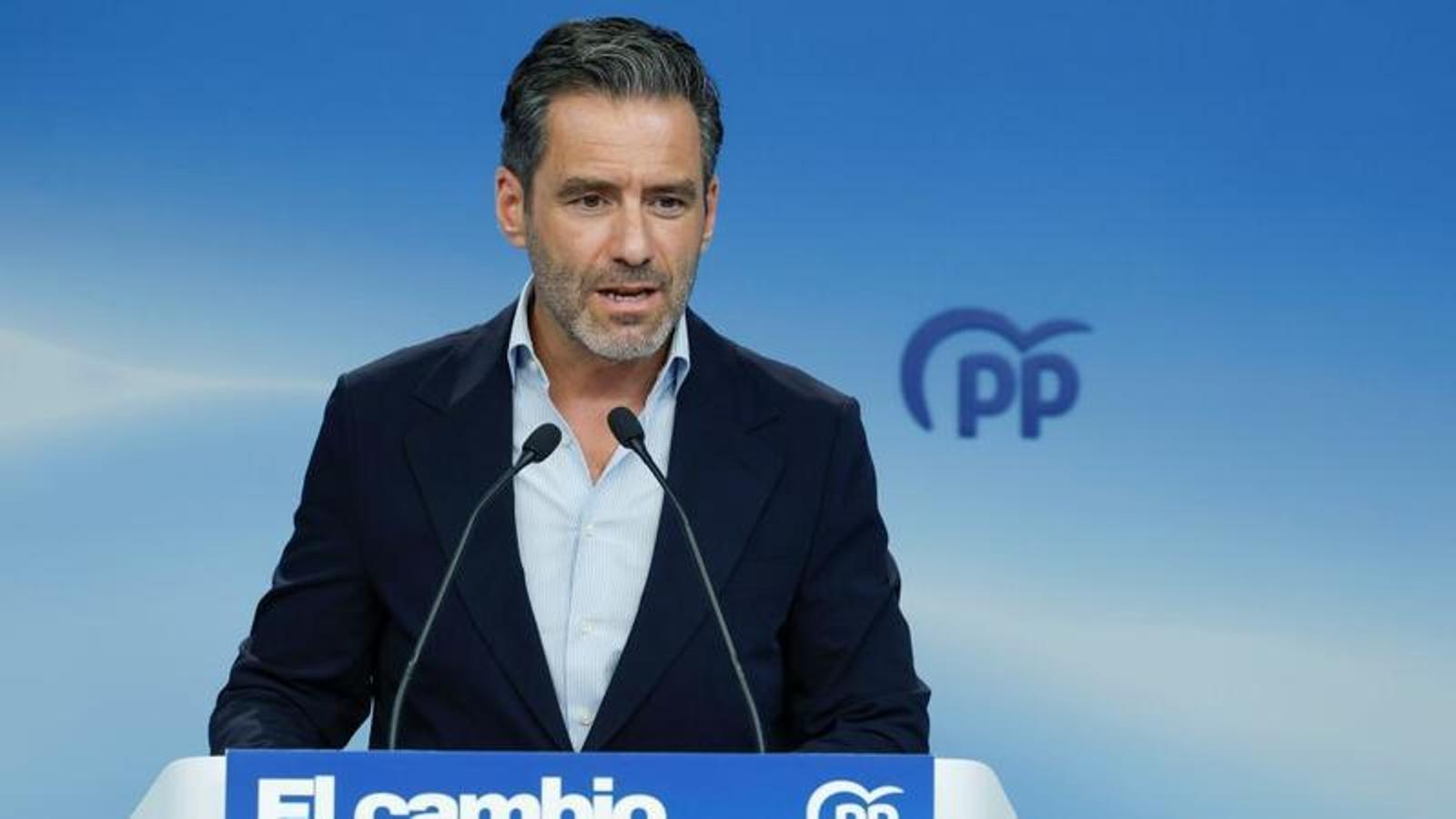
Barcelona"The Ceuta crisis is highlighting many things that are happening to the Spanish government: there is a coordination crisis among government members; there is a credibility crisis, because the citizens of Ceuta, fundamentally the Ceutans, have stopped expecting anything from the government": in an interview on La mañana de RNE the PP spokesperson, Borja Semper, was very harsh against Pedro Sánchez's government. "In Ceuta there is a security crisis, there is a very notable management crisis", he insisted, and accused Sánchez's executive of politically treating Morocco with "kid gloves".
Semper assures that the Spanish government's management in Ceuta is "unreasonable" and that, instead of security and tranquility, it is generating "more doubts about what we are facing". On the other hand, he demanded accountability from the Spanish government because the intelligence services did not foresee the migratory crisis. "I do not hear any self-criticism from the government, not a single minister who has appeared - and, of course, neither did the president of the government yesterday - has shown the slightest humility in management, in my opinion, disastrous", said Semper.
Regarding the PP's strategy for assisting migrants, Semper pointed out that his party opts for return, not distribution, including minors. "Morocco's social policy should not be done in Spain. And there is also a European Union return regulation that enables the possibility for these minors to return to the country they came from", said Semper. "The order of factors, in this case, must be: first, humanitarian reception of minors and protection, of course. Second, return to the country they came from. That is to say, Moroccan social services must take care of their minors. And, at the same time, also return to their families. If their families do not want them, or do not appear, it is the Moroccan government that must take care of them", he stressed.
Overwhelmed services
To justify the return strategy, the spokesperson pointed out that the socialists proposed it at the beginning of the crisis, and that Ceuta's immigration services are overwhelmed. "There is an evident collapse in the management of all these files and affiliation. We don't know how many minors we are talking about," he warned. "We believe that the return, the expulsion, must be produced by mutual agreement with the country of origin, which in this case is Morocco. And that the legislation, both European and Spanish, supports and allows it, as long as the administration acts with speed," he stressed.
On the other hand, Semper believes that the solidarity rally called by the Federation of Municipalities this Wednesday must be "non-partisan". "The people of Ceuta are having a very bad time – he explained–. Ceuta is a very small territory, about 20 square kilometers, with 80,000 inhabitants. It is a very beautiful place, moreover, but with narrow streets, with difficulty finding recreational spaces. One must understand what happens in a city like this, when you stop going to parks, when you stop going to the beach, when you cannot move normally through open spaces." And when he spoke about the sexual assaults that are occurring there, he pointed out that they should not be identified with immigration.
Another of the highlighted points of the interview was King Felipe VI's desire to travel to Ceuta. Semper criticized that President Pedro Sánchez spoke about it on Monday and that the date of the trip has not yet been finalized. "Many institutions in Spain have found themselves compromised and manipulated, let's say, by political interests," he said. "The King has, obviously, every right and all legitimacy to go anywhere in the national territory. And it strikes me that even today —and we all know that in a parliamentary monarchy the king's agenda is not decided by the royal household, but in this case by Moncloa, or in any case it is decided by mutual agreement, but fundamentally it is decided by Moncloa— there is this reluctance for the Head of State to go to a place where citizens would feel comforted," he stressed.
