Koldo's brother declares that he went to PSOE headquarters twice to look for envelopes with money
His ex-partner claims he was paid by a public company without going to work

-
CAT -
CAST
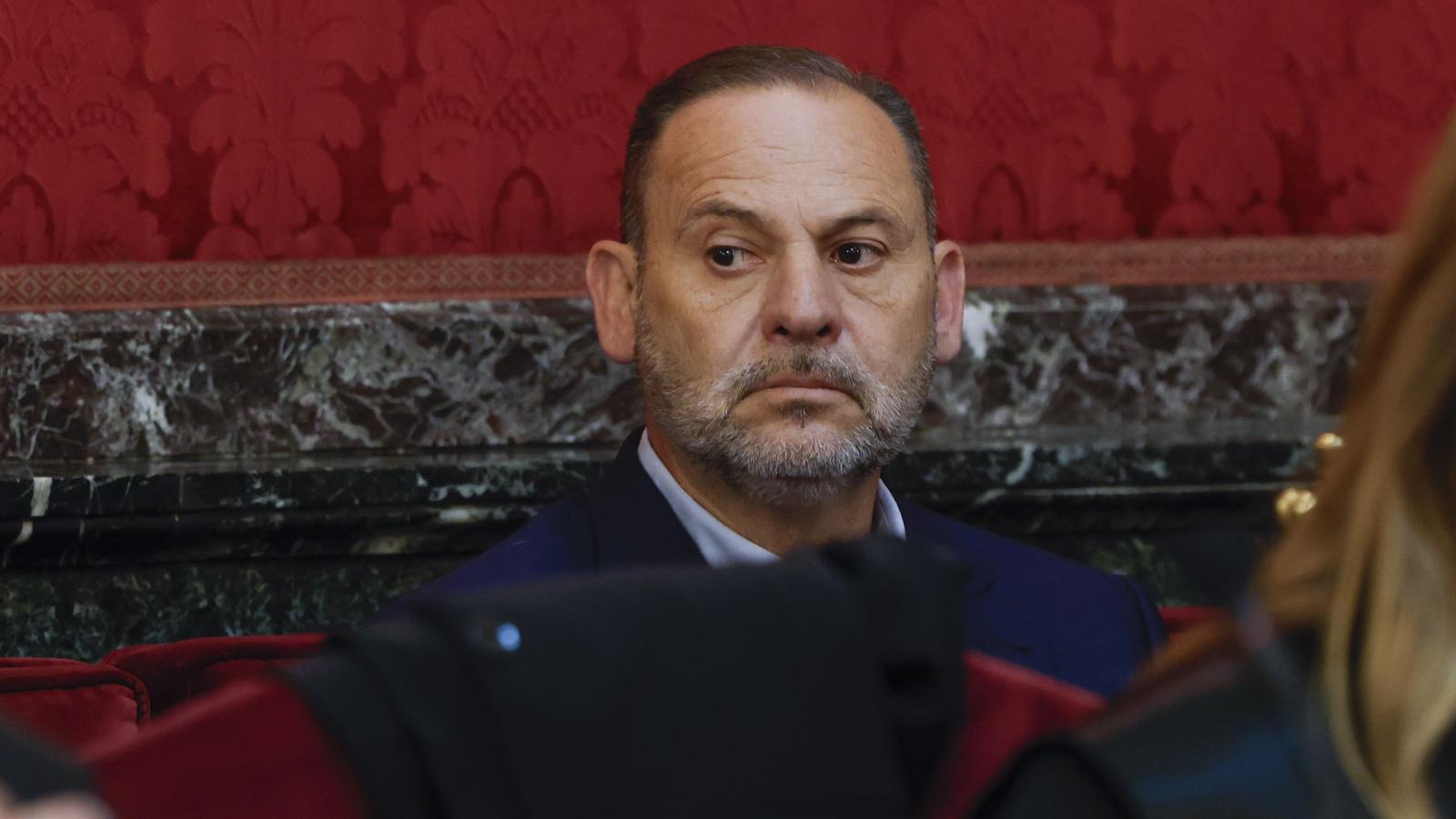
MadridThe image this Tuesday at the Supreme Court was momentous: the accused is the former Minister of Transport, organization secretary of the PSOE, and a man of utmost trust for Pedro Sánchez. The trial has begun against José Luis Ábalos, his former advisor Koldo García, and businessman Víctor de Aldama, accused of criminal organization, bribery, influence peddling, and embezzlement for irregularities in the purchase of masks during the pandemic and for political favors.
The protagonists of the first session –which lasted ten hours– were three: Ábalos's son and ex-partner, and Koldo García's brother, who testified as witnesses. The headline of great importance was taken by Joseba García, who admitted to going twice to the PSOE headquarters –on Ferraz street in Madrid– to collect envelopes with money that were for Koldo and his wife, Patricia Úriz.

"I hand over my ID, I pass through the metal detector like everyone else and they ask me who I have an appointment with," he stated when questioned by Leticia de la Hoz, who is his and his brother's lawyer. He had an appointment with Celia Rodríguez, an employee of the PSOE's organization secretariat, who, when she testified as a witness during the investigation, assured that Koldo centralized the settlements related to Ábalos and his team. Days later, the National Court began to investigate the cash payments made by the PSOE. "They told me where I had to go up and she told me, 'Here's the money.' She closed the envelope in front of me," he added. He also justified that Koldo used three envelopes to manage expenses based on whether they were attributable to the ministry, the PSOE, or Ábalos's personal matters.
The socialists have always denied any wrongdoing and have justified cash payments to party leaders for reimbursable expenses incurred in the exercise of their duties. This very Tuesday, the Spanish government has, in fact, boasted of having erected a firewall since the case broke and has distanced itself again. "Zero tolerance for corruption, we acted immediately," the Spanish government spokesperson, Elma Saiz, defended this morning. It remains to be seen to what extent the trial – and the future sentence – will end up affecting the Spanish president or not, but the PP has long used the case as a torpedo to the waterline of the political project of the current Spanish president, who came to La Moncloa in 2018 to put an end to the corruption of the popular party as sentenced in the Gürtel case.
"I wasn't actively working"
The star witness, however, was that of Jessica Rodríguez, who was Ábalos's partner between 2018 and 2019. She arrived at the Supreme Court wearing a black mask so her face would not be seen and kept it on all morning, while she waited sitting on a bench outside the room. During her statement, the cameras did not focus on her and her appearance could not be seen. "[He] Did not plan to divorce while he was minister. I did not want to continue with this situation for four years and we broke up," she explained. One of the elements under scrutiny is the rental of an apartment on Paseo de la Castellana in Madrid, which is where she lived: "I think [ Ábalos] felt guilty because he made me change my lifestyle when I was happy and he did not keep the promises he made me. And that's why he left me the apartment".

Jessica Rodríguez has a prominent role in the trial –she has been testifying for more than two hours– because she was hired by Ineco and Tragsatec –two public companies– and was being paid without going to work. And she has admitted it again: "I had an employment contract, but I was not actively working," she said. "I was waiting for Joseba or Koldo to tell me what I had to do, [...] I have no further knowledge of the work I had to do," she said later. On the other hand, in the morning, Joseba García had denied being her supervisor: "I have never been anyone's boss, I was a colleague."
One of the surprising moments of Jessica Rodríguez's testimony came during questioning by Ábalos' lawyer. "Is it true that you engage in prostitution?" Marino Turiel asked her, and he was forced to rephrase it.
—Did you receive financial compensation in exchange for sex?
—I am a dentist and I am registered.
Meetings with Aldama and trips to the Dominican Republic
Joseba García, brother of Koldo García, also explained that the eight meetings he had with Aldama, which the Civil Guard claims were to share money, were actually the result of claims he made to him after buying a car from him: "It's the worst purchase I've ever made. I asked him to give me my money back and he fled from me. I had to get rid of the vehicle like scrap metal," he lamented. He also spoke about the two trips he made to the Dominican Republic, which the Prosecutor's Office says were to receive envelopes of money that Aldama would later deliver to Koldo and Ábalos. The former advisor's brother explained that he traveled to the other side of the Atlantic for business and because he was meeting a Dominican girl. He collected an envelope at the other end of the country and later delivered it – in Spain – to Aldama's driver. But he never knew what it contained.
The former minister's son, Víctor Ábalos, also testified. "What is your father's economic situation since the proceedings began?" asked Marino Turiel, his lawyer. "Lamentable, like the whole family's," he replied. He distanced himself from the management of his father's assets – "I am not a custodian of anything for anyone," he said – and explained that he financially supported the former minister after the divorce: "If I had to lend him money, it's my money. [...] Everything I've given my father is from my income and my bank account, nothing more."
Armengol and Torres deny pressure
Before the in-person testimonies began, the two written reports submitted by Francina Armengol, who was president of the Balearic Islands and is now president of Congress, and Ángel Víctor Torres, who was president of the Canary Islands and is now Minister of Territorial Policy, were read. Both are exempt from testifying in person. Armengol has categorically denied intervening in the purchase of masks: "I never received any order or pressure to make any contract." And Ángel Víctor Torres admitted that the fact that Soluciones de Gestión –the company at the epicenter of the alleged scheme– had sold masks to the Ministry of Transport was a "positive reference." Furthermore, he acknowledged that he "followed up" on the case, but assured that he gave "no order" to benefit the company.
