The other France-Spain

Spanish right-wingers have always had a certain complex regarding France. Seeing French national unity, apparently so well-tied, in contrast to a Spanish nation that has never been able to completely neutralize the peripheral differential facts, seems to make them feel inferior: why them and not us? It disturbs them to have as a neighbor a country that General De Gaulle left substantially structured after the war. If they had the dignity to think about who the reactionary forces entrusted with the structuring of the homeland (General Franco with a war) and to whom the French entrusted it, they would see that there is an abyss that should shame them, but they pretend not to remember. It is not surprising that when the Hispanic right-wing wants to build the nation, resentment emerges and the psychopathology of small and large differences flares up.
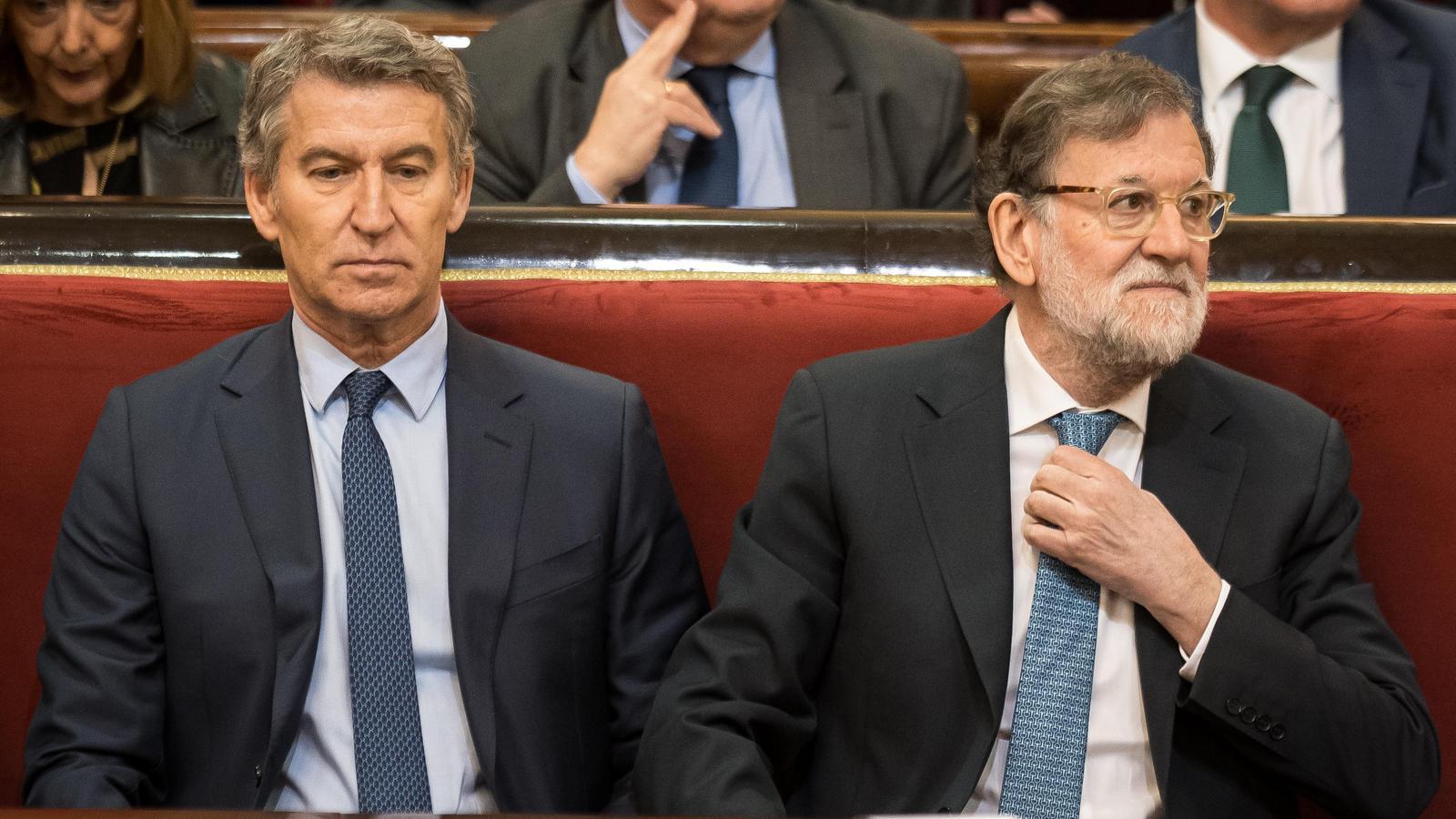
Even former President Mariano Rajoy, known for having broader shoulders than others, has fallen into temptation. And, wanting to be funny, he exposed himself: “[The French team] has a very high-level squad. However, without French players.” It’s no wonder Emmanuel Macron rushed to point out to him that nationality is a right, not a genetic attribute. It seems Rajoy is still in the primitivism of those who say that “there is only one homeland and I found you in the street”. It is a music that is here again: authoritarianism, with democracy as a scapegoat, here and throughout Europe.
Feijóo's great contribution will have been the redemption of Vox: accepting a neo-fascist party that does not hide it as a stable partner; on the contrary, it invites the PP to take the path together, which is not the same as with Junts, precisely one of the testimonies of the impossibility of bringing the debate on multinationality to Vox and the PP.
The wait is long for the PP. It seemed to have a highway to alternation and, for the moment, the only thing it has achieved is its dependence on Vox, which is growing unscrupulously and placing the presumably liberal-conservative right on the path to authoritarianism. The objective fact is that the PP is fully dependent on the far-right. Feijóo's low profile has begun to stir voices within the PP calling for an alternative, because they see that the party is losing momentum and that an ambitious acceleration is needed to allow them to regain power without falling into the hands of Vox. And Feijóo, always down to earth, opens the door to Abascal, as if he himself were holding back due to the inability to forge a project that would make voters on the fringes think and hesitate. And so – from leadership to gossip – the character is fading day by day.
Feijóo has been faltering for a few days, with Vox tightening the screws on one side and a part of his electorate seeing that the PP's activism, rather than empowering them, is disconcerting them. And so, as the decisive hour approaches, instead of opening horizons, what is generated is noise, with proposals that aim to seem daring but are forced ideas that bring more irritation than votes and are fuel for Vox. For example, with its opposition to the clean law, and with a phrase that breaks records for inopportuneness: “[Absenteeism] is a cancer that we cannot afford. [...] If company agreements stipulate that a person who does not go to work receives the same as a person who does go to work, what do you want me to say?” A resounding display of insensitivity: cancer as a metaphor for evil and absenteeism as the supreme temptation of the human condition. Certainly, one cannot go very far like this. The PP desperately needs the crutches with which Abascal tempts Feijóo.