The "barbarian" invasions

History is an endless succession of changes and, therefore, of crises. Each one seems like the end of the world. Or of what we understand as civilization. Then, life goes on. In another way.
Here and now, it is interesting to listen to the arguments against Muslim immigration: they are exactly the same as almost 2,000 years ago the Romans used against some delirious fanatics who put their faith above the laws of the state, symbolically ate their god, and worshipped a crucified Jew.
Read the letter from Pliny the Younger to Trajan (year 112) to understand the horror and the absolute incomprehension of tolerant Rome in the face of the apocalyptic sect of the "Christians". In the end, Rome became Christian and was overthrown by "barbarians" who were also Christians. Its eastern territory, Byzantium, disappeared under another "barbarian" tide, that of the nascent Islam.
That certain things happen one after another with different protagonists does not diminish their importance. On the contrary. It is enough to look back to confirm that changes are as inevitable as they are traumatic.
We tend to think that large migratory movements are a contemporary phenomenon. We have little memory: they have always accompanied humanity. The Bible, for example, in a way is a record of migrations, invasions, and successive massacres.
Let's limit ourselves to the most recent. From 1881 onwards, Russian pogroms against Jewish communities drove tens of thousands of people to emigrate to the United Kingdom and the United States, countries considered tolerant. When reviewing the opinions expressed in the London press during the Jack the Ripper crimes (1888), the unanimity that the unknown murderer must have been "foreign" and "Jewish" is striking. That is to say, a "barbarian".
The Irish famine, between 1845 and 1849, caused a wave of emigration to the United States, mainly to New York, the great port of entry. Violence between "natives" (Protestants) and "foreigners" (Irish Catholics) lasted for decades. The book and film Gangs of New York give an idea of the fury with which the two communities fought each other in the poorest neighborhoods.
That conflict ended around the end of the 19th century, when the Irish monopolized the New York police force and set about repressing a new migratory wave, the Italian one. The Italians' propensity to organize into closed communities and the transfer to North American territory of mafia practices that emerged in Sicily, Campania, and Calabria were considered clear evidence that Italians could never integrate.
During the summer of 1958, there were racial riots in several British cities. Black immigrants from the "West Indies", mostly Jamaicans and full citizens since the 1948 Nationality Act, were turned into a "mortal danger" by the movement of Oswald Mosley, founder in 1932 of the British Union of Fascists and, after 1945, a fervent supporter of a united, white, and Christian Europe.
The tension finally exploded on August 29 in Notting Hill. A stupid incident (a black pimp and his white protégé arguing in the street; when several people attacked the black man, the woman sided with him) degenerated into a street fight and, within a few hours, into a pitched battle. Groups of white youths set fire to houses where black people lived, groups of black youths joined in self-defense committees. The riots lasted a week.
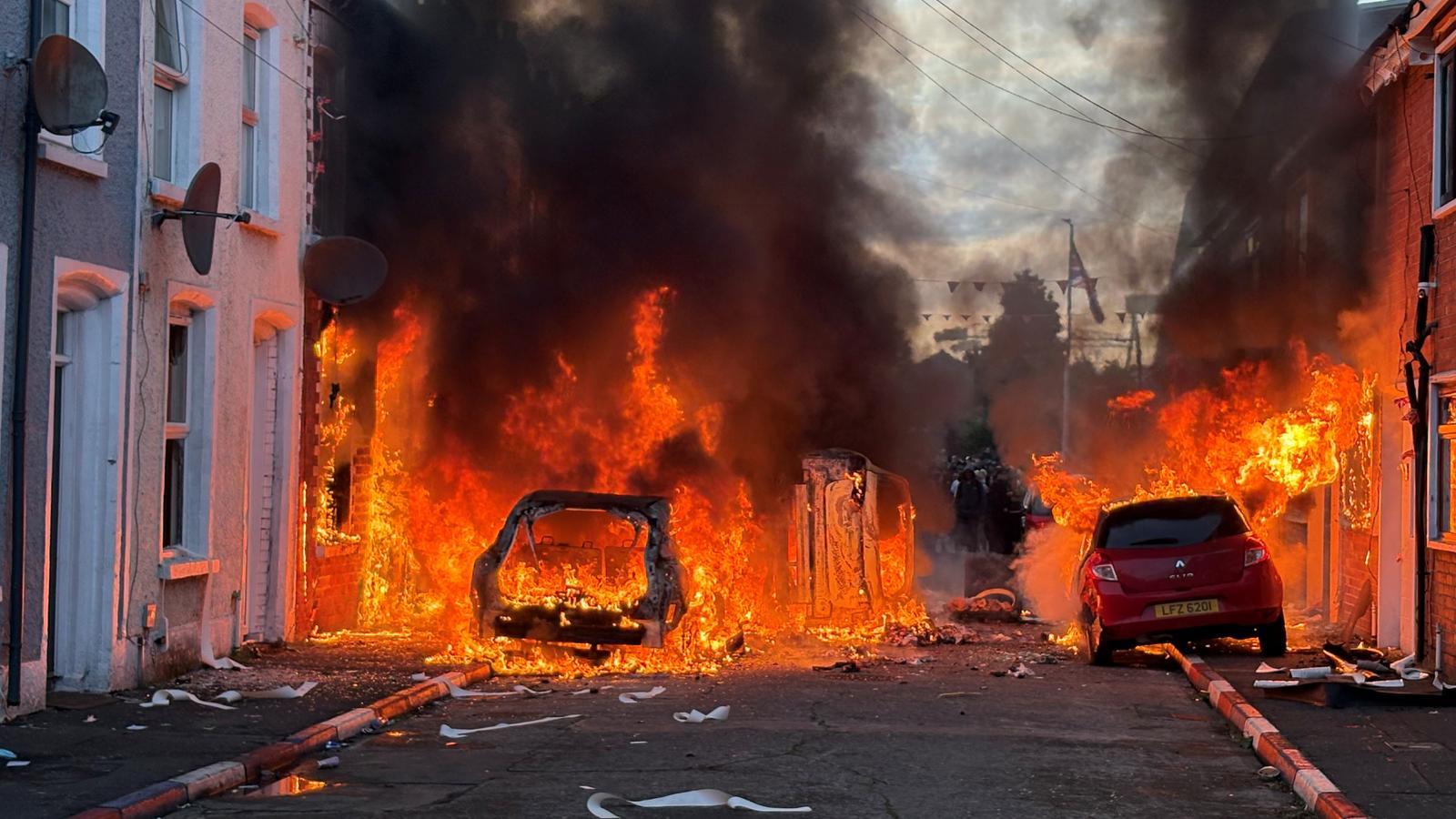
Now Belfast is burning. Technomagnate Elon Musk, economic head of the international far-right, fuels racial violence from his X network and calls his followers to "react or die." The incidents, however, would happen just the same without the furor of social networks, as they have happened so many times before.
Racism, rejection of immigrants, the humiliation they feel, the widespread conviction that Muslims will never integrate into British society, and, fundamentally, the very human fear of change (shared by "natives" and "foreigners", let's not forget) are enough to provoke the fire.
