Stop the eclipse
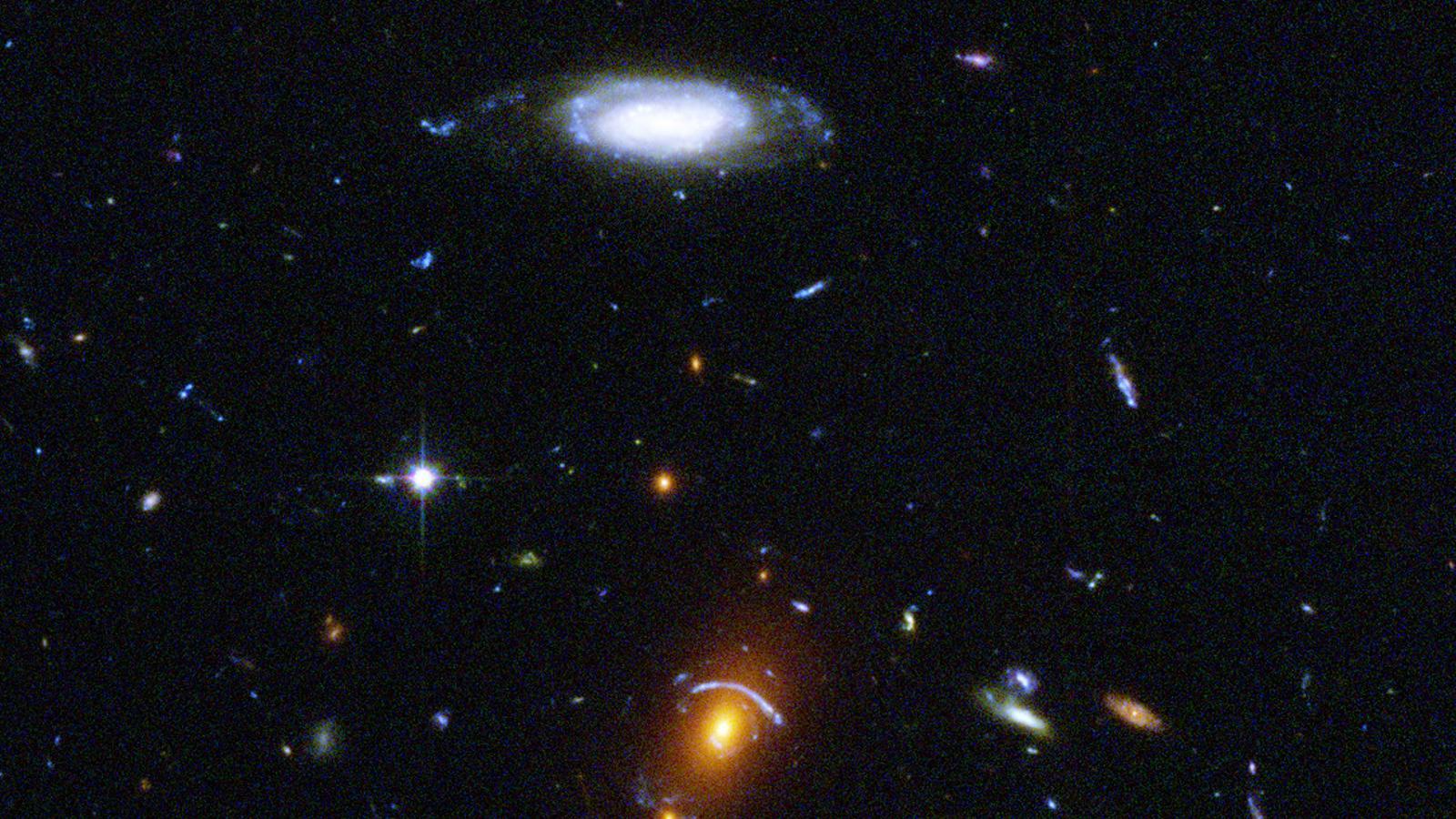

It has always been a source of inspiration for artists to play with time and the impossibility of returning to the past. In In Search of Lost Time, a long, slow novel with exquisite prose, Marcel Proust recalls his childhood. It is the evocation that makes the story attractive, that makes it unique, that transports the reader to a past that no longer exists, but which can still be imagined and dreamed of.Let's think of a long line. At one end are subatomic particles, and at the opposite end, the universe, distances measured in light-years, and black holes – concentrations of mass with such gravitational pull that not even light can escape them. Until the last century, only a part of the reality represented on this line was known to us: we did not have the technical means to observe the very small or the very large.Now, however, we even know that time slows down in the presence of mass. It is an experimentally proven fact: for the man who lives in the mountains, further from the mass of the Earth, time passes more quickly than for the one who lives on the plain. When we move at high speed, time also changes: it slows down. If we could travel in a spaceship at the speed of light, we could explore the universe without time passing for us. The comparison of two clocks—one at rest on Earth and the other orbiting at high speed, between 20,000 and 30,000 km/h, in an artificial satellite—shows that time shrinks and stretches. It has ceased to be a fixed and universal constant.Albert Einstein formulated it in the theory of relativity years before being able to prove it; the ability to understand before seeing constitutes the essence of scientific thought. The physicist postulated that the only universal constant is not time or space, as was believed until then, but the speed of light. And he raised a problem that was more philosophical than physical: what is the meaning of now and later if for each of us time is different?Until the 18th century, there were two predominant views regarding time. For Aristotle, it was the measure of change: without events, time did not exist. For Isaac Newton, time was immutable, independent, and constant: without changes, time flowed at a constant speed. The principles that Newton formulated in the 17th century, in his theory of universal gravitation, made it possible to explain the movement of the planets. But Newton was not able to explain more than the part of reality that he could see.
Today we know that neither of these two theories was correct. Reality is more complex; experimental observation has shown this. Newton's theory remained a universal reality until the theory of relativity, for what is very large, and quantum theory, derived from direct and indirect observation of the very small, and from the discovery that light is simultaneously waves and particles, were formulated. New paradigms have been created that definitively break the knowledge of space and time as independent and autonomous realities. In the new reality that quantum physics revealed, furthermore, a particle can be in two different places at the same time. What we believed to be stable and universal, time and space, have both lost these attributes. Already in the 19th century, Sadi Carnot, son of one of the revolutionaries who condemned Louis XVI of France to death in 1793, wrote the first treatise on thermodynamics, which states that heat passes from what is hot to what is cold. Heat is due to the excitation of the particles of a body. When a body heats up, the disorder of the particles increases. Unlike other physical phenomena, heat does not always allow for reversal: the train engine burns wood, which heats the steam that moves the reciprocating engine, which propels the train. In this sequence of events, it is not possible to return to the origin.This is why global warming is unstoppable and the degradation of the natural environment, inevitable. The magnitude that measures the disorder and the homogenization that thermodynamic heating phenomena produce is a measurable and calculable variable. It was defined as "entropy" by Rudolf Clausius. And it is the problem that the planet has and that conditions the evolution of our development: the multiplication of entropy by the increase in temperature produced, in particular, by human activity, and how this impacts the evolution of physical reality. The quality of energy always degrades. This realization led Ludwig Boltzmann to suicide: he understood that the world is inexorably moving towards its end.Scientific discoveries, especially from the 20th century onwards, have allowed us to understand reality better than before and to ascertain its complexity. Despite this, and even knowing the effects it has on reality, humanity has not changed its behavior. We are an intelligent species walking with firm steps towards self-destruction. It is an inexorable suicide, which no other species, animal or plant, wants to commit. Our intelligence leads us to it. We are the smartest species, which has wiped out others, like the Neanderthals... And now we are acting to wipe ourselves out. Will we know how to stop this self-induced eclipse?
