Fascism is also built

-
CAT -
CAST
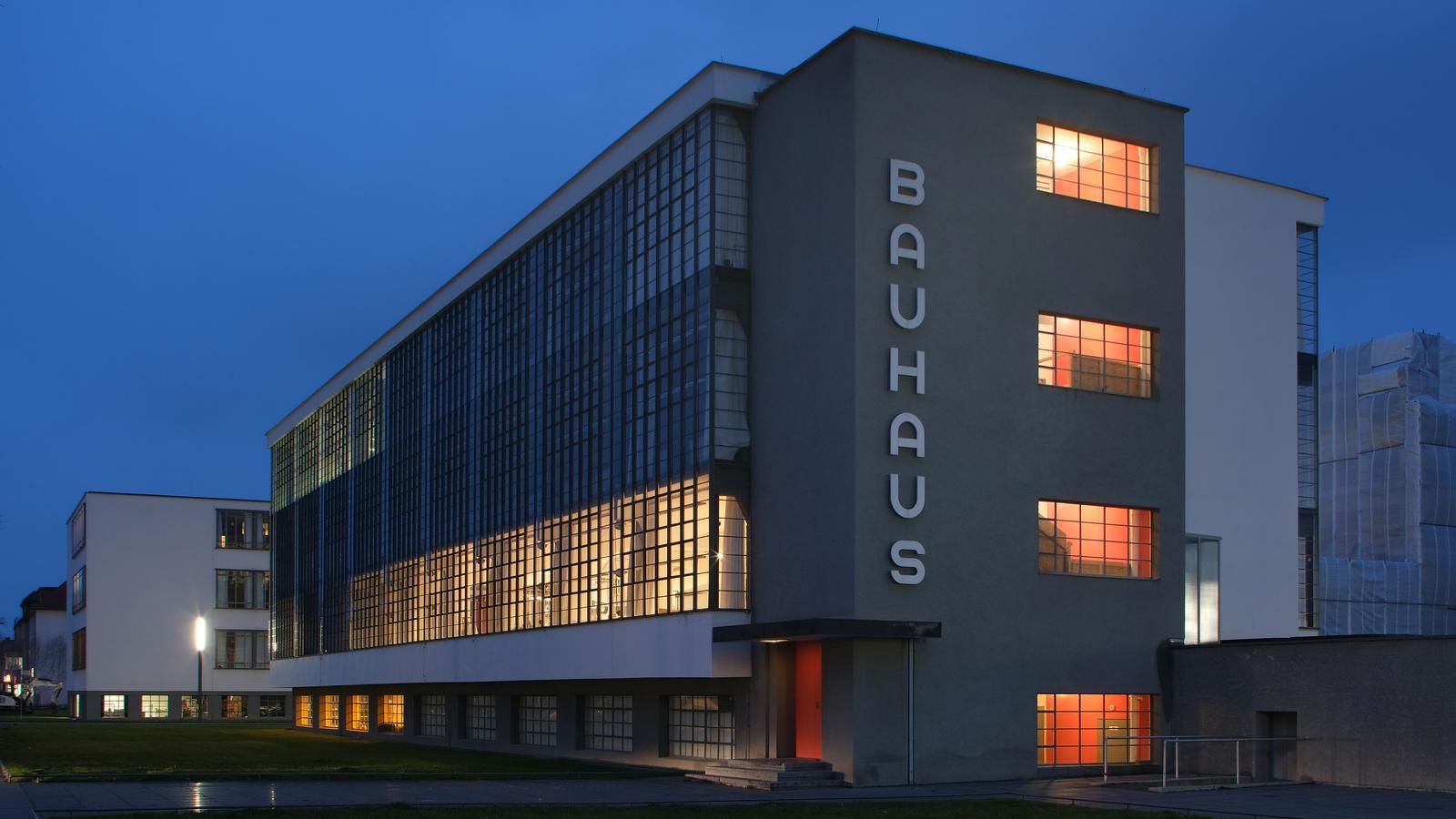
BarcelonaThis Sunday, the far-right AfD won the Saxony-Anhalt elections with 43.8% of the vote. But there is another piece of data that, for those of us who look at cities and architecture as something more than stone and facades, is particularly disturbing: in Saxony-Anhalt there is Dessau, and in Dessau there is the Bauhaus.
In recent years, the AfD has been placing the Bauhaus at the center of its cultural battle. In 2024, it was already describing it as an "irrweg der moderne", an "erroneous path of modernity", and in this campaign, it has contrasted "Think modern", linked to the Bauhaus, with its proposal of "Think german". The Bauhaus, however, is not only one of the great legacies of modern European architecture today. In 2020, the European Commission promoted the New European Bauhaus, and in 2022, the European Parliament gave it formal support, linking it to a more sustainable, inclusive, and livable Europe. Attacking the Bauhaus today is also to challenge a certain idea of Europe.
History does not repeat itself, and it would be too easy to say so, but there are mechanisms of power that return time and time again. The Bauhaus was forced to close in 1933 due to Nazi pressure, and some of its great names, such as Walter Gropius, Mies van der Rohe, Marcel Breuer, Josef and Anni Albers, and László Moholy-Nagy, had to continue their careers outside of Germany. What Nazism wanted to expel ended up spreading throughout the world.
Fascism understood very early on that it was not enough to govern the institutions, but that it was also necessary to govern the imaginary, and architecture, due to its ability to give physical form to a certain idea of society, was an extraordinary tool to do so. Albert Speer, Hitler's personal architect and later Minister of Armaments of the Reich, took it to the extreme. In Nuremberg, the large esplanades, the axes, the grandstands, the flags, and the thousands of people arranged within the same space built a very concrete image, in which the individual became small while the regime became immense.
However, it would be a mistake to identify fascism with a single architectural style. In Mussolini's Italy, classical-rooted monumentalism and rationalism coexisted, because the issue was not so much the style as the instrumentalization that was made of it. Mussolini not only wanted to build the future, he also needed to choose which architecture of the past should explain it. In Rome, he isolated monuments, monumentalized the remains of antiquity, and opened large axes like the Via dell'Impero, while entire urban fabrics disappeared to build that image of an eternal and imperial Rome.
Not all of the past was useful, and therefore, it had to be selected. Some architectures were placed in the foreground while others disappeared, and an apparent continuity was built between imperial Rome and fascist Italy. Architecture thus became an instrument to legitimize power, manufacture belonging, and present a certain vision of society as if it were natural and had existed forever.
Precisely for this reason, explaining these architectures does not mean uncritically defending the conservation of any material trace of fascism. Not every building from a dictatorship must become heritage, nor does conserving mean honoring. It is up to democratic societies to decide what is preserved, what is transformed, what is contextualized, and what may disappear, always from knowledge and not from oblivion.
There is, moreover, another way of understanding the relationship between architecture and politics that we in Catalonia know well. The republican Generalitat of Macià and Companys also bet on the most advanced architecture of its time, but not to monumentalize power, rather to put it at the service of the people. Sert, Torres Clavé, and Subirana, from the GATCPAC, designed the Casa Bloc, promoted by the Generalitat as housing for workers, with light, ventilation, green spaces, and community services; and the Anti-Tuberculosis Dispensary, commissioned in 1934 by the Department of Health and Social Assistance, made modern architecture a tool for public health in the heart of the Raval.
At heart, these are two radically different ways of understanding the citizen: as a small piece within the representation of power or as the ultimate recipient of public action. Architecture is not democratic or authoritarian because of the shape of its windows or the materials it uses, but because of the society it helps to build, for whom it is intended, and for what power intends to do through it. Some built scenographies so that the citizen would feel small before the regime; others wanted modernity to enter the homes of workers, into schools, hospitals, and clinics.
It is here that architecture ends up becoming heritage, because heritage is not only what comes to us from the past, but also what we decide to preserve, interpret, and transmit to future generations. A democratic society must be capable of explaining all its layers, including those that are uncomfortable, but without confusing memory with homage or conservation with legitimation.
Buildings do not vote and stones have no ideology, but we can select them, order them, monumentalize them, silence them, or destroy them to tell a specific story. We can also explain them from the perspective of knowledge, contextualize them, and make visible the contradictions they contain. This is probably one of the responsibilities of heritage in a democracy.
Fascism has always known this. That is why, when someone decides which architecture deserves to represent us, they are no longer talking only about buildings: they are starting to decide what kind of society they want to build.
