Every day we are more apathetic and servile before power
Are we becoming more servile to power every day? The signs point to yes. Apathy is gaining ground, especially among the youngest. We are witnessing atrocious massacres like the one in Gaza, wars of caprice like the one in Iran, imperialist aggressions like Russia's against Ukraine. The government of the world's leading power, the United States, is in the hands of delirious madmen. Yet we protest less than twenty years ago. And much less than fifty years ago.
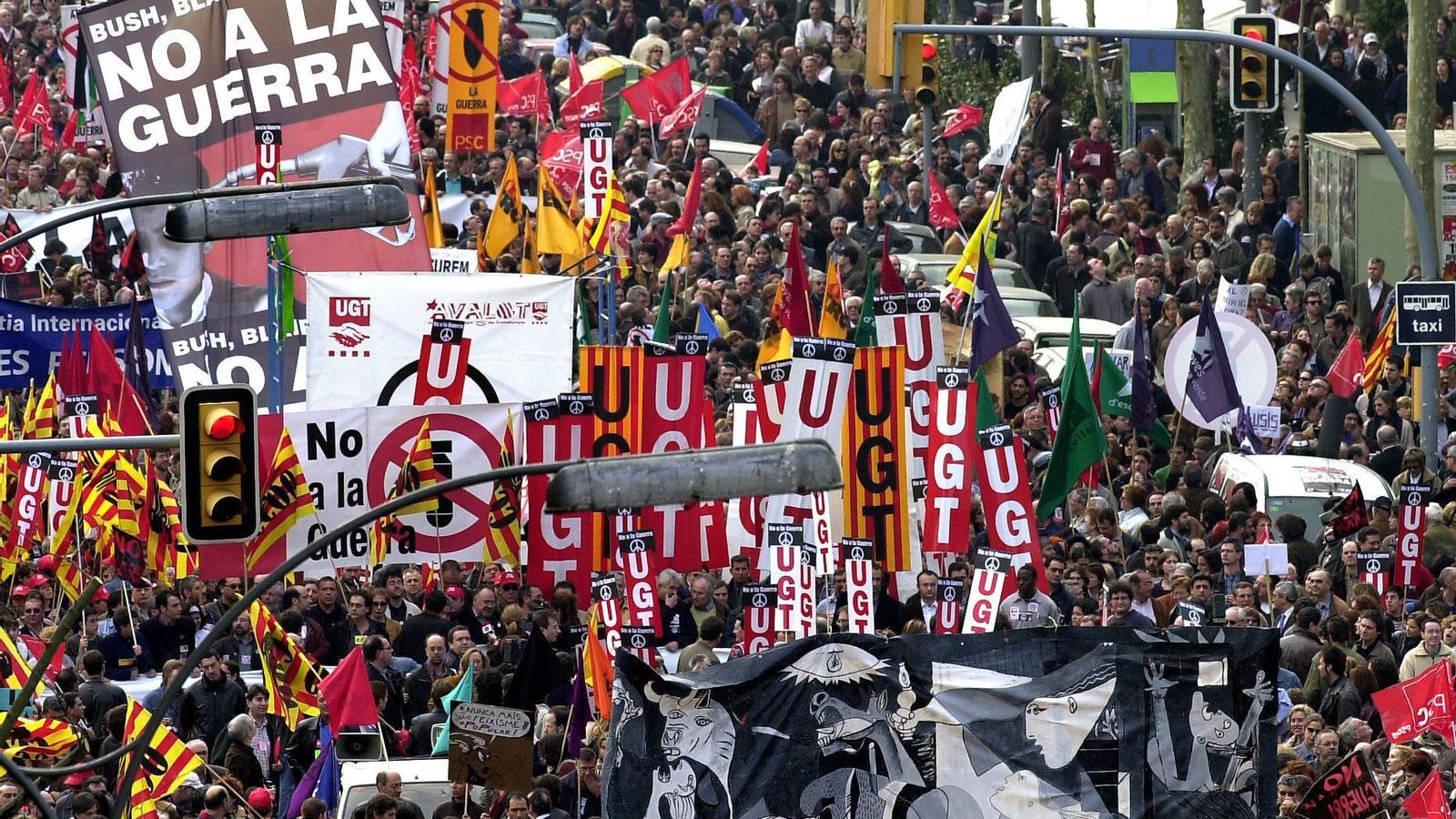
In 2003, millions of people took to the streets to oppose the invasion of Iraq. According to the Guinness Book of Records (I know we're not talking about the highest reliability, but it serves the purpose here), they were the largest demonstrations in human history. According to various estimates, nearly forty million citizens demonstrated between January and April of that year against the war worldwide.
The protests in the United States against the Vietnam War marked the presidencies of Lyndon Johnson and Richard Nixon, and were an international constant between 1968 and 1973. All of that contrasts with the present. Under the headline "Why aren't young people protesting Donald Trump?", the New York Times was this week seeking an explanation for the collective passivity.
It offered several. The tremendous academic repression against participants in the pro-Palestinian university demonstrations of 2023 and 2024 ended with their leaders and intimidated the rest. Decades of neoliberalism have generalized the feeling that protesting is unpatriotic. Politics has become divorced from moral judgment.
This was referring specifically to the United States. Another explanation, in this case extendable to the rest of the planet, focuses on the effects of social networks. Facebook emerged in 2004. Twitter, in 2006. WhatsApp, in 2009. Telegram, in 2013. TikTok, in 2016. All of them, therefore, are after 2003, the year of the last great global mobilization.
The first effect of networks was to confuse what is virtual with what is real. Suddenly it seemed that launching thousands of messages of indignation into cyberspace (the "networks are burning" thing) was equivalent to collectively demonstrating in the street. And it wasn't. The second effect was the growing difficulty for users to maintain attention on a problem for a more or less long time due to the intensive consumption of short videos in reels and the practice of scrolling on the screen. The third effect, aggravated by incipient artificial intelligence, was the almost indistinguishable mixture of what is real and what is false.
The demonstrations of the American movement Black Lives Matter, which precisely emerged on social networks in 2013 against police abuses against black people, gathered thousands of people, not millions. In the demonstrations against Trump of the No Kings movement, real participation was also relatively low. And, moreover, the average age of the demonstrators increased from 36 years (June 14, 2025) to 48 years (March 28, 2026).
In Europe, more specifically in Paris, there were two situations of relative exceptionality to the progressive citizen demobilization. After the Islamist attacks of 2015 (January 7, massacre at the satirical magazine Charlie Hebdo; November 13, simultaneous attacks in various parts of the city), more than a million citizens demonstrated. But at the head of the march was political power. The spirit was one of repulsion, not of demand.
In Catalonia, sovereigntism has lost its capacity for massive mobilization. The supposedly massive concentrations against Pedro Sánchez, in Madrid, have never gathered a real crowd.
If we are to believe the polls –and our own capacity for perception–, the feeling is spreading across the planet that things (warmongering, climate crisis, economic inequality, mass migrations) are getting worse. What is the collective reaction? Staying at home. Certainly, every day we are more apathetic. And more servile.
